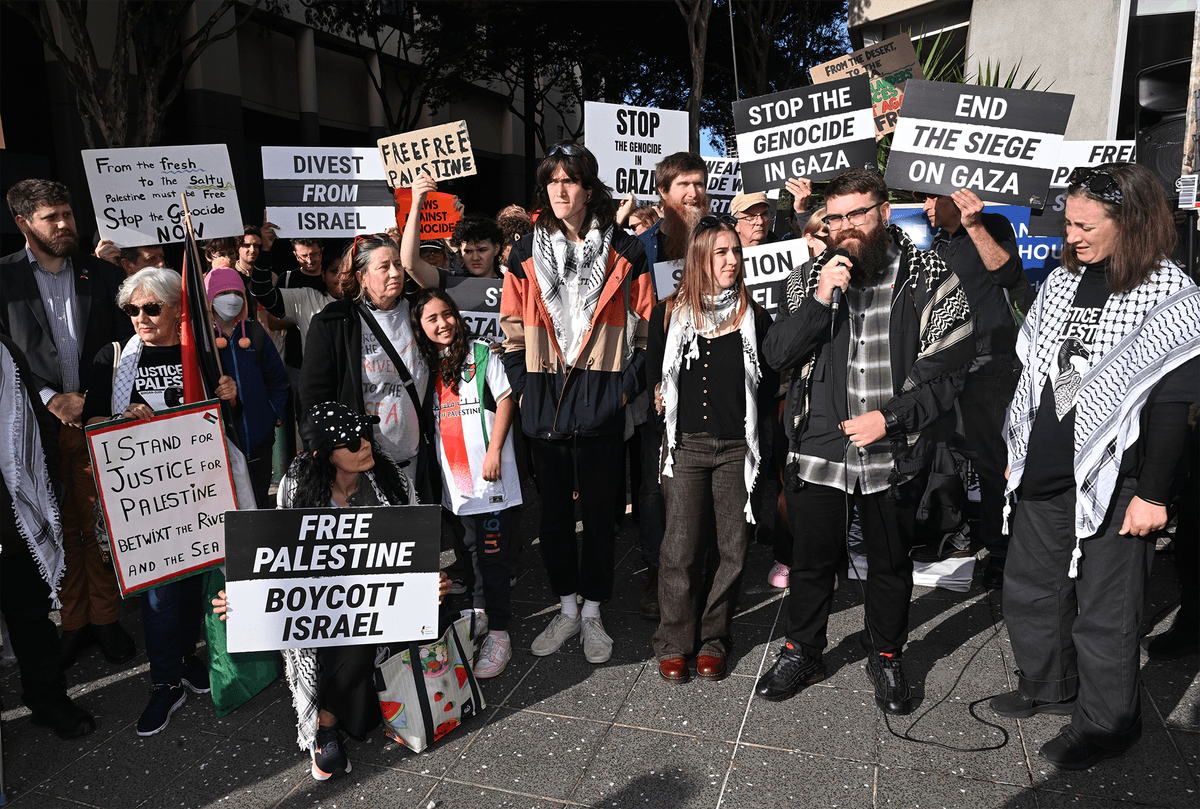
Queensland’s controversial laws banning two phrases used in pro-Palestine demonstrations will be tested in the High Court, with a group of activists arguing the legislation unlawfully restricts political communication.
Justice for Palestine Magan-djin and their legal representatives have filed constitutional proceedings against the Queensland government, asking the High Court to strike down the law banning the phrases “from the river to the sea” and “globalise the intifada”.
“We’re going after this government and we’re forcing it to answer publicly and on the record for its targeting of a grieving community in the middle of our genocide,” said lead plaintiff and Palestine Magan-djin spokesperson Remah Naji.
“This government refuses to acknowledge that people in this country reject genocide.”
Lawyer Michael Bradley, from Marque Lawyers, said the challenge argued the legislation infringed the constitution, and its implied freedom of political communication.
“We say that this law is a massive overreach,” he said.
“Australia’s constitution guarantees freedom for everyone to communicate with each other on government and political matters.
“While governments can pass laws which limit or restrict that freedom, they have to do so in a way that is compatible with our democracy, our representative system of government.”
Mr Bradley said it was the first time an Australian government had made a law that criminalises specific words.
He told reporters the case had seven plaintiffs who all had one thing in common.
“They’ve either said one of the phrases and been arrested for it, or they’re too scared to say the phrases because they don’t want to be arrested,” he said.
The Crisafulli government drew criticism in March, when it made an eleventh-hour change to its hate speech legislation to specifically ban the use of phrases “from the river to the sea” and “globalise the intifada”.
More than 30 people have been arrested under the laws since they took effect in March.
“Just to underline how stupid this law is, as a lawyer acting in this case, I have the perfect reasonable excuse as a defence for saying these words, either of those phrases but I’m constrained,” said Mr Bradley.
“I won’t say them because I cannot actually afford to get arrested and I don’t know what the Queensland Police would think of me saying them. So that’s where we’re at and this law needs to go.”
Queensland Deputy Premier Jarrod Bleijie was reported by the ABC as saying the legislation was introduced to protect the Jewish community from antisemitism and said it would be a matter for the High Court to determine the case.
“There’s a long process to go – so that’s all hypothetical at the moment,” he said.
“The law’s the law at the moment.”
The phrases can be interpreted in vastly different ways.
As University of Sydney sessional lecturer Martin Kear wrote in The Conversation:
“On one side, proponents of these phrases say they are expressions of Palestinian nationalism and their right to equality, freedom and dignity.”
“On the other side, those arguing against the phrases say they are antisemitic because they incite violence towards Israel and Jewish people more broadly and are catchcries for the destruction of Israel.”
Justice for Palestine Magan-djin spokesperson Omar Ashour said the challenge was about more than Queensland, arguing similar attempts to suppress support for Palestine were happening “all over the world”.
“We should not fail to see what this is,” he said.
“It is an attempt to silence people who simply call for freedom, for justice and for equality of the Palestinians in Palestine who are subject to a genocide that has taken at least a hundred thousand people so far in Gaza and displaced two million people.”
Jewish activist Edward Carroll said he could “proudly say” that he was the first person to be arrested for saying one of the banned phrases and displaying a sign containing it.
“For the Queensland government to turn around and say that they put these laws in to protect Jewish safety or to conflate Judaism with Zionism, that is categorically false,” he said.
“I have been charged and arrested for displaying a sign from a Jewish Zionist person.
“I stand here with my colleagues, particularly with my Palestinian friends, in solidarity with them.”
The Queensland Government now has one month to respond to the High Court filings.