Former Prime Minister Malcolm Turnbull has delivered a scathing critique of the AUKUS security pact, arguing anyone who believes the US will hand over its nuclear-powered submarines is living in a “political fantasy land”.
By Tegan George
Tue 11 Aug 2026 10.39 AEST
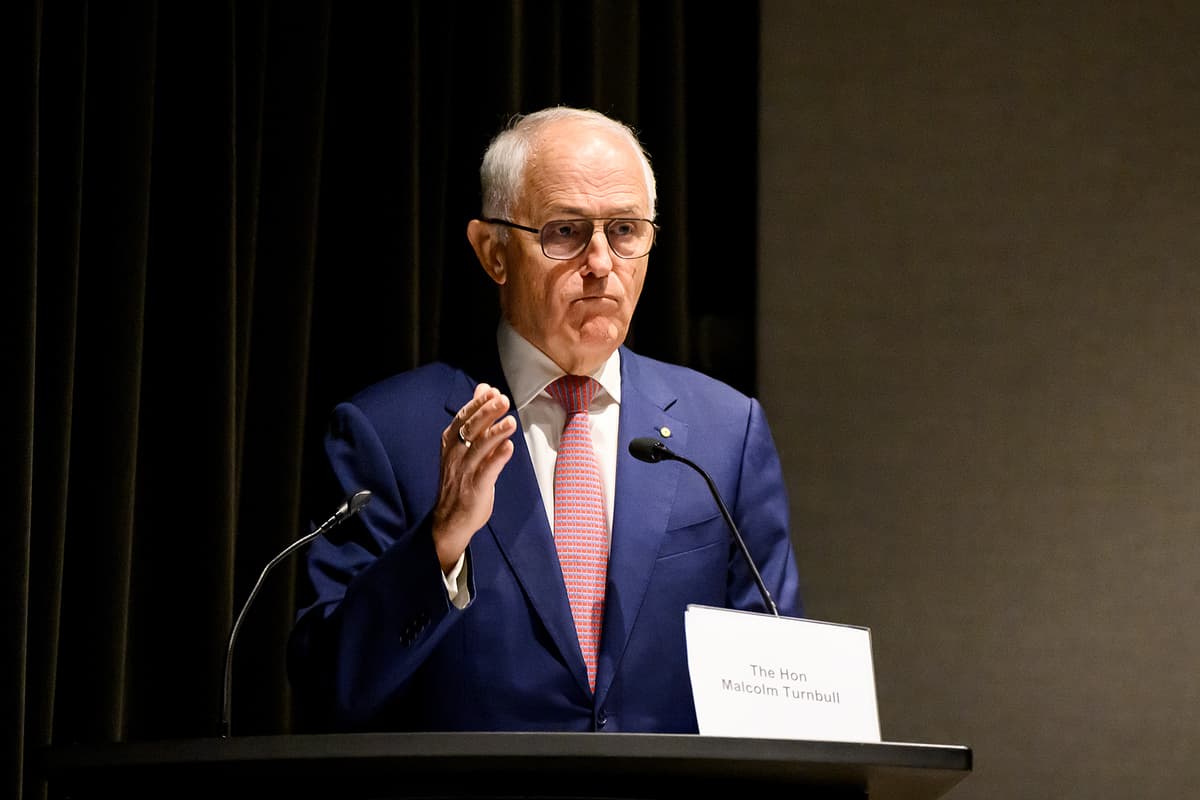
Photo: AAP Image/Bianca De Marchi


Former Prime Minister Malcolm Turnbull has delivered a scathing critique of the AUKUS security pact, arguing anyone who believes the US will hand over its nuclear-powered submarines is living in a “political fantasy land”.
Mr Turnbull told a public inquiry into the deal that Australia is unlikely to ever see the three second-hand Virginia-class boats it has been promised.
Under the $368 billion deal, a future US president must certify that the sale of the boats “will not degrade the United States undersea capabilities”.
“In what political fantasy land is a president going to do that if they’re already short?” he said.
Australia has already handed over about US$2 billion to help expand US submarine production.
However, it’s still not building enough boats to meet its own requirements, let alone supply Australia.
Mr Turnbull said the United States had been forecasting production rates would increase “for years”.
“The forecast looked pretty, pretty aggressive, you know, five or six years ago,” he said.
“Now it’s looking like a vertical take-off.”
He said Canberra won’t be able to complain or claim they’ve been “double crossed”, arguing the US has been “utterly transparent” about the terms of the deal.
“That conditionality is made very, very clear. It’s right up there in flashing lights,” he said.
“They’re acting in their self-interest, and they’ve taken advantage of a compliant and foolish counterparty in Australia. We’ve been our own worst enemy.”
The former Liberal PM has long been critical of the trilateral security pact, which was signed in 2021 by his successor Scott Morrison, former US President Joe Biden and then UK prime minister Boris Johnson.
He said it was no surprise the current US President supported the agreement, telling the inquiry, “The only question Donald Trump would ask is, ‘how did that stupid old Joe Biden do a deal as good as that?’”
He was quick to add that he did not personally believe Joe Biden was stupid.
“If you think about it, the Americans are getting $3 billion, they’re getting a naval base in Western Australia … all at our expense and they’ve got a sort of an obligation to transfer us some submarines,” he said.
The Albanese government announced an $8 billion expansion of HMAS Stirling naval base in Western Australia in March, which is where US and British nuclear-powered submarines will begin rotating through from 2027.
However, Mr Turnbull said Australians should be under no illusion about who would ultimately control the base.
“The reality is it’s a US base. It’s not called a US base, but it is a US base,” he said.
“And as we’ve seen, the US is treating it like a US base.
“This has never been discussed in the Australian Parliament. There’s never been an inquiry. These are momentous changes, and our Parliament has absolutely let us down.”
Mr Turnbull said Prime Minister Anthony Albanese should have used his 2022 election win to review the deal, saying Australia had the most to risk from the deal but was the only partner that hadn’t thoroughly vetted it.
He also argued the agreement put Australia in a weaker position.
“There is no question that it involves a massive sacrifice of Australian sovereignty,” he said.
“And one of my threshold points is that this is the worst possible time to be sacrificing sovereignty. The bottom line is that we are living in a more dangerous, more unpredictable world.”
He said the US would respect Australia more if it stood on its own.
“The more sucking up you do, all they do is put up with it for a while and then call for the next sycophant to join the queue.
“I fear that unless we change course, we will be much more vulnerable, much less safe, and we will have even less agency than we do today.
“We are a better partner to the United States when we are self-reliant, when we can speak truth to power, when we have genuine agency.”
One issue that has frequently been raised in the inquiry is whether the nuclear-powered submarines operating from Australia will actually carry nuclear weapons.
“In terms of American Virginia-class submarines carrying nuclear weapons, of course they’re capable of carrying nuclear weapons, and it’s inconceivable that the Americans would seek anyone’s consent about whether they were doing.”
Mr Turnbull also questioned whether Australia had properly considered the practical challenges of operating nuclear-powered submarines, including the long-term management of highly enriched uranium.
“We’ll be dealing with the most dangerous substance made by man. That’s what it is. Weapons-grade uranium, and it’ll be hugely challenging getting it out of the submarines,” he said.
Commissioner Leanne Minshull, co-CEO at the Australia Institute, also questioned the lack of parliamentary scrutiny.
“Not long ago, bases and nuclear-armed weapons would have been unthinkable to the Australian public, and now they’ve become inevitable without the consent I feel from the Australian public,” she said.
The crowd-funded inquiry moves to Newcastle and then Wollongong for more public hearings.
Advertisement


