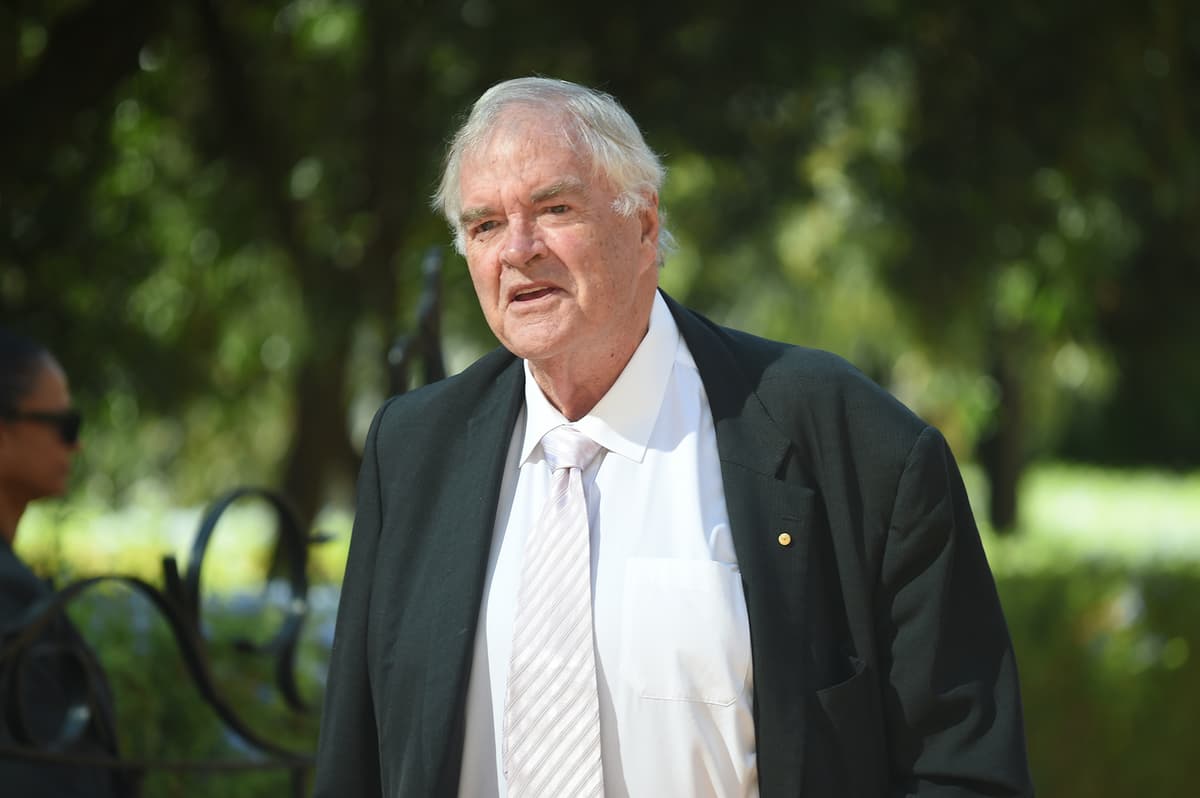
Former defence minister Kim Beazley expects the United States to deliver its promised Virginia-class submarines to Australia, arguing the country cannot afford to go it alone and would be left “substantially deafened and blinded” without the alliance.
“It will be a political decision by whoever happens to be president in 2032 whether or not the first of those submarines turns up,” he told an independent inquiry into the AUKUS security agreement.
“I actually happen to think, because the AUKUS process has survived changes of government and multiple reviews amongst our partners … I think that they will turn up.”
Under the trilateral security partnership, Australia is due to receive its first second-hand Virginia-class nuclear-powered submarine from the US in 2032.
Mr Beazley, who also served as Australia’s Ambassador to the United States from 2010 to 2016, argued the vessels were effectively indispensable to Australia’s defence, saying they were unrivalled.
“The nuclear-powered submarines are the best system for both deterrence and defence,” he said.
“There is no better submarine in the world for these purposes.
“What we get from that submarine is the certainty of us being able to destroy any target that comes within range.”
While the inquiry has previously heard arguments that the deal will undermine Australia’s sovereignty, Mr Beazley argued the country simply cannot afford genuine military self-reliance without the US.
“We are getting the product of 70 years’ development and research and continually upgrading classes … [and] trillions of dollars [of investment] in the United States,” he said.
It was technology, he said, that Australia couldn’t afford to build, even if it had the capability.
“We are deeply embedded in their military intelligence activities, and we engage with technologies which we could not afford on our own to develop.
“We are great niche contributors to this process.”
Australia currently spends around 2 per cent of GDP on defence, but Mr Beazley said even increasing that to 2.5 or 3 per cent still wouldn’t be enough to go it alone.
Get our newsletter
Quality research, analysis, explainers and factchecks from experts you can trust.
“Frankly, if you’re on your own, that won’t sustain you. Not a chance,” he said.
The former deputy prime minister pointed to the very high levels of defence spending during World War II, which he said reached as high as 34 per cent of GDP.
However, he noted the government had virtually no responsibilities for health or education and only a minimal social security budget at the time.
He also cited Ukraine, which spent US$84.1 billion – or 40 per cent of its GDP – on its military in 2025.
“That’s what you do when you finally get involved in a massive conflict,” he said.
“The things that we spend on are things that are absolutely essential for our society, and they cannot tolerate defence expenditures of that level,” he told the inquiry.
Mr Beazley said Australia had become “quite heavily interlocked” with the US through joint intelligence and communications facilities, including Pine Gap and North West Cape.
“The agreement we have at Pine Gap is, if we want to target something to listen to, look at, whatever, then we can position a satellite to do it. It’s effectively joint,” he said.
Without them, Australia would be “substantially deafened and blinded” to activities in the region, he argued, while independently replacing their capabilities would be “totally impossible”.
He said it was also worth considering that Australia and the UK’s defence budgets combined didn’t equal what the Pentagon spends on research and development and validation alone.
“All put together, that is a massive partner for research purposes, and we’re basically already there,” he said.
Mr Beazley maintained the submarines were about defence rather than aggression.
“This is not a statement of hostility to anybody, having these submarines,” he said.
“It’s a statement of our willingness to defend ourselves with a deterrent which will be vastly more effective than anything else we can simply imagine putting in place for ourselves.”