The independent inquiry, led by former Labor minister Peter Garrett, has called for the nuclear-powered submarine deal to be scrapped immediately and a royal commission be established to investigate how Australia got into 'this mess'.
By Tegan George
Wed 4 Nov 2026 13.45 AEDT
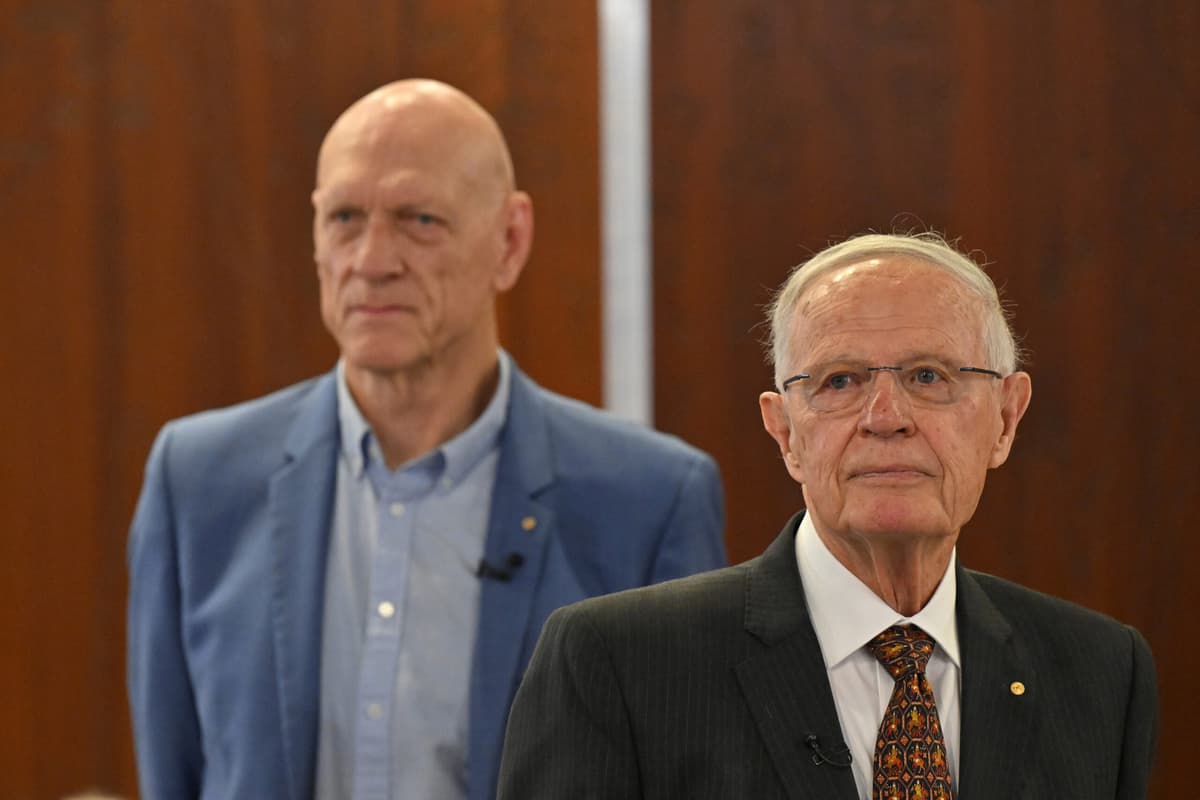
Photo: AAP Image/Mick Tsikas


Terminate the AUKUS submarine deal.
That’s the recommendation from a five-month public inquiry into the trilateral security agreement that’s been described as the “worst, most costly and riskiest defence decision ever made by an Australian government”.
The independent inquiry, led by former Labor minister Peter Garrett, has called for the nuclear-powered submarine deal to be scrapped immediately and a royal commission be established to investigate how Australia got into ‘this mess’.
While the project has been widely projected to cost around $368 billion, Mr Garrett said the inquiry estimated the true cost could approach half a $1 trillion, when an extra $180 billion was factored in to manage the radioactive waste.
“There is next to no hope of the AUKUS submarines ever being delivered on time,” Mr Garrett said in a speech at the National Press Club (NPC).
“There are no refunds, no enforceable obligations on partner countries and no recourse if things go wrong. We therefore recommend that notice should immediately be given to scrap AUKUS before more money is wasted, and the many risks inherent to the project continue to escalate,” he said.
The community-funded inquiry received more than 1,000 submissions and heard from some of Australia’s most senior former political and military figures, including a former prime minister, three former defence ministers, two former foreign affairs ministers and retired rear admiral and submarine commander Peter Briggs, along with academics and community groups.
Former Chief of the Australian Defence Force Chris Barrie, who served as a commissioner on the inquiry, said the AUKUS submarine plan was “untenable”.
“It should be ended as soon as possible,” he told the NPC.
“And we should never allow an acquisition program like AUKUS to define our national security.”
Mr Barrie said commissioners supported maintaining Australia’s submarine capability but questioned the need for long-range nuclear-powered vessels.
“The only way I can conceive of Australians being involved in a war with China would be by joining a conflict between the United States and China,” he said.
“That may serve the interests of the United States. It would not serve ours.”
“It would be madness for us to take on a great power like China.”
Mr Garrett said a “galling” omission from the AUKUS planning was the lack of a clear plan for safely disposing of the radioactive waste generated by Australia’s future nuclear-powered submarines.
Quality research, analysis, explainers and factchecks from experts you can trust.
“After 60 years, and with more money and nuclear expertise than Australia, neither the UK nor the US has managed to develop and construct a permanent below-ground, high level-radioactive waste storage facility,” he said.
Yet Australia was somehow meant to deliver a solution “overnight”, he said.
“Astonishing, reckless, cavalier, wilful blindness are a few words that spring to mind to describe this fiasco,” he said.
“We are grappling with what it means to become the first non-nuclear-weapon state to operate nuclear-powered submarines fuelled with weapons-grade uranium,” said Retired Admiral Barrie.
Following 10 full-day public hearings across eight cities, the inquiry commissioners concluded the AUKUS deal lacked the social or political licence needed to proceed.
Mr Garrett said the finding was particularly significant at a time of dwindling trust in democracy and “should not, cannot, be discounted or ignored”.
The inquiry made 17 recommendations, including calls to scrap Pillar One, establish a royal commission and reconsider Australia’s participation in other aspects of the AUKUS deal.
Pillar One, which includes buying at least three second-hand Virginia-class nuclear submarines from the United States before building a new fleet of SSN-AUKUS submarines.
The proposed royal commission would investigate how Australia entered into the agreement under former prime minister Scott Morrison and who was involved in the decision.
The commission also called for Pillar Two, which covers advanced defence technologies, to be recast, along with the suspension of specific AUKUS-related developments at HMAS Stirling in Western Australia and Osborne in South Australia.
There was also one recommendation for the Australian public – to share and debate the inquiry’s findings.
“We must safeguard our capacity to decide for ourselves,” said Retired Admiral Barrie.
“Sovereignty is not ownership of a submarine or a flag above a base. It is the ability of an Australian government to decide and act in Australia’s interests – including when our allies would prefer that we did not,” he said.
“The test is not whether we can say yes – that may look easy, but it will be hard. It is whether we can say no – and that is likely to be the toughest decision an Australian government has to make.”

