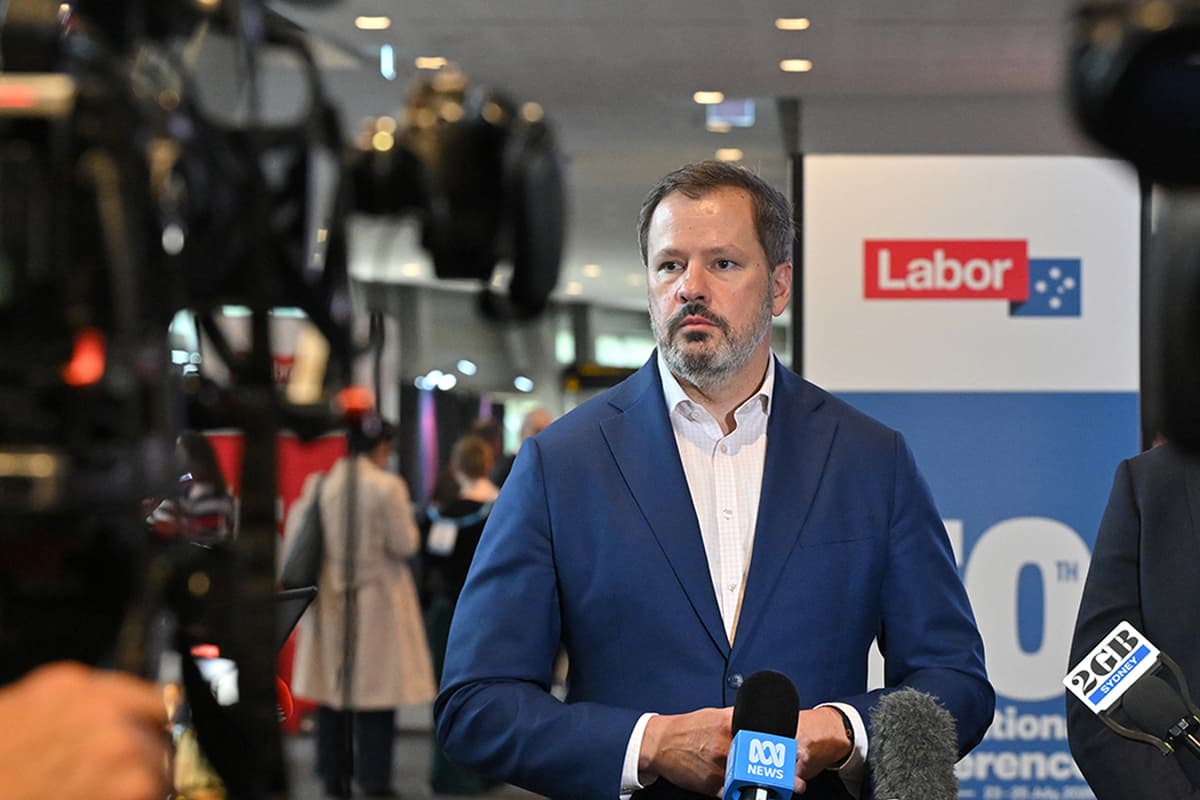
Ed Husic isn’t much for keeping quiet these days. The Labor firebrand and former minister has made a name for himself since being booted from the ministry following the Albanese government’s re-election in May 2025, in what his supporters say was punishment for internal, and in some cases, external rabble rousing on issues like Gaza and the direction of AI policy.
Husic has spent what some would consider the political wilderness building new coalitions and exploring just where voters believe his party has gone wrong.
After 18 months he has settled on three main groups: workers whose wages have stalled or gone backwards in real terms and are now facing existential threats from artificial intelligence and capital, people choosing between rent and groceries while imbued with a sense of hopelessness for the future, and those watching Israel’s actions in Palestine who have lost faith in their government to do any more than the bare minimum.
His main thesis of where it’s all going wrong has been drawn from his conversations and meetings across this time — his government is lacking the courage to act — on Palestine, on a gas tax, on lifting real wages, and on exploring different ways to address the cost of living crisis and inflation.
In an interview with the
7am podcast, Husic returns to courage as the way through the government’s mid-term slump, warning that it shouldn’t take an electoral collapse for Labor to offer up brave policies, which centre voters and the party’s values.
“I think there is a benefit of being a student of history, and I think that should be more widely appreciated,” Husic said.
“ You know, where we have really lost our support base in times past is where there’s a sense of disappointment.
“…[Our supporters] believe that our party will come in and shake up the status quo. Our members don’t sign their membership cards saying they’re signing up for the status quo. So they expect that we will press for change. And when there are big issues like this, that they feel strongly about, and that they feel the government should act strongly about, or upon as well. You can understand that disappointment.
“…I think we can, we can do better. But I think the problem for us, I think this is particularly the case federally. I think the problem for us is we have too many people that did politics in the 90s and 2000 who believe that if we took strong stands, we would be hammered by the Murdoch forces and the conservative forces in this country.
“Yes, we absolutely will be hammered by them. But the impact of that compared to 20 years ago is completely different. And I think there is an expectation of political parties that they be able to represent why they’re there, what they’re seeking to do a lot better. And I think that is the bigger test, not Rupert Murdoch’s army of newspapers in this country, rather the expectations of people that vote for us and who think that we should be doing a lot better on some of these big issues.”
Asked if that was a criticism of leader Anthony Albanese, Husic said it was “broader than that.”
“This is not just one person. I think there are a lot of people in this building that think that if they take strong stands on these type of issues, that they will be hammered by the Murdoch Army. And I don’t level it at just one person. I think there are a lot of people who have thought like that. We have to accept we will be hammered by them, and we cannot take strong stands just because we’re in alignment with some of their campaigns.
“We have to be able to say ‘this is why we are doing what we’re doing, we think it’s important for the long term.’ I think our housing reforms and getting rid of the terrible impact of taxation incentives on housing, we should own that.
“We should say this is absolutely a good thing. This demonstrates when you see the behavior of investor loans over the last six or so months in particular, that is exactly what we wanted to do. We did not want investors competing for established housing. If they want to invest in new housing, go for it. Knock yourself out. But the fact that those loans have dropped in the way that they have, is a perfect reflection of strong Labor policy that needed to be brought in to make it easier for for the next generation of people who, I increasingly must say, am concerned about in terms of the development of things like AI, etc., what that does to their position in the long term, we have to be able to have a strong position on these issues.”
So what’s Husic’s position on those issues?
“Well for one, he wants to see a gas tax introduced, if only to prepare Australia for the near future when coal and gas earn considerably less. And he wants to make rebuilding the position of low and middle-income Australians the government’s central focus. And for that to come to fruition, he says he’s prepared to be seen as a radical.
“If you’re on a $90,000 income in about 2021, you took a 5% hit on your income. Even the Reserve Bank thinks it’s going to take until the end of 2036 for that to to go back and match where it was at at 2021.
“So you can imagine, I mean, people are being genuinely ripped off in terms of their incomes. So here’s the trick. How do you repair the the position of low and middle income earners inside the sort of constraints of conventional thinking, which is you can’t get a pay rise above inflation because that’s instantly criticised by hard right aligned economic commentators and business?
“They say you need to get a pay increase based on productivity. Productivity has been flat for ages, and no one’s really got a handle on how to lift this up or, if you do increase productivity for most working people, it’s, oh, so I work harder, you do better. But I have to work with less in terms of my income. And I think we do need to repair people’s incomes higher than inflation, higher than productivity.
“We need to take those radical steps. But it’s seen as a step too far.”
Husic pauses to give another example here, from a recent exchange he had with banking CEOs in his role as head of the Economics Committee.
“I asked one of those CEOs, do you get measured on your productivity? Is your remuneration tied to it? And you get a whole lot of words back, but not yes or no answers. And I also ask, okay, do you get remunerated on the basis of how much better the productivity is in your business? Can you give examples? And they can’t do that either.
“And when you look at the average income or the remuneration of the top 100 ASX companies. those CEOs take home, on average $6 million as remuneration and literally, or nearly all of them, have no measure of productivity.
Get our newsletter
Quality research, analysis, explainers and factchecks from experts you can trust.
“However, they expect their workforces only to be having a pay increase if their productivity improves. So this comes to my point. Thinking differently. Thinking about how we repair the position of low and middle income earners in this country will require give and take from business as well. And it can’t be that government has to always put its hand in its pocket to pay out to fix the problems created by business, while business then tells us, well, you need to cut government spending as well.”
Which, for the Australian context at least, would be radical thinking. But Husic wouldn’t go as far as to limit CEO pay.
“If we limit their pay and they don’t fix the broader issues, we’ve got nowhere other than feeling good about limiting the pay of senior executives in the country.
“And my criticism is I appreciate how difficult it is to run these organisations. But what I don’t appreciate is that the logic that applies to them is not applied to the rest of their workforce, or that they argue a policy setting that doesn’t work for the rest of the country. And so I think that disconnect, too, is causing a big problem in politics, unless we are prepared to see how we improve the take home pay, the secure jobs of low and middle income earners. We aren’t going to get anywhere.
“So from my perspective, it is, you know, paying people better for secure work, taxing them less and also pricing them fairer. When you see some of the biggest businesses in this country pricing their products during a crises, like what we’re going through now and using it as a step to higher profits at the expense of everyday people as well.
“So I think we have to have a very different approach to make people’s lives feel a lot better. And I think politics will transform in that climate, where people think government and business is actually doing something that’s beyond or something that’s aimed at everyday Australians, and not just for the benefit of some Australians.”
He’s also for capping prices on basic groceries.
“The howls of protest that I got to that and the suggestions that I was bringing in food rationing, or that I was doing something that a communist nation would be arguing while walking past the fact that in a modern economy, the number of times governments intervene on prices…
“The reality is governments intervene all the time on prices. Why aren’t we intervening on something as basic as that when people are under pressure?”
He also wants to see a national, economy-wide AI act that would force developers and deployers to find and deal with any risks before a model was released, rather than just raise the alarm afterwards, create a new data and digital regulator with teeth, with powers closer to the ACCC’s to regulate Big Tech, as well as more as an explicit focus of the impact of AI on jobs.
“The Australian Bureau of Statistics pointed to this last week, pointed to the fact that redundancies are at their highest level since the pandemic, saying that its business costs that are being cut using AI and the fastest way to undermine the social license around the around artificial intelligence is for businesses to just roll it out without regard to impacts,” he said.
“And so I think that needs to be dealt with. I think we, as a government under Minister Amanda Rishworth, set up a really good body to look at the employment effects of AI in the workplace. Look, it’s only met twice a year. I think it needs to meet more. I think in the scheme of the breadth of issues that it’s looking at, it hasn’t said that it’s looking at the impact of AI on jobs, on unemployment. And I think it needs to have a lot more of a detailed look at that. It currently doesn’t. It should.
“And my strongest recommendation to business is to not just think of technology as plug and play. They need to see how this fits in the process, how it affects not just their employees, but the people that they serve their customers as well. And, you know, if we want to just do a plug and play, have the AI there, humans only interact with the AI and not another human, that’s part of the reason why Robodebt went off the rails is that the feedback loops were all wrong because the design of the process was faulty and bad and didn’t take into account vulnerable people.
“Business shouldn’t make the same mistake, frankly. They should have seen what’s happened in Robodebt and automated decision making and be able to think that through and not just push scores of Australian workers out the door because they’re in a rush to cut costs, boost profits, boost their own take home pay, boost the benefit to shareholders. And it’s just every day Australians lose out again.
“And I think more broadly, I think the big thing that business needs to think about, I think it’s important, if I may say, that we do have bigger businesses in our economy. They employ a lot of people. They generate a lot of wealth and economic growth for the economy. It’s very important, but it should not be under any way, shape or form that the bigger you are as a business, the less consequence for your bad decisions or bad behaviour.
“If that continues, that will be absolutely acidic in terms of the broader political landscape where people feel that there are rules for, for some and none for others. And it all depends on how big you are as a corporation or frankly, as a government too. And I don’t think that is a healthy thing for democracy.”
Also not healthy for democracy in Husic’s view, is the disappointment of the Australian government response to Israel’s actions in Gaza.
“There have been more protests on a weekly or near weekly basis by Australians in great numbers on this issue that have been completely and utterly ignored, either by Australian politics or by the media,” he said.
“Like if there was on any other issue, people out in the streets so often and so loudly in such strength of numbers, and it was ignored, I couldn’t imagine how that would be treated.
“Yet it seems on this issue, it’s treated this way, and people expect that their countries and their governments will have a view and also have a propensity to act on big issues like this.”
Husic said the lack of courage shown by his government in acting on Israel, would come to be a “stain” on it’s legacy. But that lack of courage was leading to more disconnect from the concerns of Australians in all sorts of major and minor ways, Husic believed, which was sending voters into the arms of others.
“Probably the biggest issue we’ve got in Australian politics is the complete disconnect from the pressures that people are facing,” he said.
“We can say that we recognise it, but we don’t seem to do much that matches up with the expectations of people feeling that pressure. And that’s the big thing we’ve got to do.”