Sixty leading economists have urged the Albanese government to introduce a 25 per cent tax on gas exports or adopt a similar revenue-raising policy.
By Tegan George
Mon 23 Nov 2026 16.43 AEDT
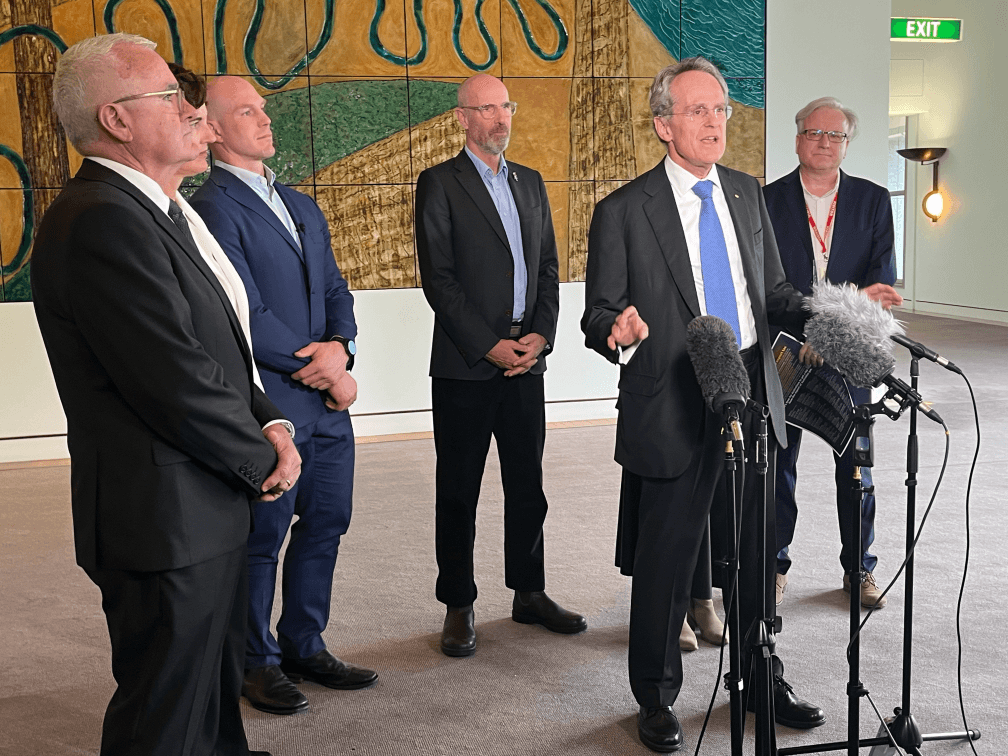


Sixty leading economists have urged the Albanese government to introduce a 25 per cent tax on gas exports or adopt a similar revenue-raising policy, as pressure mounts for it to rein in spending ahead of next month’s budget update.
In an open letter, signatories — including Nobel Prize-winning economist Joseph Stiglitz and former Australian Competition and Consumer Commission (ACCC) chairs Rod Sims and Allan Fels — argued Australians are missing out on billions of dollars in revenue from the nation’s gas exports.
“We have noticeably an issue with the budget deficit. Right? Everybody’s talking about it. Yet you’ve got this $50 note sitting on the pavement. All you do is bend over and pick it up,” said Mr Sims, who is now the chair of the Superpower Institute (TSI).
“Australia is missing out on $17 billion annually that could fund health, education, aged care and housing, which are all essential to the prosperity and wellbeing of all Australians,” said Greg Jericho, chief economist at the Australia Institute.
“It is ridiculous that our government is literally giving over half the gas exported from Australia to a handful of largely foreign-owned gas giants for free, while essential services are being cut for ordinary Australians.”
Mr Sims described the Petroleum Resource Rent Tax (PRRT) – designed to tax profits from oil and gas projects – as “deeply flawed”.
“We get less than 30 per cent of the revenue from our fossil fuel, our gas exports. Norway and the UK get over 75 per cent,” he said.
Australia Institute research shows that no gas export project had ever paid PRRT prior to 2023, and that revenue remains low and is expected to fall despite massive windfall profits recorded by exporters.
But despite overwhelming public support, Prime Minister Anthony Albanese ruled out the proposed tax in the lead-up to the May budget, arguing it was the “worst possible time” to jeopardise key trading partners.
“It’s political cowardice. It is political donations. It is post-parliamentary political careers for major party politicians, and for that matter, One Nation politicians. The whole thing is a giant rort,” said Greens senator Nick McKim.
With support from across the crossbench, Mr McKim said Parliament had the numbers to legislate the tax “by the end of the week” if the government came on board.
“These people wonder why they’re struggling in the polls. They’re struggling in the polls because the community doesn’t feel represented by them,” said independent MP Andrew Wilkie.
Quality research, analysis, explainers and factchecks from experts you can trust.
The comments come as the latest Newspoll puts Opposition Leader Angus Taylor ahead of Anthony Albanese as Australia’s preferred prime minister.
Mr Wilkie blamed successive federal governments for being “spineless” when it came to standing up to the resources sector.
“For some reason, the resources sector is politically all-powerful, and a succession of federal governments basically genuflect at their altar and give them whatever they want,” he said.
Independent MP Kate Chaney said constituents had raised the issue while she was door-knocking in her WA electorate at the weekend.
“There are lots of people in my electorate who work in the gas industry, but people were raising this with me unprompted … people are saying we want to get a fair return for our gas,” she said.
Independent senator David Pocock said the issue wasn’t going away, and that independents and minor parties would campaign heavily on it in the lead-up to the next federal election, expected in 2028.
“If we look to the end of the decade, the Australian government will raise almost as much from slugging Aussies with passport fees to get a passport than from the Petroleum Resource Rent Tax. This has to change,” he said.
Independent WA senator Fatima Payman said too much of the wealth generated by Australian gas was flowing to foreign-owned companies.
“As a new mum, I appreciate and I know exactly what a 25 per cent tax on gas exports could do for our economy,” she said.
“It means 17 billion dollars a year that could go into funding free childcare for so many families out there who are already struggling after being hit by five rate rises this year alone.
“What we’re calling for is not radical; it’s a basic ask that could go a long way.”

