The CGT discount, not a lack of supply, is driving house prices up
There are persistent rumours that the Federal Government will be making changes to the capital gains tax (CGT) discount and possibly negative gearing – perhaps as soon as the next budget. This is great news for everyone who wants to see housing become more affordable.
Mon 20 Apr 2026 08.00
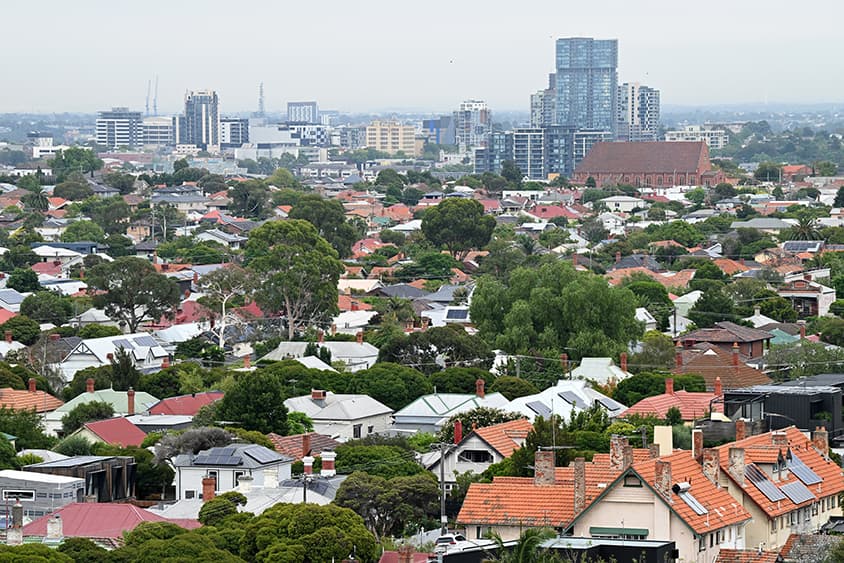
Photo: AAP Image/James Ross


There are persistent rumours that the Federal Government will be making changes to the capital gains tax (CGT) discount and possibly negative gearing – perhaps as soon as the next budget. This is great news for everyone who wants to see housing become more affordable.
The CGT discount is the culprit for big increases in house prices over the past two decades. After it was introduced in 1999, prices began to increase much faster than incomes:
But correlation doesn’t equal causation. So, how do we know that it is really the CGT discount pushing up prices? How can we be sure that it isn’t just a lack of supply?
We hear commentators say all the time that this is a problem of housing supply. It has been restrictions on property developers that created this crisis, and now we need to build our way out of it. Or another popular claim is that the problem is immigration, we’re letting too many people into the country, which then uses up our housing stock.
All these claims rest on the idea that the population is growing much faster than the number of homes.
But we can test that. If we look at the last 10 years, the population has increased by 16%. For the number of homes to have kept up with the growth in population, they must have increased by at least 16%. But, they have actually increased by 19%.
The number of homes is increasing faster than the population. We can see this below:
To be clear, just because the housing crisis wasn’t caused by a lack of supply doesn’t mean that building more homes won’t help fix it. More supply will help make housing more affordable. But it is also the slowest and most expensive way to solve the crisis.
It has not been a lack of supply that has driven up prices, but an increase in demand. Specifically, an increase in investor demand for housing.
The introduction of the CGT discount, combined with negative gearing, has made investing in housing very tax-effective. People have rushed into the housing market, showing up at auctions across the country, outbidding owner-occupiers and pushing up prices.
Scrapping the CGT discount will remove the main incentive. Fewer people will want to buy investment properties, and some investors will sell up and get out of the market. This will increase the supply of housing for owner-occupiers, slowing house price growth and letting more first-home buyers get into a home of their own.
But how can we be sure that this will fix the problem?
In 2023, the Victorian Government announced an increase in land tax on properties rented out and properties left vacant. This reduced the amount of money that those owning an investment property would get, and discouraged people from buying or owning an investment property.
Victorian landlords shouted loudly about the new tax. They declared that they were going to sell up and leave the market. They claimed this would decrease supply and push up rents.
But how do we know they actually sold up? They wouldn’t be the first group that claimed to sell up if hit by a new tax, but then didn’t. I’m looking at you, gas industry.
Well, we know they sold up because Victoria has a central system for registering rental bonds. These are the bonds that renters must pay as insurance against not paying rent or damage to the property.
As we can see in the graph below, after the announcement and increase in tax, the number of rental bonds fell. This means there were fewer rental properties.
If those investors sold up, they must have sold to owner-occupiers. And more owner-occupiers mean more first home buyers. Home ownership rates in Victoria have been rising.
So, what happened to house prices?
Well, in Victoria, since March 2023, house prices have only increased by a tiny 4%. Meanwhile, average house prices across Australia increased by 21%.
But won’t fewer rental properties mean rents will go up?
Well, in a word, no. When investors sell as a group, that means there are more owner-occupiers. More owner-occupiers means more new people owning their own home; more first-home buyers.
Before buying a home, most first-home buyers rent. So, if a rental property gets sold to a first-home buyer, the number of rental properties goes down by one. But at the same time, the number of families wanting to rent also goes down by one.
Fewer investors shouldn’t have an impact on rents.
And we have the proof. We can compare what happened to rental prices in Melbourne with other capital cities and the average across Australia.
We can see the average for all capital cities was an increase of 17%, compared to Melbourne, where the increase was 16%. So, all those investors leaving the market doesn’t appear to have had much impact on rents.
At the moment, commentators are saying that before we can have affordable housing, we need to spend billions of dollars and wait decades for more homes to be built.
But that is not the case. We could scrap the capital gains tax discount. This would discourage speculators and help those who want to buy a home to live in.
Australia has moved away from the idea that homes are a safe and secure place to live. Instead, we are treating them as a way to build a financial nest egg. A way to make money.
There are lots of different ways to invest. Investing in housing is currently causing real harm by locking people out of home ownership. We just need to encourage people to invest in other things.
Oh, and one last thing. Getting rid of the CGT discount would raise tens of billions of dollars. We could use that to build more homes, or anything else we want.
Win-win.
This article was adapted from a talk Matt Grundnoff gave to the Newcastle Institute on the 8th of April 2026.
Related Articles
Vanuatu urges Australia to rethink fossil fuel reliance, backs 25% gas export tax
One of the world’s most vulnerable nations to climate change has urged Australia to reassess its reliance on fossil fuels and impose a 25 per cent tax on gas exports. Vanuatu’s Minister for Climate Change Adaptation, Ralph Regenvanu, told SBS that Australia should be using the global energy crisis as a catalyst to ramp up its shift to clean energy.