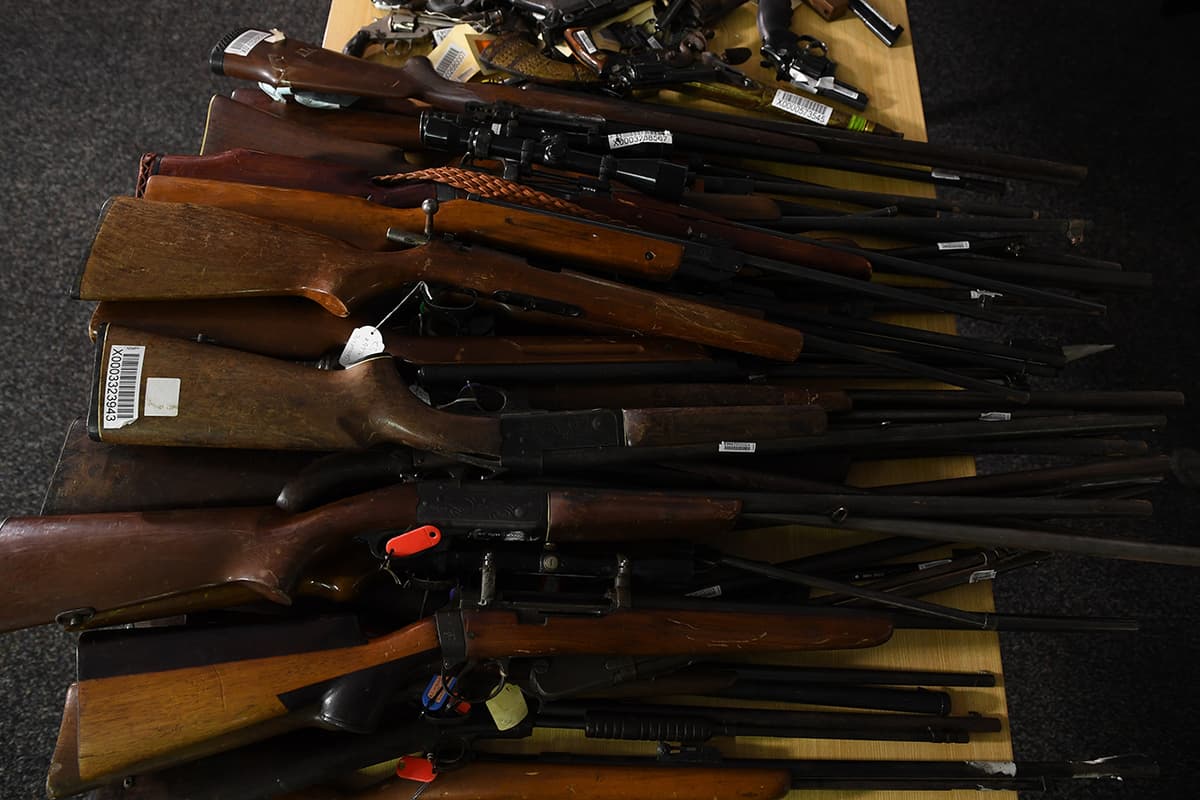
New South Wales was the first state to tighten its gun laws after the Bondi Massacre, limiting the type and number of guns someone can own in the state. While there has been predictable outrage from the gun lobby, they’re already working.
NSW Police data shows that gun dealers’ sales have been cut in half since the laws were passed in late December – from around 5,000 per month last year, to around 2,000 per month this year.
For laws with the stated aim of reducing the number of guns in the community, this is a clear success.
Similarly, the number of applications for new guns, known as ‘permits to acquire’ (PTA), has shrunk from around 7,000 per month last year to just 5,000 per month after the new gun laws were passed.
There is a notable spike in the number of PTA applications in December of last year, the month of the Bondi massacre.
Combined, this is having a clear impact: this is the first time the number of guns in NSW have declined in decades.
Despite a clear decline in the number of guns, sporting shooters argue that a spike in the number of firearm licence applications demonstrates the new laws are failing.
It’s true that licence applications are up – over 2,000 people applied for a firearm licence in each of January, February, and March 2026, while applications were consistently below that mark last year. At the same time, licence renewals are down, so the total number of applications is actually lower than its peak last year.
Even then, the question remains: if gun sales are down, who are all the new people applying for licences, and why do they need them?
According to the Sporting Shooters Association of Australia, the bulk of this surge comes from the wives and adult children of shooters applying for gun licences to dodge ownership caps. Their CEO, Tom Kenyon, told The Australian:
“Our experience is wives are annoyed the government is restricting their husbands from their sport for no good reason… They think: why should he lose his firearms? I’ll just go and get my licence.”
If this seems dodgy, that’s because it is.
While there are currently no rules preventing a legally owned gun being “lent” to another licence-holder, provided they’re allowed to use it, this kind of licence application is a big part of what Australia’s gun laws are designed to prevent.
A key part of the National Firearms Agreement (NFA) signed by all Australian governments after the Port Arthur massacre in 1996 is the requirement for someone to have a “genuine reason” to own a gun before being given a licence.
This was designed to stop people from owning a firearm for personal protection, violence against others, or other illegitimate reasons. The reasons include sports shooting, hunting, employment, collecting and farming. Notably missing from that list is “owning a gun on someone else’s behalf to circumvent firearm laws”.
However, the requirements for “proving” that a person has a genuine reason to own a firearm are relatively weak. For example, if someone owns a rural property or can get permission from someone who does, that’s enough to “prove” they need a gun for recreational hunting in NSW. And, if that’s the proof they used, they never even need to use their new gun to keep the licence.
There is a catch to all this, however. If any of these new applicants have knowingly provided misleading information about why they need a firearms licence, that could become a problem for them. It is an offence under the NSW Firearms Act to “make a statement or provide information that the person knows is false or misleading” in an application for a firearms licence, punishable by up to 14 years in jail.
While enforcement of these rules can sometimes be lacking, the NSW Government recently announced $40 million in extra funding for the firearms registry to, among other things, “process… genuine reason checks” and “expand membership and participation reporting obligations”.
If there was ever a good time to apply for a dodgy gun licence, now is definitely not it.
The evidence is clear: NSW’s new gun laws are working. They offer a clear path forward to any other states and territories to reduce the number of guns in their communities; they only need to follow NSW’s lead.