In economics, they say you can tell what people really want from what they spend money on. It’s called revealed preferences. In politics, you can tell what governments want to take action on by how long it takes them to do something.
AUKUS is an example of a government moving at a breakneck pace.
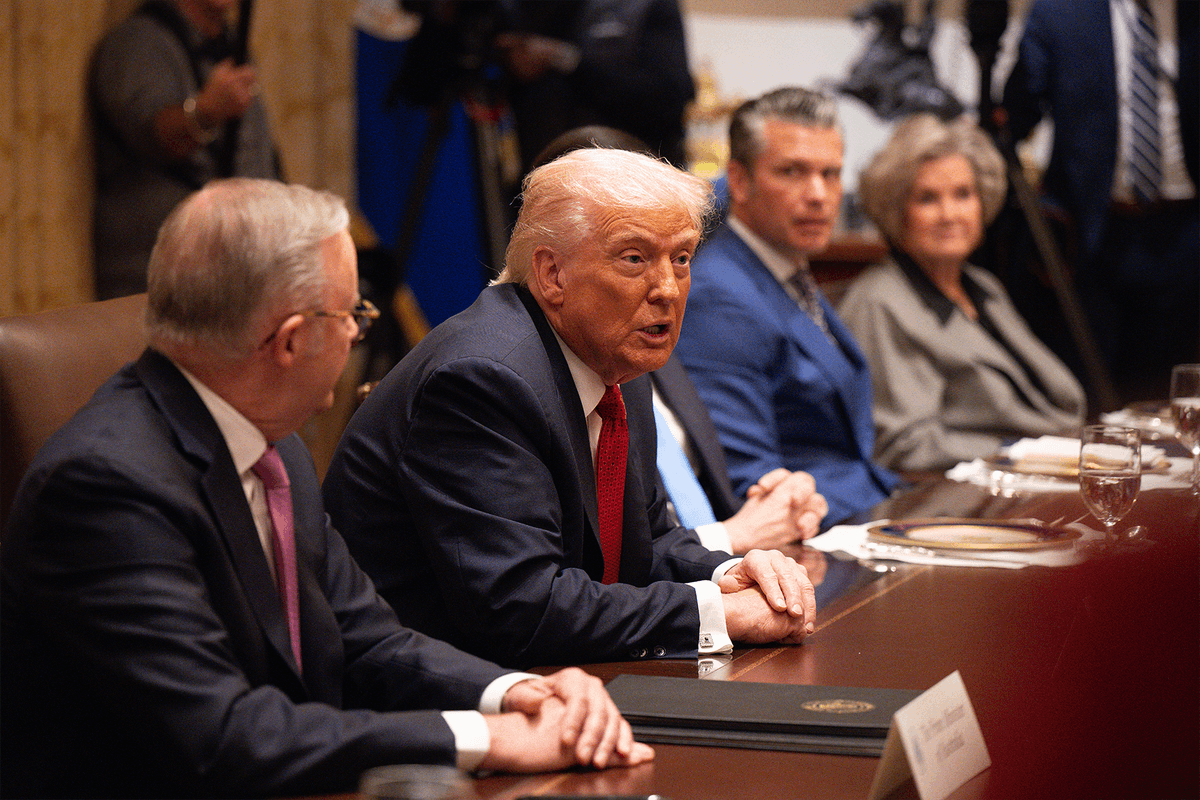
The AUKUS agreement was made just two years after officials started looking into the feasibility of acquiring nuclear-powered submarines. Although then US President, Joe Biden, had stipulated that the decision must be bipartisan on the Australian side, Morrison gave Albanese just 12-hours’ notice, claiming that Labor may have leaked AUKUS information had it been briefed sooner.
Less than two days after learning about the AUKUS agreement, then opposition leader, Anthony Albanese, decided to support the biggest defence procurement in Australian history.
The announcement, made on 15 September 2021, came less than 24 hours after Australians learned that an announcement was coming.
This isn’t just a quick turnaround for a massive multinational defence deal; it’s a fraction of the time it takes Australian bureaucracy to do far simpler tasks.
So, how does AUKUS stack up against other decisions that Australian governments make?
How long do things take?
- Approving a baseline level of government security clearance takes four weeks. A baseline clearance is needed to join the Australian Defence Force. In 2025, 31,646 clearances were granted.
- It takes six weeks for the government to process a passport application.
- To process an Age Pension application, it generally takes 83 days, and 101 days to process a Disability Support Pension.
- It takes 56 days for the government to approve an NDIS plan.
- Granting development approval could take about 100 days.
- It took the federal Attorney-General’s Department 150 days to respond to The Australia Institute’s FOI request on proposed FOI changes.
- It took the Department of the Prime Minister and Cabinet 583 days to respond to an FOI request.
- It took the Albanese government 1,049 days to table its response to the Murphy review. Serious legislative changes in response to the review remain outstanding.
- To get the highest level of government security clearance, it generally takes 180 business days. In 2025, there were 4,773 granted.
- Visa applications vary – Approving a Student Visa takes 19 days; Skilled (Temporary) Visa, 70 days; Skilled (Permanent) Visa, 9 months; and Partner (Provisional/Temporary) Visa, 20 months.
- It took more than 5 years for the Joint Committee on the Australian Commission for Law Enforcement Integrity to conduct its Inquiry into the Integrity of Australia’s Border Arrangements. It then took the government four years, or 1,267 days, to respond to it.
- It took 24 years (or 8,562 days) for the government to respond to the Certain Maritime Incident report, which dealt with the 2001 “children overboard” affair. The Senate Select Committee handed down its report in 2002, and it wasn’t until 1 April 2026 that the Government formally tabled its response in the Senate.
What do some of those timelines tell us? That serious decisions and rigorous review take time.
Every day, Australian bureaucrats make decisions. But, unlike AUKUS, they generally don’t come at hyper-speed.