Advanced search
The Point - home
DonateSubscribe
HomeWhat's NewOpinionOff the ChartsExplainersFactcheckAbout Us
The Point — home
DonateSubscribe
The Point — home
Advanced search
  • Home
  • What's New
  • Opinion
  • Off the Charts
  • Explainers
  • Factcheck
  • About Us
DonateSubscribe
Subscribe
  • Home
  • What's New
  • Opinion
  • Off the Charts
  • Explainers
  • Factcheck
  • About Us
The Point - home
Privacy PolicySitemapComplaints & CorrectionsNewsletter

The Point recognises the ancestral connections and custodianship of Traditional Owners throughout Australia. We pay respect to Aboriginal and Torres Strait Islander cultures and to Elders past and present.

©2025–2026 The Point, an initiative of The Australia Institute

OFF THE CHARTS

Question Time: Ted O'Brien finds another rake to step on, explained in 3 charts

The Shadow Treasurer, who you would think would have an easy day given the RBA decided not to cut interest rates, unfortunately keeps finding a rake to step on.

By Greg Jericho

Tue 4 Nov 2025 15.54 AEDT
Economy
Question Time: Ted O'Brien finds another rake to step on, explained in 3 charts

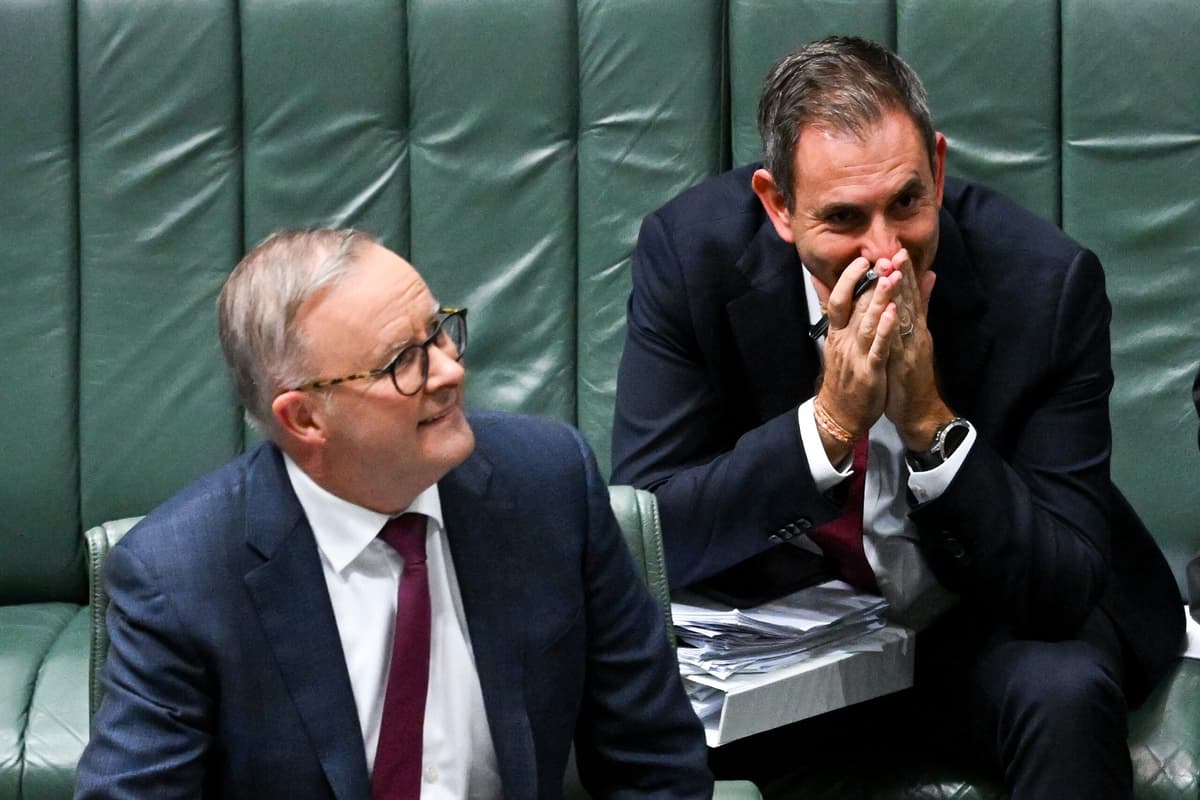
Photo: AAP Image/Lukas Coch

Republish this article

This article is licensed under Creative Commons — Attribution-NoDerivatives 4.0 International (CC BY-ND 4.0).

Republishing guidelines

  • You must credit the author(s) and The Point.
  • You must link back to the original article.
  • You may not edit or modify the article content.
  • Images may be subject to separate copyright and are not included in this licence.

Ted O’Brien asked the PM (who flicked the question to the Treasurer, Jim Chalmers) that:

“RBA’s forecast for headline inflation to peak at 3.7%. In the middle of next year, well above the target band and not to return to the band until 2027. My question to the Prime Minister is, given the government’s spending is running four times faster than the economy, isn’t it time to rein the Treasure inner to stop his spending spree?”

Fair enough I guess, except Chalmers had actually read the RBA’s statement on monetary policy which contains those forecasts, and alas for O’Brien, a few others.

While the CPI is not expected to get below 3% until June 2027, the RBA notes that

Year-ended headline inflation is expected to remain above 3 per cent for much of 2026, before returning to be a little above the midpoint of the target range by late 2027.

You can see this here:

So you might think case closed, O’Brien wins.

Problem is the RBA also noted that:

Changes in the timing of electricity rebates will cause additional volatility in headline inflation over the next couple of years.

So it is really due to a lot of erratic stuff, not underlying inflation. And while it did slightly revise up the underlying inflation measure – which the RBA actually targets, the revision was small, and we’ll be back under 3% soon – not in 2027 but next year:

And then we get to O’Brien’s point about “the government’s spending is running four times faster than the economy”

Firstly, that is a rather dopey point – if the economy is running slowly, the government should be assisting to stop the economy going into a recession. The RBA estimates that GDP will only grow around 2%. That is well below the long-term average of 2.75%-3%. Given public demand on average grows at around 3.3%, anything below that is actually below what the government probably should be spending.

As it is the RBA has revised down how much the public sector is contributing to the economy. The government is not only contributing less to the economy than usual, but probably less than it should be given rising unemployment.

But when you only care is attacking government spending, as is the case for Ted O’Brien, that logic does not register.


Related Articles

WHAT'S NEW

New research reveals Australians are putting in $300 worth of unpaid overtime every fortnight

By Tegan George

New research from the Centre for Future Work reveals the average employee is putting in almost three and a quarter hours of unpaid overtime each week, equivalent to 4.4 full-time working weeks a year. Across the country, its report estimates the value of unpaid overtime at $97.93 billion annually.

Economy
New research reveals Australians are putting in $300 worth of unpaid overtime every fortnight

OPINION

Australia’s gender pay gap falls below 20% for the first time

By Gemma Killen

Australia's gender pay gap has fallen to a record low. This year, the pay gap is 19.7%, which means that for every dollar men earn, women earn just over 80 cents. Over a year, this adds up to an average difference of $27,467.

Society & InequalityEconomy
Australia’s gender pay gap falls below 20% for the first time

OPINION

Productivity, New Technologies, Working Time

By Greg Jericho

This is an edited version of a speech delivered by Greg Jericho (Chief Economist at The Australia Institute) at the Academy for Social Science in Australia Annual Symposium. 

Economy
Productivity, New Technologies, Working Time

FACTCHECK

Factcheck: No, a gas export tax would not drive up gas prices for Australians

By Greg Jericho

This morning, Minister for Industry Senator Tim Ayres argued that a gas exports tax would mean higher prices for Australians. Except this is not true. A gas tax would actually lead to lower prices for Australians.

Economy
Not true
Factcheck: No, a gas export tax would not drive up gas prices for Australians