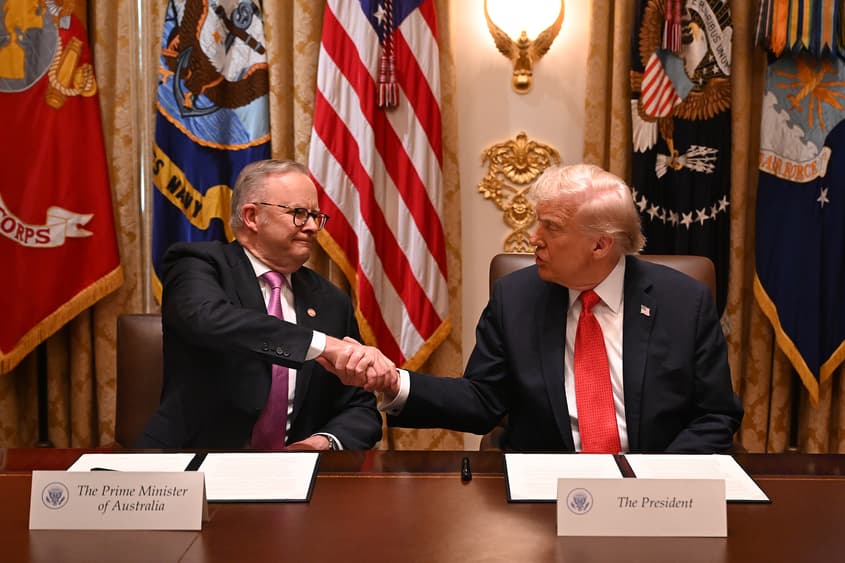
While the initial Israeli and US air strikes on Iran are legally very dubious, the pace with which the war has escalated will result in those significant legal issues being set aside – for the time being at least.

Thu 12 Mar 2026 22.00
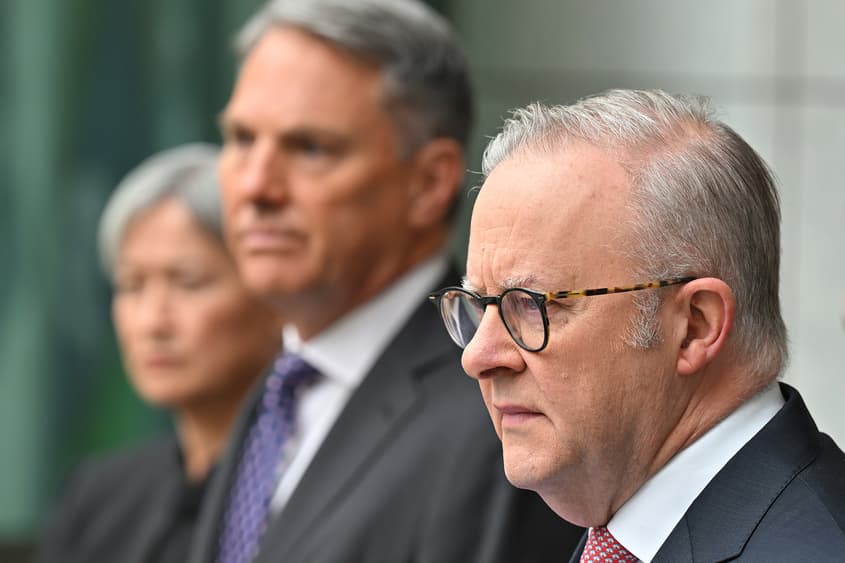
Photo: AAP Image/Mick Tsikas


While the initial Israeli and US air strikes on Iran are legally very dubious, the pace with which the war has escalated will result in those significant legal issues being set aside – for the time being at least.
Whether the legal justification for the war and its significance gains the prominence of the legal and political debates that erupted in Canberra, London and Washington over the 2003 Iraq War remains to be seen.
Given President Trump has said that decisions such as going to war are based on his “own morality” rather than UN Charter principles, and Israel’s ongoing disregard for international law as evidenced in its refusal to accept International Court of Justice rulings regarding the Occupied Palestinian Territories and during the Gaza conflict, international law appears of little relevance for those protagonists.
Historically, Australia has taken a different view with respect to international law. This has become increasingly important following Australia’s support for the Israeli and American attacks on Iran, and its 10 March commitment to provide military support to the UAE via an E-7A Wedgetail and accompanying 85 defence personnel.
Australia’s consistent position since 28 February has been that it is up to Israel and the US to outline the legal justification for their attack on Iran.
While the Israeli and American justifications for their Iranian strikes have been vague and ever changing – from ensuring Iran never acquired a nuclear weapons capability, to regime change and allowing the Iranian people the opportunity to take control of their own future – the only hint of a legal justification for their conduct has been self-defence.
Self-defence is an undisputed right under Article 51 of the UN Charter. However, it only applies in the case of an armed attack having actually occurred, or in exceptional cases where an armed attack is sufficiently imminent that one State needs to respond by way of anticipatory self-defence. Iran had not launched an armed attack against either Israel or the US, nor was there any compelling evidence it was about to do so.
As such, there is no justification for Israel or the US acting in self-defence in this instance.
Any direct Australian military support for Israel or the US would therefore not be consistent with international law. Australia would be joining an illegal war if it sought to do so.
It is, though, important to note that whatever intelligence support is being provided to the US via Pine Gap does not directly implicate Australia. The intelligenceis too far removed from the actual conflict and can properly be characterised as part of daily intelligence and military cooperation between longstanding allies.
While the Albanese Government has made clear that it does not wish to directly engage in the conflict, two recent developments have forced Australia’s hand in clarifying its legal position.
First, the USS Minnesota attacked the Iranian frigate IRIS Dena in the Indian Ocean south of Sri Lanka.
It was subsequently confirmed that three Australian submariners were on board as part of Australia’s longstanding military-to-military exchanges with the US and under an AUKUS training program.
The Australians may not have been engaged in any ‘offensive conduct’ as part of the Minnesota attack, but no precise details have been given as to what role they played. While legally they clearly were not in command and operationally could have been insulated from the attack, it is difficult to envisage how given the confines of a submarine where every crew member has an assigned role ensuring the operational efficiently of the vessel that they could have been mere observers.
Nevertheless, given the outbreak of hostilities between Iran and the US, the IRIS Dena was a legitimate military target under international humanitarian law.
Second, during the Wedgetail deployment announcement, Prime Minister Albanese expressly referenced Australia seeking to respond to a UAE request for assistance by way of ‘collective self-defence’.
This critical principle is referenced in Article 51 of the UN Charter and well known to international lawyers. It allows a State acting in self-defence to request others to come to its military aid and assistance.
A classic example of this occurred following the 1990 Iraqi invasion of Kuwait, when a ‘Coalition of the Willing’ was assembled acting under both a UN mandate and collective self-defence to expel the Iraqi forces from Kuwait.
The evidence is clear that the UAE has come under Iranian attack following the outbreak of hostilities across the Gulf, and that the UAE was not the original protagonist in this conflict.
What is unclear is the extent to which the US airbases in the UAE have been used in the Iranian campaign.
If those bases were hosting any US military personnel, once the conflict commenced, they became combatants and could be legitimately targeted by Iran. While reporting suggests that the UAE would not permit US strikes on Iran to be launched from the Al Dhafra air base south of Abu Dhabi, that does not diminish the role of the UAE in hosting US military forces clearly part of the international armed conflict.
What is not contested is that Iran has struck civilian infrastructure across the UAE including Dubai airport. There is no justification under international humanitarian law for such indiscriminate attacks. Australia is therefore on solid legal ground in responding to the UAE’s request to come to its military aid under the doctrine of collective self-defence.
Canberra is nevertheless traversing a very narrow legal corridor in this conflict. Australian personnel deployed to the Gulf remain subject to Australian military law and justice, and the Rome Statute of the International Criminal Court.
Notwithstanding some views that the rules-based international legal order is crumbling, this is not a lawless world. International law governing the use of force and how a conflict is conducted by the combatants is centuries old. The principles are well understood. What is needed is global citizen States to apply, support and enforce the law.
Donald R. Rothwell is Professor of International Law, School of Law, ANU
Advertisement
Former Greek finance minister and economist Yanis Varoufakis has warned that fascism is re-surging in global politics, with extremist ideas gaining influence even in countries where the far-right is not in power.

Australia’s AUKUS agreement has dragged the country into the Trump administration’s war on Iran with Prime Minister Anthony Albanese accused of obfuscating the country’s involvement.

It isn’t always easy to keep up with what’s happening in the US. “Shorter America” is a series where Dr Emma Shortis loops you in on what’s going on in America and shares news and analysis that you can trust.
The President of Peace has started another war. It began with the bombing of a school in southern Iran. According to Iranian authorities, the death toll from that strike now sits at 168. Many of the victims were children.