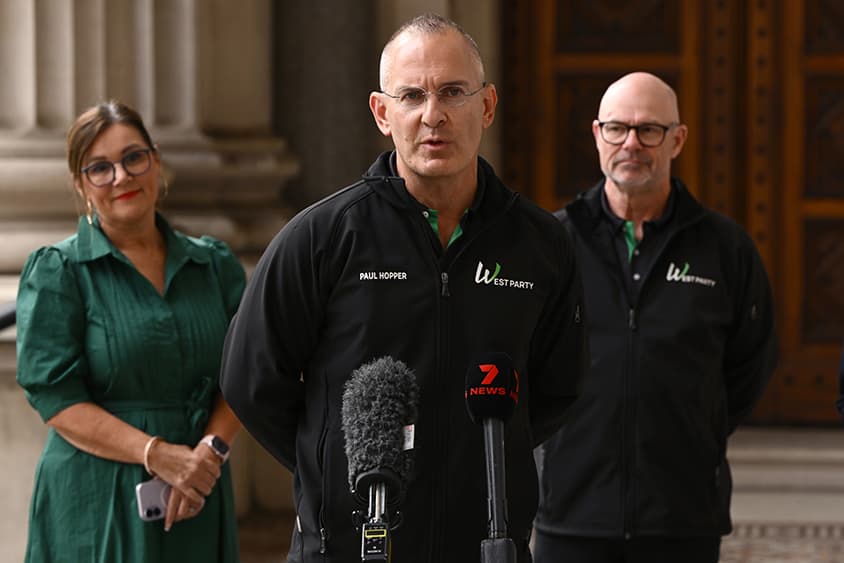
In 2018, the Victorian Parliament put a cap on political donations – but left loopholes that established political parties can exploit. State independent candidates Paul Hopper and Melissa Lowe went to the High Court to challenge one loophole: that “nominated entities” could give uncapped donations to the major parties while everyone else was limited to about $5,000 per donor.
Mr Hopper and Ms Lowe argued that it goes against the Australian Constitution to limit political donations to independents and minor parties while leaving a loophole for the major parties.
This month, the High Court of Australia agreed, finding the loophole unconstitutional. But the laws were too interwoven for the Court to strike out the loophole. Instead, the Court voided all of Victoria’s political donation laws, leaving it to the democratically elected Victorian Parliament to rebuild them in a fairer and more consistent way.
What was in the Victorian laws?
Victoria’s laws included:
- Donation disclosures, requiring political parties and candidates to publish details of larger donations received.
- High levels of taxpayer funding for political parties and candidates, working out to about $9 per voter.
- A strict donation cap of about $5,000 per donor per four-year electoral cycle. However, the cap has several exceptions (loopholes), including:
- donations from candidates
- contributions from MPs and their staff
- nominated entities
- so-called “membership fees” (which can be as high as $250,000) and
- “affiliation fees” from associated entities.
- A ban on foreign donations
Three years ago, Australia Institute research identified that these laws were unfair, actually serving to concentrate political financial power instead of distributing it.
There has already been one state election under those laws. The next Victorian state election is this November.
What is a nominated entity?
A nominated entity is an organisation with a special relationship with a political party that is allowed to donate to that party beyond the donation cap that applies to everyone else.
Three jurisdictions brought in nominated entities at the same time they brought in donation caps: Victoria, South Australia, and the Commonwealth. So far, only Victoria’s have been challenged in court.
Victorian-nominated entities contributed millions of dollars to Labor, the Liberal, and the Nationals, while Victorian voters were capped at about $5,000 each.
Nominated entities are not the only problem with donation restrictions
Australia Institute research shows that nominated entities are only the tip of the iceberg when it comes to unfair donation restrictions – whether in Victoria, South Australia, or federally.
Other examples include “donation splitting” by federal parties with multiple branches, where each branch receives a donation just below the cap; levies charged by Victorian parties on staff and MPs that sit outside donation caps; and special administrative funding in South Australia, some of which can be used for electoral purposes.
What might happen next?
The Victorian Parliament will want to reintroduce some political donation regulations before the November election.
The safest option would be for the Parliament to just reintroduce donation disclosure laws. Transparency around who is funding parties and candidates would allow Victorian voters to make up their own minds.
There is no great danger in abandoning donation caps, at least for this year’s election. Of the 60 state elections in Victoria’s history, 59 were fought without donation caps – and they include some of the state’s most competitive, policy-driven, and vibrant elections.
The worst thing the Parliament could do is simply reintroduce the old laws, including the $5,000 donation cap, but with the nominated entity loophole excluded. This would be a missed opportunity. It could also leave them open to another constitutional challenge, because although the court only examined the nominated entity loophole, nominated entities are just one of the ways in which the rules unfairly favoured the major parties.
The Australia Institute has proposed a fairer form of donation cap, called the “mega-donor cap”. This still allows for private fundraising but limits the total financial influence that any one donor can have. A “mega-donor cap” would also close off one remaining loophole in conventional donation caps: that wealthy donors can split donations across many like-minded parties, provided each one comes under the cap.
Other jurisdictions are vulnerable too
South Australia and the federal parliament have also adopted donation restrictions with a nominated entity loophole – raising concerns that their schemes are unconstitutional too.
Neither the Albanese Government federally nor the Malinauskas Government in South Australia allowed a parliamentary inquiry before rushing donation restrictions through – despite 35,000 Australians saying any major change to election law should go to a parliamentary inquiry.
Now the federal laws are the subject of a constitutional challenge from former independent parliamentarians Zoe Daniel and Rex Patrick.
Parliamentary inquiries could have made these laws fairer from the outset, instead of leaving it to expensive litigation in the courts.