It is as a “positional” good — that is, a product or service in limited supply that consumers want more of as their income increases — that the self-declared “elite” schools come into their own.
Many well-heeled parents (or those in possession of well-heeled grandparents) pay large amounts of money to be associated with particular private schools. Having worked in the advertising industry, I am well-versed in how premium brands depend on charging high prices. High prices are one of the ways these brands create the impression they are superior. We have been groomed for generations to believe that the more you pay for something the better it is. That’s why premium brands do not actually have to be worth more, just appear to be. The positional good gained from purchasing a premium brand is the status its possession bestows upon the consumer.
Turning left when you board a plane doesn’t get you to your destination any quicker, or even more safely. It may get you there in more comfort and even luxury, which is pleasant, but the reason you are getting on a plane in the first place is the same, whatever seat you sit in.
The major selling point of any form of “first class”, whether on an airline or for exotic coffee or luxurious quilted toilet paper, is the boost to the purchaser’s ego and their sense of their importance or “position” in society. When I see an expensive SUV proudly flaunting a sticker declaring “I’m a (insert name of posh school here) Mum” (such stickers really exist) I know exactly what those parents have bought, and it isn’t, necessarily, a better education.
It feels more like membership of an exclusive and therefore highly desirable club. Especially as many of these publicly subsidised high-fee schools now offer facilities beyond the dreams of wildest avarice. Consider these random examples: a library built to look like a Scottish castle (exclusive does not equal tasteful); sports stadiums the envy of professional football teams; an air conditioned equestrian centre (can’t have the students riding a hot horse); plunge pools for headmasters; and a wellbeing centre featuring no fewer than six ice baths for recovery sessions (getting overheated seems to be a theme) along with a 25-metre pool.
I have often argued that Catholic and other so-called “low” fee schools (low to whom and compared to what?) rely on the glittering brands of high-fee schools like Riverview, Abbotsleigh, Geelong Grammar, Churchie (the Anglican Church Grammar School), PLC, King’s, St Paul’s, Somerville House, Ascham, Frensham, St Margaret’s, Lauriston Girls and so on that make the private school brand so aspirational.
These so-called “elite” schools work in the same way that haute couture works for European fashion houses. Few can afford the clothes Dior, Yves Saint Laurent, Dolce & Gabbana, Louis Vuitton or Balenciaga send down the runway. High fashion’s unattainability is, in fact, the point. How can anything be exclusive if it does not exclude most people?
It appears to be human nature to yearn most for what is hardest to get. Yet almost everyone can have a taste of such exclusive brands by purchasing their lipstick, skincare products, perfume, or sunglasses. Yes, those items are also ridiculously overpriced, but they are within the reach of the many, not just the few.
Indeed, the turnover from such relatively affordable items bearing the magic brand names is how these fashion houses stay solvent. The loss-making but highly publicised haute couture is really just an advertising campaign for the mass-produced, lower-priced items that keep the businesses alive.
So it is with the Riverviews and Abbotsleighs of this world. Most families could not dream of paying their fees, but they can access a little bit of brand “private” by buying their child a place in a more affordable (although still overpriced) Catholic or Christian school.
While I am not convinced that education ought to be a positional good at all, I am absolutely certain that taxpayers’ money should not be used to help some schools maintain their prestige and elitism.
Inevitably, once the public funding of private schools became entrenched, our schooling system began to shift from an emphasis on the public good towards the private and positional. The Hawke Labor government’s education minister John Dawkins was focused on education that produced workers who would enhance Australia’s productivity and international economic competitiveness. He saw education as a national positional good.
Researchers at Queensland University of Technology have written of the Hawke government’s reforms that, “While equity and access were promoted, they were framed in terms of social efficiency, resulting in the individual and the economy being placed centre stage.”
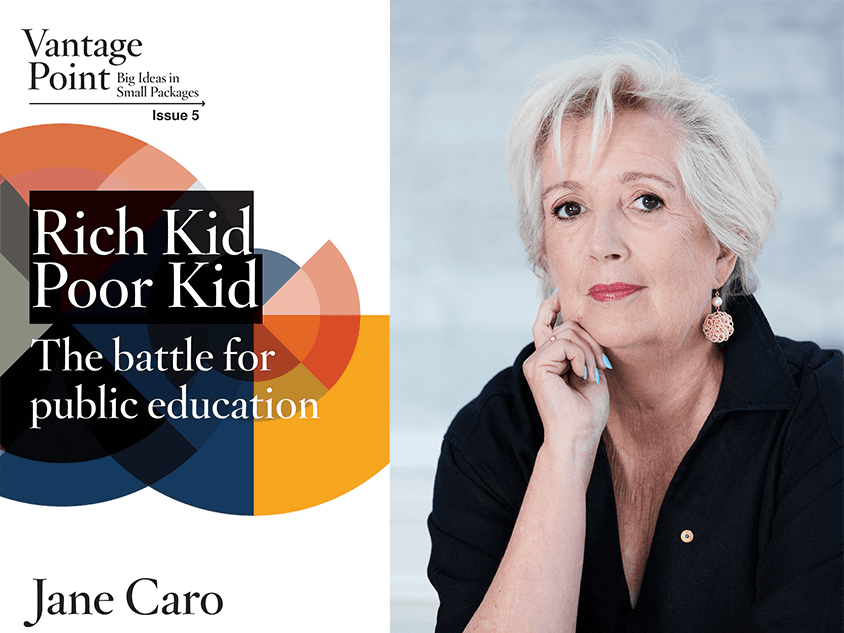
This is an edited extract of Rich Kid Poor Kid: The battle for public education (Vantage Point Issue 5), by Jane Caro AM. Available from May 5 in all good bookshops.
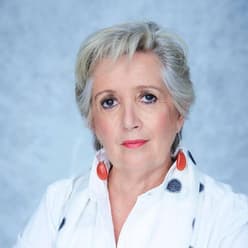
Jane Caro AM is a Walkley award winning columnist, author, novelist & social commentator. She occasionally appears on TV, regularly on radio, makes a lot of speeches and writes often in SMH, Age, The Saturday Paper. She is on the board of the Public Education Foundation. She was awarded the B&T Women in Media Lifetime Achievement Award in 2023. She is a feminist and an advocate for public education. She’s written 14 books, including The Stupid Country. How Australia is Dismantling Public Education and What Makes a Good School both co-authored with Chris Bonnor. Her two latest novels the Mother and Lyrebird are best sellers.