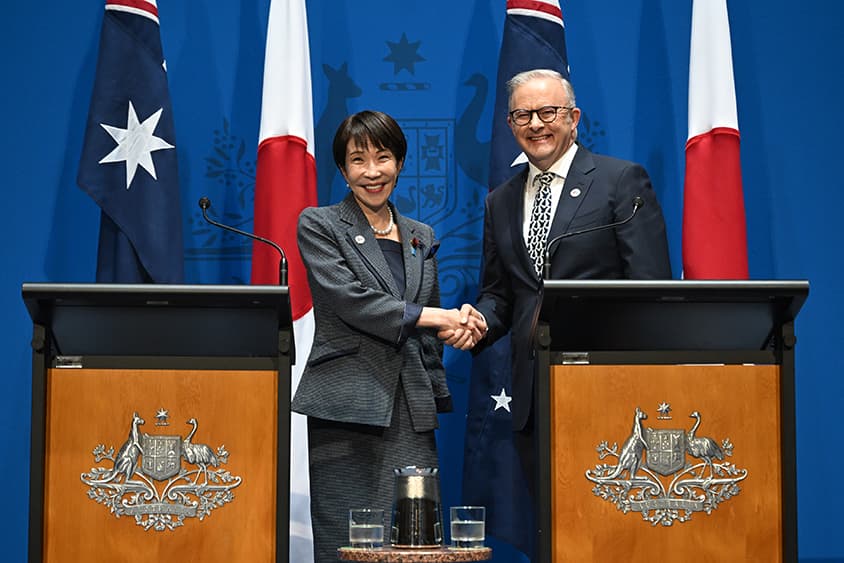
On Monday this week, Japanese Prime Minister Sanae Takaichi made her first official visit to Australia since taking office, attending the Australia-Japan Annual Leaders’ Meeting with Prime Minister Anthony Albanese. The two leaders signed multiple new agreements, including increasing defence cooperation and strengthening energy security.
In the midst of the global energy crisis sparked by the US-Israel war on Iran, Australia and Japan’s recommitment to fossil fuels is feeling less like energy security and more like a desperate attempt to maintain a beleaguered and risky status quo that prioritises corporate profits over the welfare of both nations’ citizens.
The devastation caused by the war is being felt by communities across the Middle East, with thousands killed and millions displaced. Beyond the conflict zone, the extreme volatility and risks posed by fossil fuel dependence have become stark. Despite this, neither Albanese or Takaichi spoke about the need to end the war, or meaningfully transition our energy systems.
Takaichi’s trip has also coincided with some of Japan’s largest protest rallies, with over 50,000 people gathering in Tokyo on Sunday in response to her proposed change to Article 9 in the country’s constitution. This clause renounces war and the threat or use of force as a means of settling international disputes.
We spoke to Reina Tashiro from We Want Our Future, one of the organisers of the protests, who described how Japan is “taking a massive step toward becoming a ‘war-capable’ nation” and juxtaposed the country’s military buildup with the soaring cost of living people in Japan are facing; “as people’s lives and the economy are exhausted, the Takaichi administration is creating a distorted reality where only militarization advances at an abnormal pace.”
She explained how Japan took responsibility for the tragedies of the war it waged against Asian nations by establishing and maintaining a Constitution that declares: ‘never again shall we be visited with the horrors of war through the action of government’, which is embodied in Article 9.
“While the Prime Minister and the LDP argue for changing the Constitution to a ‘form suited to the times,’ in an era where war and genocide are repeated globally, there is no form more suitable than our current Peace Constitution. We believe that what politicians should be doing now is not changing the Constitution, but practising the politics that the Constitution demands. This is the conviction that is bringing people together in Japan today”, says Tashiro.
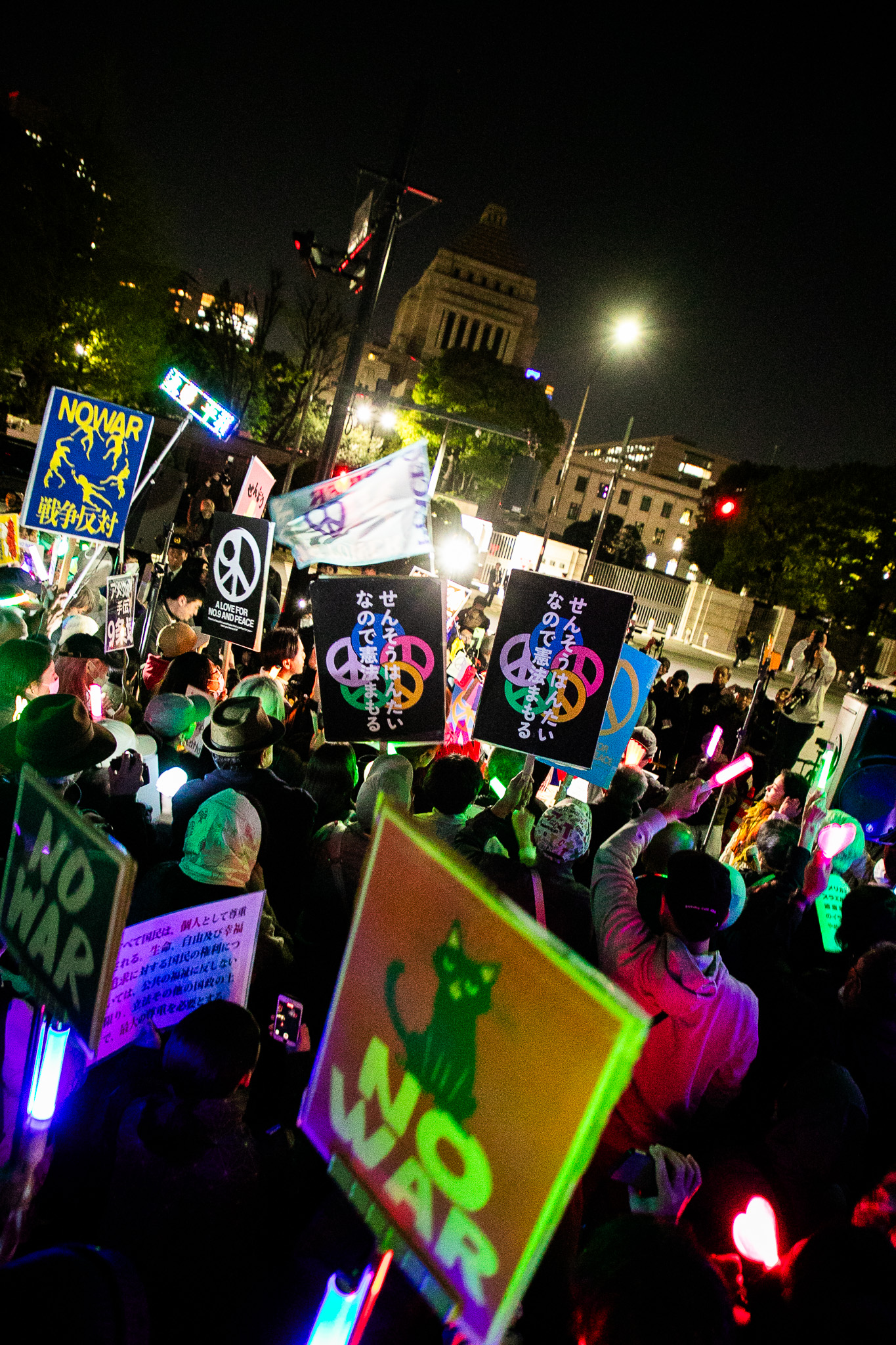
Protestors outside the National Diet in Tokyo in April 2026. Credit: Daiki Tateyama.
Japan is leading the Asia-Pacific down a dangerous path of fossil fuel expansion and militarisation, a vision which civil society across the region has rejected. Fossil fuels and war are deeply intertwined. As described by Shereen Talaat from the MENA Fem Movement, “Oil and gas remain the hidden architecture of the global order. Control over energy routes, reserves, and infrastructure shapes alliances, military strategies, and economic policy.”
Continued fossil fuel dependence and increased militarisation benefit Japanese companies. Japan recently signed a deal to supply the first three of 11 new warships to the Australian Navy at a total cost of up to AUD$20 billion, to be built by Japanese conglomerate Mitsubishi Heavy Industries, which is also one of the top three gas turbine manufacturers. Most gas turbine capacity is being manufactured for Asia, where Japan has been strategically cultivating demand for gas in order to keep its companies embedded and profiting across the supply chain.
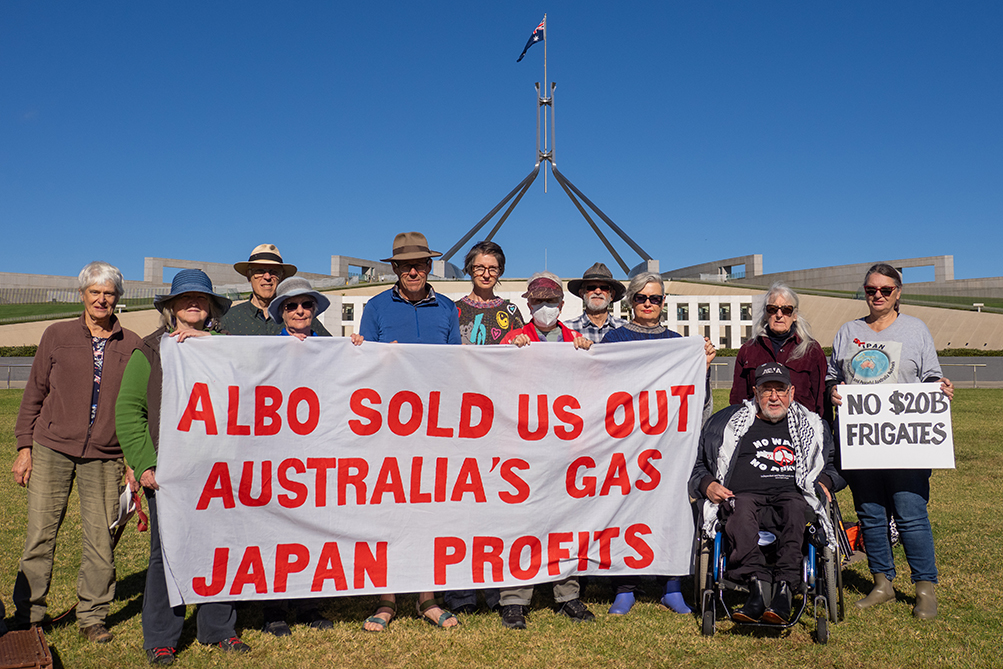
Protestors outside Parliament House during Takaichi’s visit to Australia in May 2026. Credit: Leo Bild.
The relationship between fossil fuels and war is mutually reinforcing, as war fuels the climate crisis, which is further intensifying conflict. A new report from the Fossil Fuel Treaty initiative examines these connections in the context of rising military expenditure and the financing gap for a global just transition – making an incredibly compelling case that reallocating military expenditure to finance the transition is a win-win.
Military activity is one of the largest and yet systematically under-reported drivers of greenhouse gas emissions; the world’s armed forces, if ranked as a single country, would be the fourth largest carbon emitter. Alongside emissions, militarisation actively undermines the conditions needed for a just transition by entrenching geopolitical competition, eroding trust, weakening multilateral institutions and narrowing the space for the international cooperation that a just transition away from fossil fuels requires.
In December last year, Japan approved a record defence budget exceeding AUD$85.9 billion for the coming year alone, up almost 10% from 2025; while the Australian defence budget has seen an AUD$53 billion increase, reaching a record AUD$425 billion over the next decade.
States may believe it is possible to increase military expenditure while meeting climate and development needs; however, “current trends make it less and less realistic. The ever-creeping military and security budgets – which create more harm to people and planet – and inadequate financing for climate justice and sustainable development demonstrate that no state has figured out a “balance” that can take the planet back from the brink of destruction.”
Military demand also competes with and often overrides the resource needs of the transition itself. Critical minerals, another area of cooperation between Australia, Japan, and the US, are increasingly prioritised for applications in weapons manufacturing.
A report by the Transition Security Project found that these minerals, such as lithium and rare earths, which are required in the production of electric vehicles, solar panels and wind turbines, are being directed into the manufacture of precision-guided weapons and “AI-driven autonomous platforms”. The Trump administration’s new graphite and cobalt stockpile alone could be directed to manufacture a fleet of 150,00 electric vehicles.
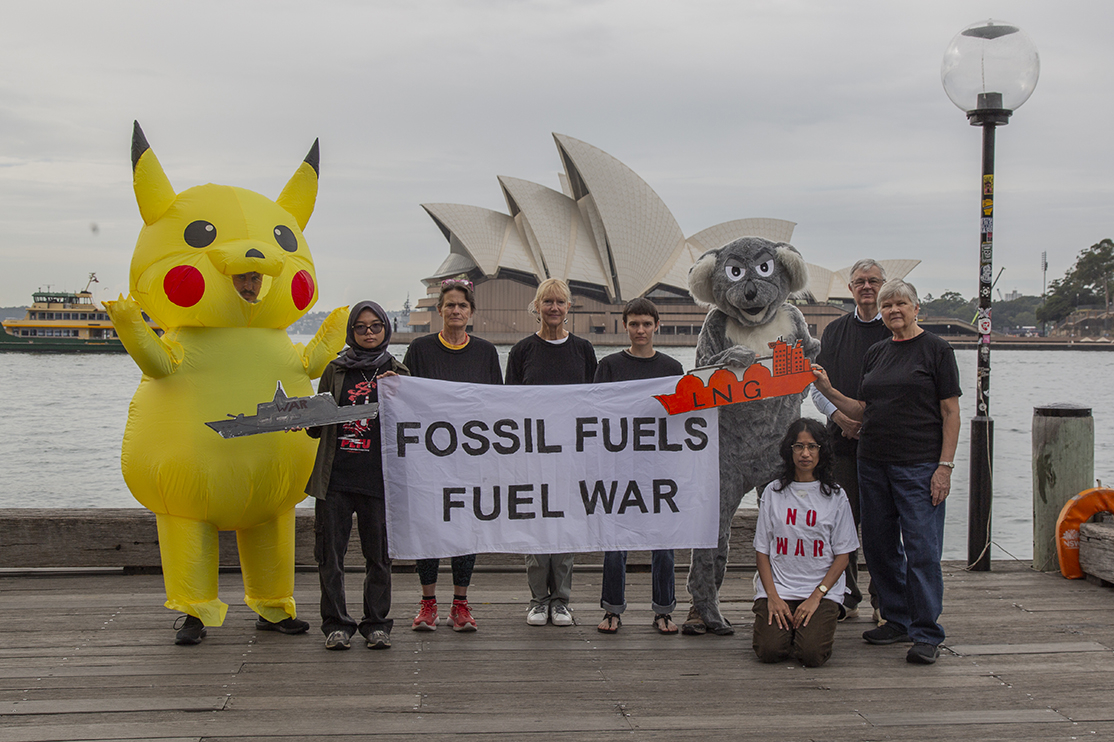
Protestors in Sydney during Takaichi’s visit to Australia in May 2026. Credit: Isabella Brown.
This year marks the 50-year anniversary of the Basic Treaty of Friendship and Cooperation between Australia and Japan. This Treaty recognises that the two countries should not only work together for their own mutual benefit but also for their common interest in the prosperity and welfare of other countries in the Asia-Pacific region.
Fossil fuel extraction and dependence is devastating our region, from the current energy crisis to the profound impacts of climate change. Increasing military spending does not equate to safety and security, and neither does the continued promotion of fossil fuels. At COP30, President Lula da Silva stated:
“Spending twice as much on weapons as we do on climate action is paving the way for climate apocalypse. There will be no energy security in a world at war.”
The path to prosperity for communities across our region is a rapid and just transition away from fossil fuels to renewable energy, and a reorientation of our economies towards peace; it is high time our leaders act on this.
Dr Suhailah Ali is the Director of Climate Justice at Jubilee Australia Research Centre, originally from Fiji and currently based on unceded Bidjigal country.