What comes next in the demagogue’s push towards high fame and total power? The demagogue’s ruling party, helped by dirty tricks, cunning media tactics, government handouts and nonstop talk of defending ‘the people’ against a corrupt and untrustworthy opposition, prepares for the next election. If term limits apply, and running again for office is prohibited, the demagogue, knowing that millions of dissatisfied people still find their message attractive, is tempted to change or openly defy the constitution. Honesty no longer matters. But then it never did.
From the demagogue’s perspective, the only important consideration is that previous victories granted the demagogue and their party the chance to seize control of the core institutions of government. Winning office allowed them to kidnap the legislature, the courts, the bureaucracy and other key institutions, to exploit their weaknesses and profit from their remaining strengths, to operate a spoils system to reward supporters, to silence journalists and to outflank, punish and politically crush their listless opponents.
And so, in preparation for the next election, the governing party machine, in the hands of its big boss Leader, ramps up talk of democracy and ‘the people’ laced with stern warnings about ‘enemies’, the dangers of subversion and the collapse of law and order. The point is finally reached where ballots ruin democracy just as effectively as bullets. By now, elections have become more than elections. ‘Elective despotism’ is on the agenda. That was the pertinent phrase coined long ago by Thomas Jefferson in his Notes on the State of Virginia (1785).
He had in mind the misuse of election results by a winner who proceeds in various ways to concentrate the powers of the legislature, judiciary and the executive into the same hands. That’s ‘precisely the definition of despotic government’, he wrote, adding that in practice the corrupting effects of the concentration of power would be spread ‘through the body of the people’ to the point where the despot would ‘purchase the voices of the people, and make them pay the price’.
That’s exactly what the demagogue now seeks to do. Elections come to resemble rowdy plebiscites, public rituals, carnivals of political seduction, celebrations of the mighty power of the demagogue-led state, endorsed by the votes of millions of loyal followers. What Jefferson didn’t foresee is that as the transition away from power-sharing democracy towards despotism in the name of ‘the people’ gathers pace, something more startling happens. In the hands of the ruling party and its demagogue leader, the razzamatazz about ‘the people’ has a more sinister effect: it aims to redefine who ‘the people’ are.
It used to be said that despots’ best magic trick is that they make the people disappear, but that joke no longer applies. Desperate to tighten their grip on state power, with eyes on the forthcoming election, the demagogue and the governing party hand bread, roses and promises to loyal followers and undecided waverers. But they also hit hard against their targeted so-called ‘enemies’. There’s no bare-faced fascist Big Lie, only blather and barney. The demagogue and their government are mere specialists in headline hunting. They prefer weaponised confusion, reckless accusations and dark insinuations. They spread foul language, peddle bullshit, pick political fights, tighten border controls and build mental and physical barbed-wire fences against foreigners and ‘foreign’ influences.
On all these matters, they cheat and tell lies with impunity. They twist the facts, trade in underhanded inuendo and false syllogisms (‘I hate terrorism; you hate me; you’re therefore a terrorist’), spread bewilderment and stage dramatic stunts designed to capture maximum public attention. The blarney and blather lay siege to people’s imaginations. The aim is to persuade millions of their followers that the fabrication of reality is perfectly normal or, more cynically, that veracity really doesn’t matter because people know that living the lies, bullshit and nonsense together in solidarity is a positive instrument of curing their ressentiment and promoting their dignity. That’s why all the talk of conspiracies, scapegoating, boastful exaggerations, clownery and weaponised nonsense spread by media organs loyal to the demagogue continue to be popular, and why the demagogue sooner or later rolls out their signature campaign tactic: stirring up trouble about who counts as ‘the people’.
The effort to redefine ‘the people’ is much more serious than the problem of ‘majoritarianism’ taking hold of politics, the old fear, expressed by nineteenth-century liberals like John Stuart Mill, that ‘the people may desire to oppress a part of their number’ so that ‘precautions are needed against this as against any other abuse of power’. The problem is different. We could say that at this stage of the career of a successful demagogue, a new kind of demogenesis takes hold.
Peddling fears of domestic and foreign enemies, the government moves to scapegoat and ostracise people who are deemed not to belong to what Donald J. Trump has repeatedly called the ‘real people’. Demagoguery has an eliminationist quality. Depending upon the context, to repeat, past demagogues railed against monarchs, aristocrats, railroad magnates, bankers, black and indigenous people, Jews, atheists and Chinese immigrants. Context still matters.
Today’s demagogues have different hate objects. They target Muslims and their so-called ‘terrorism’ and disloyalty to an imaginary ‘Hindu nation’ besieged by ‘Rohingya’, ‘Bangladeshis’ and other ‘infiltrators’ (Modi). Or they spit at liberals, ethnic minorities, narco-terrorists and environmental activists. ‘Poles of a worse sort’ (Kaczyński), ‘Moroccans’ (the Netherlands’ Geert Wilders), people who are not ‘real Hungarians’ (Orbán) and ‘proponents of anti-Semitism’ (Benjamin Netanyahu) are warned. So are dark-skinned people arriving on boats, same-sex parents, ‘left wing’ dissident intellectuals and opponents of Italianità (Giorgia Meloni).
Regardless of the context, the pattern of exclusion everywhere has a serious consequence. The Great Redeemer repeats, and repeats again, that their leadership and their government enjoy the backing of an authentically ‘sovereign People.’ But for this to happen, and to win the coming election, more’s needed than citizenship verification drives, redrawing boundaries, fiddling with voter registration rules and striking citizens off the electoral rolls, as Modi and other demagogues have already done. What’s required is the creation of a new and purer ‘people’—a pasteurised people who (it’s said) are the faithful foundation of a true democracy ruled by a true leader whose strength comes from the true ‘People’.
It’s an Alice in Wonderland dynamic of jubjub birds, shouting sheep, mad hatters and knaves of hearts who steal tarts. It’s as if the whole point of elections is turned inside out and upside down. The principle that in a democracy the people are sovereign, that they have the unconditional right to choose representatives who for a time govern in their name, is scrapped. The reality is just the opposite. In the transition from democracy to despotism, it’s the government led by the demagogue which acts as the sovereign blessed with the right to decide which people are entitled to vote backed by the power to persuade them to vote the right way. The result: the government votes in the people.
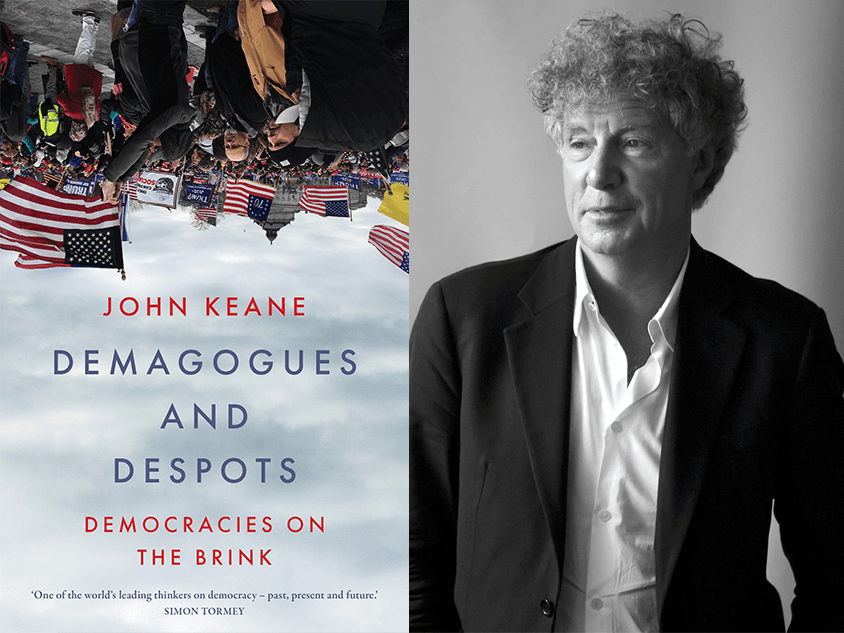
This is an edited extract from Demagogues and Despots: Democracies on the Brink by John Keane (NewSouth), available now for $32.99.
John Keane is Professor of Politics at the University of Sydney and is renowned globally for his creative thinking about politics, history, media and democracy.