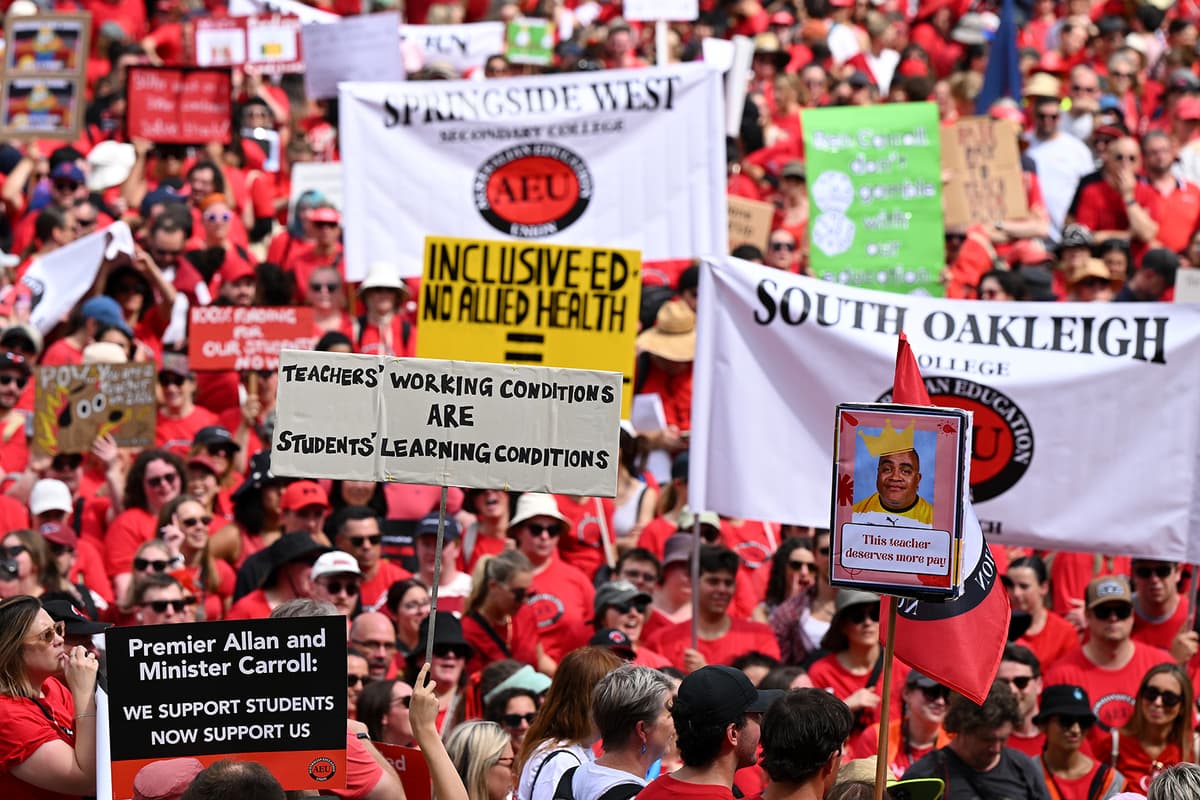
The current Victorian teacher dispute has been framed publicly as a “pay dispute”, but the negotiations have consistently revolved around a broader issue: what exactly do we mean when we talk about staff conditions? The answer depends entirely on who is speaking.
Although all parties use the word “conditions”, they are often referring to different things. For the Victorian Government, conditions are primarily industrial and structural; the formal settings of employment, such as hours, entitlements, class-size targets, and system sustainability.
For the Australian Education Union (AEU), conditions are about whether workload and staffing structures make teaching professionally sustainable over time. Teachers themselves tend to define conditions more personally and experientially, whether the day-to-day reality of the job is emotionally and practically manageable. Principals, meanwhile, frame conditions in operational terms such as whether schools can realistically function and implement agreements within existing staffing, compliance, and resource constraints.
At its core, the dispute reflects a deeper disagreement about what should count as genuine improvement in teachers’ working conditions. The government’s position largely assumes that if formal industrial protections are strengthened, through measurable entitlements, nationally competitive pay and clear workload rules, then conditions will materially improve.
The AEU and its members argue that formal protections alone are insufficient if the daily realities of the job remain dominated by workload intensity, unpaid labour, emotional exhaustion, social media impacts, student behaviour and mounting retention pressures.
Principals often find themselves between these positions, trying to support staff wellbeing while managing operational realities within finite staffing and budget constraints. This divergence in how “conditions” are defined helps explain why the dispute is difficult to resolve, even once substantial wage increases are placed on the “in-principle” table.
The Victorian dispute reflects a broader international shift in how “working conditions” are understood within education systems. Teachers and unions around the world have continued to define conditions more expansively over the last decade, encompassing the total cognitive and emotional load of teaching, levels of professional autonomy and trust, administrative burden, behavioural complexity, mental health impacts, staffing adequacy and the long-term sustainability of the profession itself.
This reframing is evident in disputes and policy debates across countries including the United Kingdom, United States, Canada, and New Zealand and is increasingly reflected in discussions within the Organisation for Economic Co-operation and Development (OECD) about teacher workload, wellbeing and retention. Governments, meanwhile, still largely operate within older industrial frameworks built around measurable entitlements and productivity.
The comparative table below shows that each group is often speaking about a different version of “conditions”. Governments usually focus on measurable industrial structures. Teachers focus on the daily realities of the job. Principals focus on operational sustainability. Education support staff focus on recognition, safety and realistic role expectations. Unions attempt to connect all of these concerns into a broader argument about whether public education systems remain sustainable at all.
| Group |
How they define ‘conditions’ |
Main concerns |
| Teachers |
The daily realities of the work and whether the job is emotionally and practically sustainable. |
Workload, burnout, unpaid overtime, behaviour management, lack of planning time, administrative overload. |
| Australian Education Union (AEU) |
The long-term sustainability of the profession and workforce retention. |
Staff shortages, excessive workload, attrition, insufficient support staff, growing student complexity. |
| Principals |
Whether schools can function effectively under increasing complexity and limited staffing. |
Recruitment shortages, operational viability, compliance burden, leadership burnout and safety concerns. |
| Victorian Government and Education Departments |
Formal industrial settings and measurable entitlements within a sustainable public system. |
Budget management, staffing supply, industrial compliance, recruitment and retention.
|
| Education Support staff/paraprofessionals |
Recognition, safety, adequate training and realistic workloads in increasingly complex classrooms. |
Low pay, insecure hours, exposure to violence, lack of professional recognition and unpaid collaboration time. |
The challenge for meaningful reform is that every perspective is partially correct. Formal entitlements matter, but so does responding to the daily realities of the job.
Workload reduction matters, but so does operational feasibility.
Inclusion matters, but so does adequately resourcing the paraprofessionals and support staff expected to deliver it.
Without acknowledging these overlapping definitions, education debates continue to be fragmented, with each group believing the others are ignoring the real issue. Energy gets spent on defending positions rather than refining shared understanding, and reform cycles repeat because underlying assumptions were never aligned in the first place.
If we fail to get working conditions right, the consequences will not stop with teachers. When working conditions do not address the realities of the daily work, schools struggle to attract and keep experienced teachers. That means more vacancies, merged classes, out-of-field teaching, casual staffing, interruptions to student learning and fewer adults available to meet increasingly complex needs. There is strong evidence that working conditions in schools shape student outcomes. The OECD has highlighted that teacher wellbeing is linked not only to stress and intentions to leave, but also to the quality of teaching and student wellbeing.
Real change requires bridging these definitions. Governments cannot ignore what teachers are clearly reporting such as workload issues, burnout and exhaustion, simply because formal protections exist. At the same time, unions and educators must recognise the operational and financial constraints of running large public systems. Sustainable reform depends on moving beyond the false choice between “pay” and “conditions” and acknowledging that modern teaching requires both fair compensation and genuinely manageable work.
Finding middle ground begins with a shared understanding that conditions are not just what appears in an agreement, but what makes teaching a profession people can realistically remain in for the long term.
Ben Sacco is a highly respected education specialist, author and Managing Director of Education Economy.