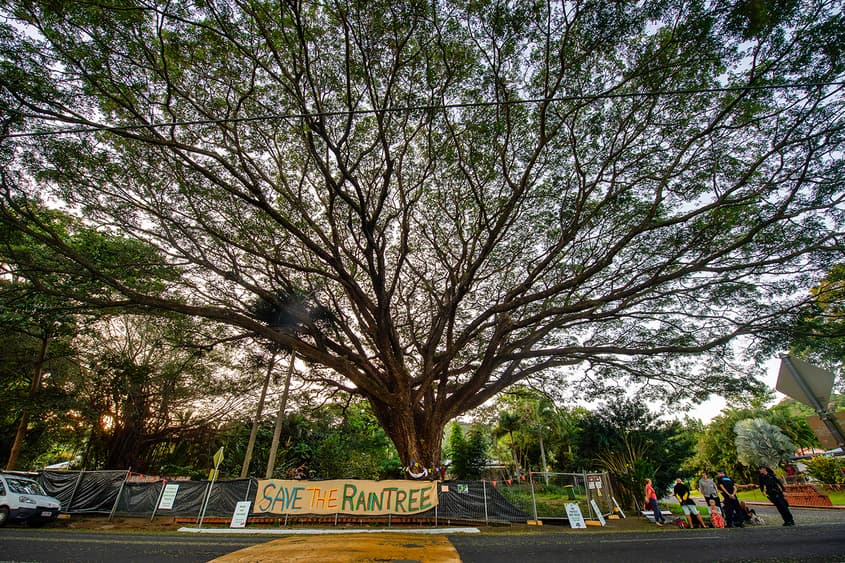
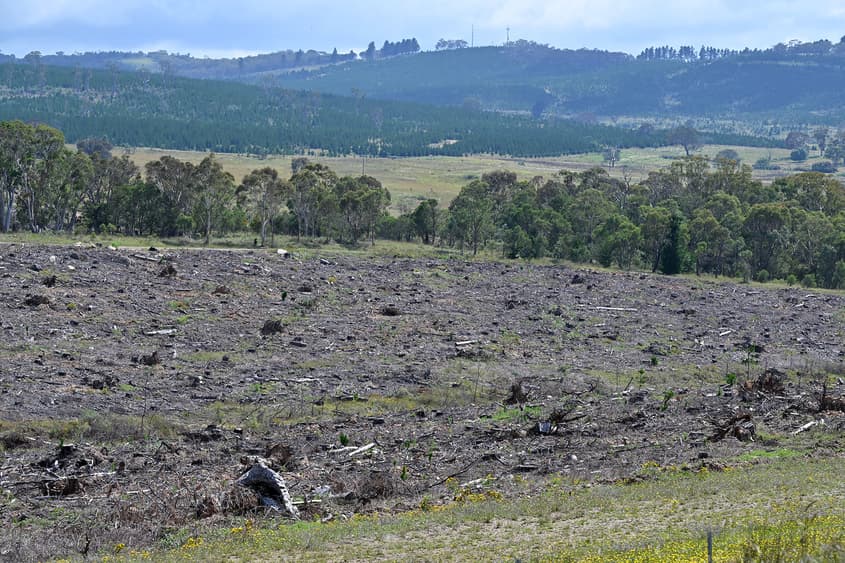
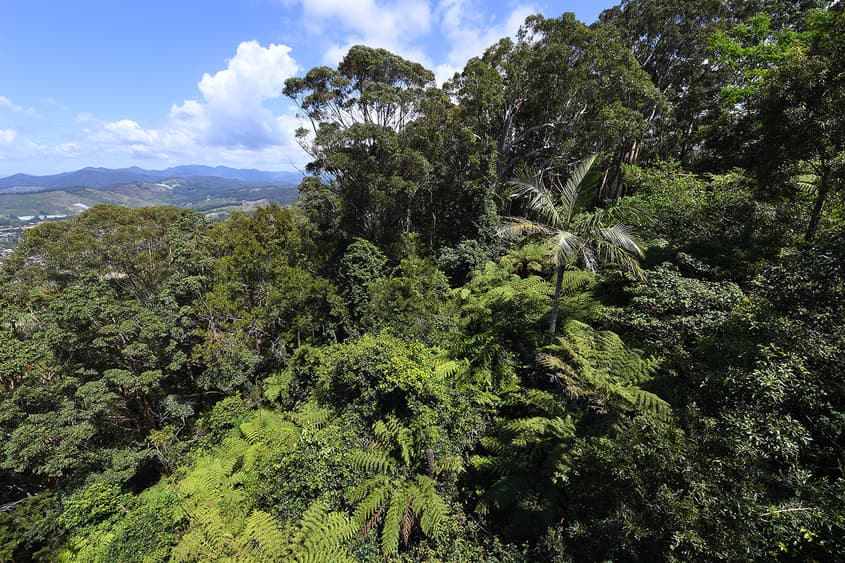
In the Cairns suburb of Freshwater, chainsaws are about to destroy an 80-year-old raintree to make way for a dual-occupancy investment property.
One of the building’s two pools will sit where the raintree stands now. It feels like a cruel joke, but this is how our year-long battle to save it will end.
It will take crews three days to destroy what took most of a century to grow. The trickiest part will be dealing with the 40-metre-wide canopy that spans the entire width of Old Smithfield Road and the footpaths on both sides.
When the workers are done, our community will be left to endure sweltering summers without its vast expanse of protective shade outside our local primary school.
We’ll also be left without its contribution to cleaner air and our wildlife, including black cockatoos and protected brush turkeys, who will be looking for new homes.
Just about everyone in Cairns knows this tree, described by landscape architect, environmental educator and ABC television presenter Costa Georgiadis as a “cathedral of nature”.
The majority of it stands on public land but that didn’t stop the Cairns City Council from allowing a material change of use to allow the investment property to be built on adjacent private land that supports the other part of the tree.
The council’s approval came with a condition that the tree’s destruction be offset through replacement planting to maintain neighbourhood amenity and mitigate climate impacts.
If we are all very patient, in a few decades or so, we might regain some of the protective qualities of our doomed community asset.
I joined the Freshwater raintree campaign early on due to my deep concern about how nature loss is affecting human health.
As a GP, I know heat kills more Australians than all other natural hazards combined.
Yet across the nation, we are chopping down the very things that help us build climate resilience, showing repeated disregard for their value as a natural air con.
The campaign was like nothing I’d been part of before. It was connected, collaborative, cohesive, cooperative, committed, and caring.
On the weekend, as we explored legal avenues to save our tree, our Buddhist nun and a retired Anglican priest led our community in prayer.
Some sat in peaceful protest at the base of the tree as gongs resonated through the air. Others sat on the street nearby.
Meanwhile, the developer’s site manager was busy erecting fencing around our tree and erecting a sign that warned us: “Danger. Keep Out.”
The irony is that we could not be more aware of the danger.
Alongside so many other Australians we are witnessing the wholesale loss of nature in our cities and towns.
It’s not new knowledge that human health is inextricably tied to the health of our natural world. We literally depend on it for everything.
Year on year, we are seeing the mounting impacts of nature loss on our overstretched health services.
Extreme heat already leads to more deaths and hospital admissions than any other hazard in Australia, and this is set to worsen alongside climate change.
In Western Australia, a study found areas badly hit by dryland salinity had an associated elevated risk of hospital admissions for depression.
Conversely, research by the University of Adelaide estimated that every visit to a national park saved the health budget around $100.
And a 10% increase in tree canopy cover is linked to reduced risks of all causes of death, including heart attacks.
Those statistics invite us to acknowledge that health begins outside of hospitals and GP clinics.
For Traditional Owners, caring for Country is inseparable from caring for people, culture, community and future generations.
It’s time for the authorities to listen and learn.
As we think about the days ahead, and the now inevitable loss of our tree, I’m reassured by what I’ve learned about my community over the past year or so.
I’ve learned they are resilient. I’ve learned they are determined, dogged and intelligent. And I’ve learned they will not let the next tree fall without a fight.
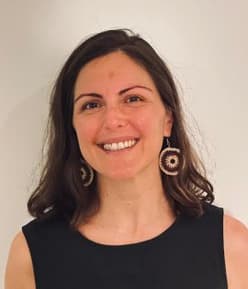
Dr Nicole Sleeman is a GP in Gimuy (Cairns), FNQ