It takes courage to host an ABC live broadcast – like the Afternoon Show. I should know, I’ve done it, albeit briefly. Unlike the late James Valentine, AM, who hosted Sydney’s 702 Afternoon Show for an astonishing 25 years – and had the audience hanging on to his every word, and frequently joining in. Former BBC journalist and host of the ABC’s Saturday Extra, Nick Bryant, called James a genius.
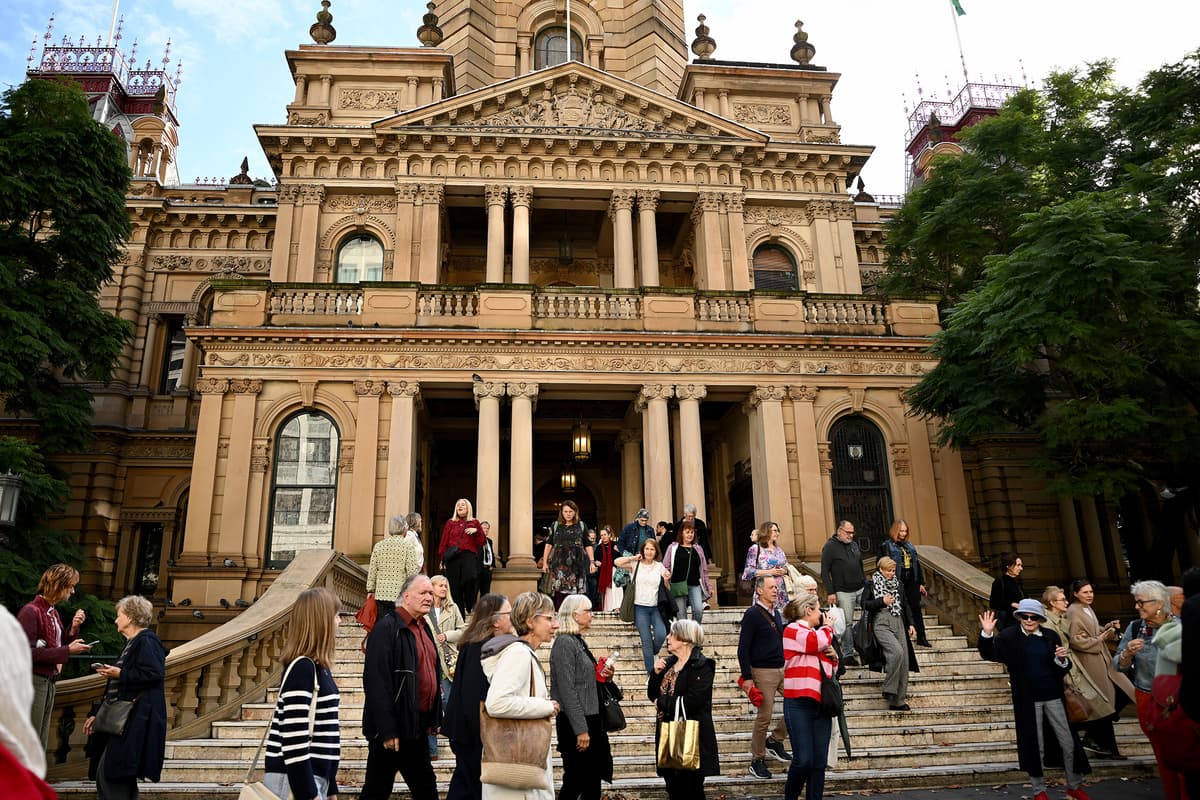
It also takes courage to use Voluntary Assisted Dying, which James did so openly, just a few weeks ago, two years after a cancer diagnosis. That people loved him was shown by his Memorial in Sydney Town Hall last Friday – it was packed. I went out of respect and admiration.
As the ABC wrote:
‘For someone who revelled in finding joy in the ordinary and bringing humanity to radio, one of Valentine’s final wishes was to make it publicly known his choice to access NSW’s VAD laws.
In doing so, Valentine and his family further broke down the taboos associated with the subject, said colleague and friend Andrew Denton.
“To talk openly about voluntary assistance dying, it takes a bit more of the stigma away,” he told 702 ABC Sydney.
The love, humour and warmth in Sydney’s town hall was palpable. Around 2000 people packed the place, at least half of them had never met him, but had listened to him for years. Jimmy and Mahalia Barnes, Paul Kelly and Kate Ceberano all sang. Margaret Throsby talked of the overwhelming tide of love and sadness pouring into the ABC, and the Governor General, Sam Mostyn, said she had awarded him an Order of Australia just days earlier.
As his son Roy Valentine said,
‘Something shifted when Dad died. How openly people grieved, how much we talked about voluntary assisted dying. If the conversation shifted even slightly to a more open and broader place, that’s all Dad was aiming to do.’
That James and so many others have that choice is in no small part due to the consistent polling by the Australia Institute, since 2011, and its support for Voluntary Assisted Dying, which demonstrated Australia’s support for it to all those who campaigned for it, like Andrew Denton.
For example, in 2011, a survey of 1,294 was conducted by the Australia Institute, where Australians were asked:
‘In your view, should terminally ill patients also have the option of choosing the time when they die?’
83% said yes.
When asked
‘If someone with a terminal illness who is experiencing unrelievable suffering asks to die, should a doctor be allowed to assist them to die?’
75% said yes.
The figures were consistent when measured against voting intentions, sex and religion.
And they stayed that way throughout the following years of regular polling.
Politicians were reluctant to pass the laws in spite of the public support, but gradually the tide turned. By April 2021, it was legal in one state, Victoria, and the rest of Australia was to follow – with two exceptions. Neither the ACT nor the Northern Territory had legalised VAD, because the Commonwealth law forbidding it in the Territories was still in place.
After the Federal election in 2022, Australia Institute Deputy Director Ebony Bennett commented:
‘It is a quarter of a century since Kevin Andrew’s bill made Territorians second-class citizens. Since then, all states have passed voluntary assisted dying laws, but the territories cannot even debate them. Dying with dignity is a powerful idea, championed by the Northern Territory in world-first legislation 25 years ago, just as marriage equality was a powerful idea championed by the ACT. Both were overturned by the federal Coalition government.’
However, although VAD is now legal in the ACT, access is still not equitable. The Australia Institute raised the issue in our submission to the ACT government in 2023 on the passing of the ACT’s VAD bill,
‘In a trend accelerated by the COVID-19 pandemic, an increasing number of people now access medical services via telephone or internet (telehealth). However, the Commonwealth Criminal Code Amendment (Suicide Related Material Offences) Act 200516 makes it a crime to use a ‘carriage service’ to discuss suicide-related material, this effectively makes it illegal to discuss VAD via telehealth.
Given that VAD is available in every jurisdiction in Australia except the Northern Territory, state and territory governments should urge the Commonwealth government to remove the provisions in the Commonwealth Criminal Code Amendment (Suicide Related Material Offences) Act 200519 that prevent Australians from accessing VAD via telehealth. This is likely to be of great benefit not only to the very ill, but to Australians in remote and regional areas.’
James Valentine’s Memorial wrapped up with a New Orleans Jazz tradition, the Raise the Roof Band playing When the Saints Come Marching in with James’ saxophone carried in the lead. It’s time for more courage.
Marilyn Chalkley’s best job was broadcasting for the ABC, her most important working for an Australian Deputy Prime Minister, as media adviser, and the hardest running a patisserie and making macarons for 12 hours a day. She now writes part time for the Australia Institute documenting its history.