It’s not surprising the Christopher Nolan of all directors would be the one to tackle the Odyssey. He seems particularly fit for the literature of dead white males and the grand narrative of great men.
This of course appears a criticism, but I say it as one who rates Nolan as among the very best of current film directors, and who has seen every film he has made in the cinema since being told by a friend 26 years ago I absolutely had to go see Memento.
But Nolans’ films are decidedly bloke-heavy. They don’t really come within sight of passing the Bechdel test, not so much because two women characters never talk to each other about something other than men, but they scarcely feature two women characters talking to each other at all.
As such the Odyssey might seem rather perfect for Nolan given the first view we have of Odysseus’s wife Penelope in Homer’s epic is of her son Telemachus telling her off and telling her to go to her room and “stick to the loom” because “It is for men to talk”.
But pointedly Nolan has taken as his translation of his adaptation that of Emily Wilson – the first woman to translate the work into English. Her translation brings a very different tone to others – one which I found much more vibrant and deeper.
Consider the opening lines as translated by Robert Fagles:
Sing to me of the man, Muse, the man of twists and turns
driven time and again off course, once he had plundered
the hallowed heights of Troy.
Many cities of men he saw and learned their minds,
many pains he suffered, heartsick on the open sea,
fighting to save his life and bring his comrades home.
But he could not save them from disaster, hard as he strove –
the recklessness of their own ways destroyed them all,
Here Odysseus is very much the active – he does “twists and turns” he very masculinely “plundered” and he was the one who was “fighting” to bring his comrades home, but it was the fault of their “recklessness” that “destroyed them”.
This is a bloke’s epic.
By contrast Wilson has a much different opening:
Tell me about a complicated man.
Muse, tell me how he wandered and was lost
when he had wrecked the holy town of Troy,
and where he went and who he met, the pain
he suffered on the sea, and how he worked
to save his life and bring his men back home.
He failed, and for their own mistakes, they died.
Odysseus is now “complicated”, he “wrecked” Troy and he “worked” rather than fought to save his men. And crucially, “he failed” and “they died”.
Such a translation gives Nolan an opening into the narrative that is common among all his major protagonists – whether it be Hugh Jackman’s magician in The Prestige, Christian Bale’s Dark Knight, DiCaprio and McConaughey in Inception and Interstellar and of course Robert Oppenheimer – of the conflict, doubt and the guilt of their actions, in short: the complicated man.
The narrative is one of those that most of us know something about even if we’ve never read it.
It concerns Odysseus, king of Ithica, trying to get back home after the decade away fighting the Trojan War. Because he angers the gods (mostly Poseidon) the journey is rather longer than anticipated and involves many adventures and trials. Meanwhile back home his wife Penelope and son Telemachus (who was born just before Odysseus left for Troy) are having to deal with a large group of men who believe Odysseus is now dead and so want Penelope to choose one to become her new husband and king.
It is a story that contains traps for any adaptation. A tale involving gods and nymphs, a cyclops, men turned into pigs, a journey to Hades, plus battles in Troy with a wooden horse could quickly become either a campy-fest filled with unintentional comedy of weird looking creatures and old men swanning around in togas on Mt Olympus or a bluescreen marathon of various CGI figures talking to each other with all the soul of an interaction with a chatbot.
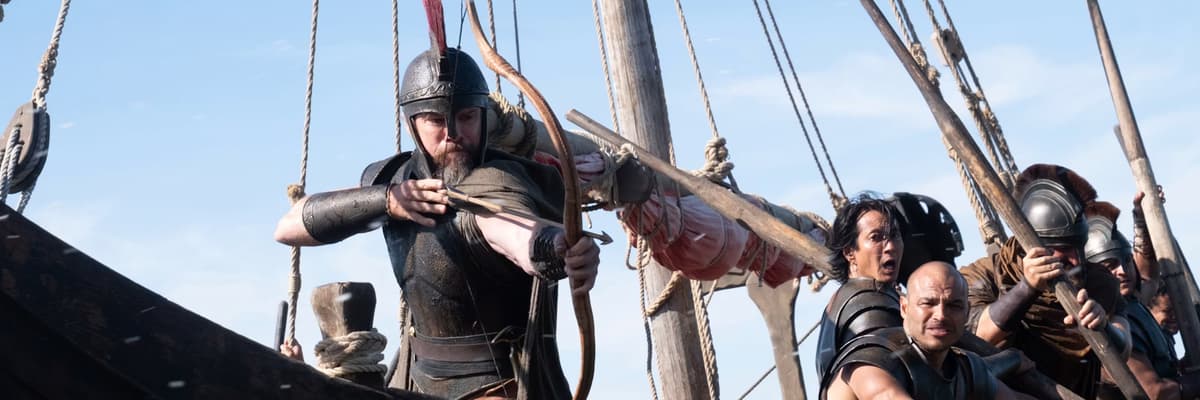
Nolan avoids both. The film is very much of an ancient Greece closer in spirit to earthiness of Game of Thrones than the pretty men of Wolfgang Peterson’s Troy. Nolan mixes the goddesses and warriors and the fantastical and the human seamlessly – never feeling like we have jumped into a different movie. Indeed, the scene of Circe (Samantha Morton) turning Odysseus’s men into pigs is one of the most brutally intense in the three hours.
Yep, three hours. That run time is a key. Nolan’s films always play with time, and so too does Homer’s Odyssey. Often Odysseus, played with a gravitas and full complications by Matt Damon, asks the nymph Calypso (Charlize Theron) how long he has been with her, how long has he been away.
And while he talks to her seeking to remember his journey, we are plunged into flashbacks of he and his men encountering Cyclops and Laestrygonians and others that are interrupted with the narrative set in mostly present time of Telemachus (Tom Holland) and his wife Penelope (Anne Hathaway) on Ithica waiting, hoping for his return as they deal with her many suitors – chief of whom is Antonius (a marvellous Robert Pattinson).
The time is crucial, because for the Odyssey to work it has to feel like the journey has been a struggle. And at one point – perhaps this was around hour two – as the crew, with Himesh Patel an excellent second in command as Eurylochus, despaired yet again at what the gods and Odysseus had done to them, I also thought to myself that they (and we) were never going to get to the end.
I also wondered around this time, as Odysseus finally seemed about ready to leave Calypso, where has been for 7 years eating lotus flowers and forgetting (a departure from Homer where the lotus flowers are on a different island earlier in the story) whether the film warranted not just its run time, but the budget, the cast, the IMAX cameras, the hype.
Because while it looked great (and please see it on the biggest screen you can, so as to take in not just the stunning cinematography but the full seat rattling sounds of Ludwig Göransson’s score) is it not just a bit of a silly story that doesn’t really matter?
And then in the last act the stakes are ramped up. To say they are ramped up to 11 sounds too small – this is Nolan, a man who made a film about the making of the atomic bomb and had people wondering if he was actually going to set off such a device just to make sure the scale was properly captured.
The scenes of the Trojan Horse and the pillage of Troy convey a sense that this was the obvious film to make after Oppenheimer – a film which pointedly did not show the destruction of either Hiroshima or Nagasaki. Nolan seems to be saying, “Oh you want to see the hell of war? Fine, let me show you”.
But the Odyssey is also a tale of a man wanting to get back home, and of his wife and son desperate for his return and for me this perhaps hit the most. Hathaway is brilliant in her role. At turns subtle and then able to reach for the high points that convey the pain she feels as she waits. She will definitely be having an Oscar run (as will just about everyone involved in every category)
Holland is a perfect Telemachus – innocent, eager, weak, determined.
Important too are the many supporting roles – John Leguizamo steals every scene as Eumaeus, Odysseus’ most loyal servant; Elliot Page is a tragic Sinos and Zendaya is the goddess Athena and well, it does not take much to believe that she actually is. Lupita Nyong’o as Helen of Troy and her twin sister Clytemnestra does not have much to do, but does it well.
But it all stands on the shoulders of Damon. A man playing his age of 55 and yet retaining some of the Jason Bourne physicality. He drops the sneaky charm of The Martian, this return home is a much weightier affair. Homer’s Odysseus might not really have been much about guilt, but Damon very much treats his king of Ithica as a complicated man – hubris and sorrow and anger and calm.
Nolan does not keep true to the text throughout – he omits things, throws in some lines from Christopher Marlowe, and has Odysseus utter words from Aesop and Virgil.
And the ending, while obviously involving all of the famous bloodbath of Odysseus returning to deal with the suitors, is less Homer and more Tennyson. Nolan appears to look to the line from Ulysses of an aged Odysseus who says
for my purpose holds
To sail beyond the sunset, and the baths
Of all the western stars, until I die.
It’s a massive film. See it.