It was never a question of if, but when. The world’s most devastating avian influenza has now hit Australian shores.
Given its ability to travel long distances fast, if the virus is not already in other states like Victoria and South Australia, it could be so in under 48 hours.
The H5N1 flu strain poses an existential threat to Australian agriculture and wildlife – many species already classed as threatened.
Governments need to act quickly to reduce the risks of H5N1 to agriculture and the environment.
One of those risks is Victoria and South Australia’s “recreational” shooting of native quail.
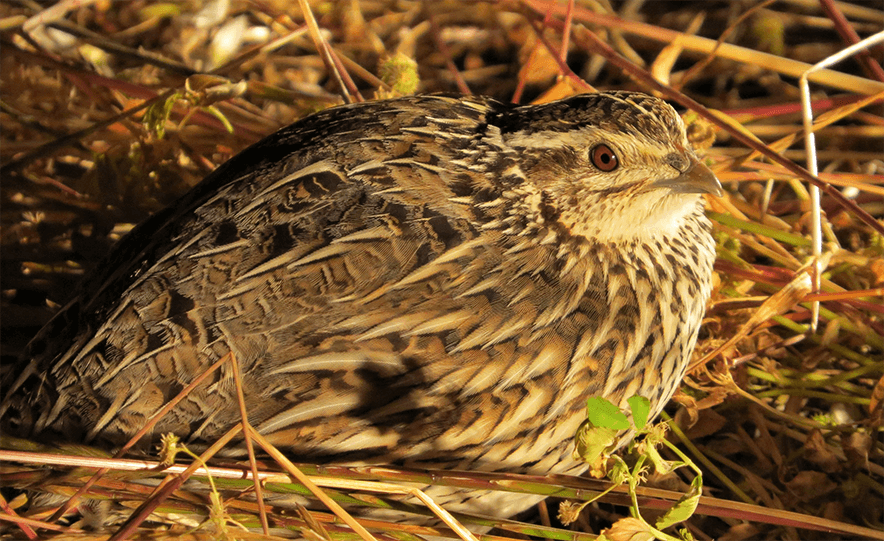
Stubble quail are a small, ground dwelling bird. Their striped feathers help them blend into undergrowth across various habitats.
For a quarter of each year, hunters can flush them out with dogs and shoot them with shotguns, up to 20 birds per day per hunter.
Several Australian quail species are already threatened, and there are growing concerns for the stubble quail. Government population estimates rely on controversial modelling that extrapolates counts of a few hundred birds into estimates of millions.
Around Victoria, residents are reporting that quail are becoming more scarce. Despite this, nearly 200,000 quail are bagged by hunters in Victoria each year, with tens of thousands more injured and left to die.
Worse still, hunters, their vehicles and dogs, can be inadvertent vectors in the spread of bird flu, to which quail are particularly susceptible. Like chickens and turkeys, quail lack genetic resistance to the virus. Quail suffer extreme & rapid mortality rates, with a flock mortality rate of up to 100%, often dying within 24 to 48 hours.
For reasons of biosecurity containment, ecological preservation, and human health monitoring, governments must act quickly. Recreational quail hunting should be suspended immediately.
The Victorian Minister for Environment, Enver Erdogan, has the power to do this under the state’s Wildlife Act, as does Agriculture Minister Michaela Settle under the Biosecurity Act 2019.
The Victorian Government has previously acted on less severe H7 bird flu strains, when Agriculture Victoria immediately banned all gamebird hunting (including ducks and Stubble Quail) within restricted zones. But because H5N1 is drastically more pathogenic, transmissible and environmentally consequential, such precautionary bans should proactively be extended state-wide.
The costs of halting quail hunting now would be negligible. The costs of not doing so, could be catastrophic.
This is a basic test of whether the government is capable or willing to take appropriate action to protect our wildlife and agricultural industries.
We cannot claim to take biosecurity seriously while simultaneously allowing recreational hunting of one the species most vulnerable to H5N1.
Waiting for dead birds to appear across Victoria is not a strategy. It’s a failure of leadership.
Kerrie Allen is spokesperson for conservation group Regional Victorians Opposed to Duck Shooting Inc (RVOTDS), an organisation committed to protecting waterbirds and waterways.