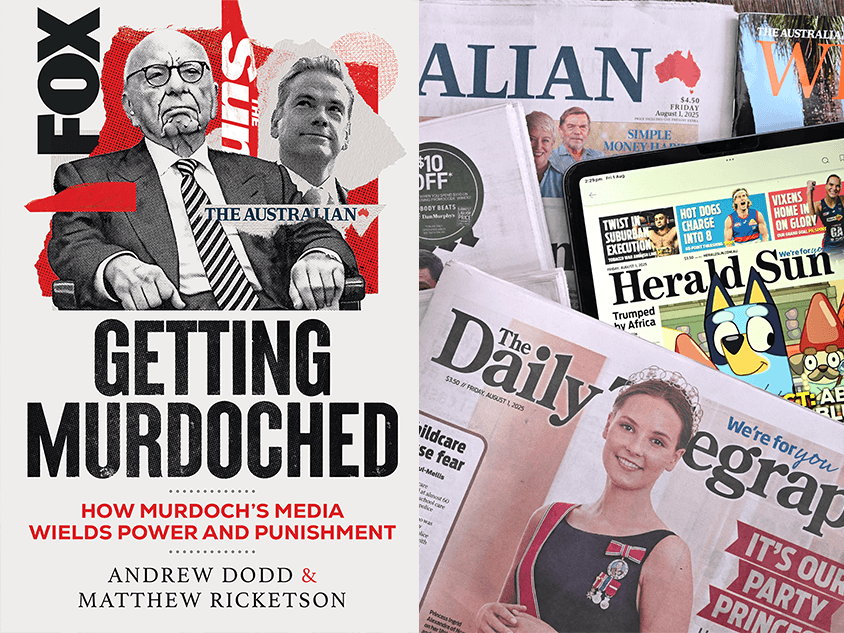
murdoched [mer-dokked] imaginary verb, past participle of murdoch. To be targeted or editorially attacked when one’s ideas or deeds do not accord with a media proprietor’s programs or publications. Murdoching hinders or harms those targeted and distorts and debases public discussion. It manifests in many forms, some of which resemble journalism. As in, ‘getting murdoched’.
David Nutt knows his name is irresistible to headline writers. His area of expertise is the effect of chemicals on the mind, so calling him ‘the Nutty Professor’ is, granted, a lot easier than using his full title of Professor of Neuropsychopharmacology – a word that’s probably never appeared in a newspaper headline. For a period, he was the chief drugs adviser to the British Labour government, so he understood that media interest was inevitable, particularly when he was advocating for more evidence‑based policies for drugs like cannabis. However, nothing prepared him for the phone call he received in November 2009 from a journalist at Rupert Murdoch’s Sun newspaper.
He remembers the reporter’s opening question: ‘What would you say if I told you we are going to do an exposé on
your children’s drugs and drinking habits tomorrow?’ He also remembers his shocked reply, which was along the lines of, ‘Well, I’d say you were a despicable piece of shit.’
He refused to speak to the reporter, pointing out that the question was completely unethical. ‘My kids have got nothing to do with my professional life.’
A fortnight earlier, in a public discussion about legalising drugs, Nutt had made the observation that a legal product – alcohol – was a serious social problem, more so than psychedelic drugs. It was a nuanced point but, as Nutt notes, the newspaper ‘doesn’t know how to spell nuance, let alone be nuanced’. The next day, the home secretary concluded Nutt’s messaging sent the wrong signal to young people and asked him to resign as the chairperson of the Advisory Council on the Misuse of Drugs.
On 14 November 2009, the day after the reporter’s phone call, The Sun published a full‑page spread with the predictably puerile headline ‘Off his Nutt’, accompanied by pictures from his son Steve’s Facebook page. In one Steve was smoking a roll-up, in another he was celebrating at a Christmas party. The article referred to Facebook photos of Nutt’s daughter, Lydia, that ‘show her and her girl pals cavorting with a bottle of spirits in hand – and were uploaded two years before she turned 18’. The article also outed oldest son Johnny because he had ‘posted photos of himself prancing NAKED in the snow in Sweden’.
Nutt complained to the Press Complaints Commission, but it was several weeks before it persuaded the newspaper to take down the pictures.
Nutt says that, of his three children, his daughter was the most upset. From Sweden, Nutt’s eldest son laughed off the coverage as pathetic. His younger son was angry enough to write a letter to The Sun, which they printed two months after publication. In the letter, Steve clarified that he had been ‘smoking a rolled-up cigarette which did not contain cannabis as the article
NEWSED AND ABUSED
insinuated’, his younger sister was not drinking underage, and his older brother was neither drunk nor under the influence of drugs; he was simply following the Swedish winter custom of a ‘sauna followed by a romp in the snow’. The letter finished: ‘Innocuous photographs were taken out of context in an attempt to discredit my father’s work.’
The family was the victim of a journalistic hit job. Nutt had already lost his platform as the government’s drugs adviser; this seemed to be more about punishing him for the progressive views he’d already expressed, suggesting that he must be some kind of hypocrite who lacked the credibility and moral authority to regulate how others behaved if he couldn’t control his own children. His children – unfairly exposed, misreported and held up to ridicule – were collateral damage. Almost none of the tenets of ethical journalism were observed.
In other words, they had been murdoched.
* * *
Discrediting someone by association is one form of murdoching. Contriving a case of hypocrisy is another. Murdoch’s News empire has perfected dozens of ways of ruining reputations and damaging public discourse, not by practising fearless reporting to serve the public’s interest but by abusing people, punching down and producing crap journalism. Just another day at the international bullying factory.
Lots of people get murdoched. As well as scientists, there are law reformers, academics, public broadcasters and advocates for media accountability. People who can be ‘othered’, such as members of the Muslim, Indigenous, LGBTIQA+ and refugee communities, are prime targets. Politicians who did what Murdoch didn’t want done copped abuse, along with those who didn’t do what he did want, or who once did what he wanted but
GETTING MURDOCHED
weren’t doing it any longer. News also enjoys picking on celebrities and royals, along with enemies of the company’s friends and friends of the company’s enemies. Critics get attacked, especially if they’re former employees, along with anyone News considers unpatriotic or who can be painted as progressive, whether they be ‘liberals’, the ‘loony’ or ‘radical’ left or, of course, ‘too woke’. Sometimes the targets are innocent bystanders, who happen to be in the wrong place at the wrong time. In many instances people wear several of these labels, making them even more likely to become targets in a game of bully bingo.
Some get murdoched with a single article or broadcast. But more commonly, they’re subjected to a sustained barrage that lasts days, weeks or in some cases years. The after‑effects range from bemusement to humiliation. Some endure depression or deep anxiety. Others lose their jobs or face family breakdown. In the worst cases, people contemplate or actually commit suicide.1 So, we’re talking about real harm here, not temporary embarrassment. It’s the kind of damage that News itself would write copious irate stories on if it were being perpetrated by anyone other than itself. But whenever a rival organisation outs the Murdoch media, the company ensures its sins are downplayed or buried.
In a way, everyone knows this is what Rupert Murdoch’s outlets have been doing for decades. But in another important way they don’t, because the Murdoch media rarely turn the spotlight on their own behaviour in the way they do on others.
This is an edited extract of Getting Murdoched by Andrew Dodd and Matthew Ricketson, published by Hardie Grant Books. Available in stores nationally from the 30th of June.