ALP supporters had much more cause for satisfaction with the Hawke government’s environmental record.
After taking office in March 1983 Hawke explained that the poor economy inherited by his government would preclude it from implementing all Labor’s campaign initiatives, but the commitment to prevent the flooding of the Franklin River remained sacrosanct. ‘The dam will not go ahead’, Hawke affirmed in an early post-election statement.
Negotiations with Tasmania’s obdurate Premier Gray proved fruitless, and the dispute was ultimately resolved by the High Court. Attorney-General Evans, keen to obtain evidence for the court case about the Gray government’s damaging construction work, authorised RAAF jets to take aerial photographs; when Gray vigorously protested, Hawke reprimanded Evans (unnecessarily, some Labor activists felt).
A High Court majority including Murphy narrowly upheld the World Heritage Properties Conservation Act. It had been the first bill introduced to parliament by the Hawke government. The constitutional basis of the majority decision had not been available during the Whitlam government’s equivalent controversy concerning Lake Pedder. But that ministry had paved the way for the Hawke government’s Franklin success by ratifying the World Heritage Convention, which had brought Australia’s areas of World Heritage significance (according to the High Court) within the ambit of the national government’s external affairs power.
Labor’s election victory in March 1990 owed much to Richardson’s adroit political skills as Environment minister. Before the mid-1980s he had not been renowned for dedication to particular policy issues, and his sudden emergence as a fervent conservationist was regarded cynically in some quarters. But his transformation was genuine, and mirrored the changed perspective of many enlightened Australians as environmental awareness spread rapidly during the 1980s.
The Hawke government’s faith in the virtues of market forces and its generally pragmatic approach reduced the differences between the ALP and anti-Labor, but the conservatives’ inadequate response to environmental concerns did provide Labor with an issue where it could distinguish itself sharply from its main opponents. This process accelerated after Richardson became Environment minister in July 1987.
As Hawke realised, by demonstrating environmental sensitivity his government would be adopting a populist and visionary approach simultaneously.
During the government’s third term several major cabinet decisions gave far more satisfaction to the conservationists than the economic rationalists. Uren, the valiant left-winger who had been a dedicated battler for the environment over two decades earlier, well before it became fashionable, felt distinctly uncomfortable with some aspects of the Hawke government’s performance, but he praised Richardson warmly: ‘He’s tough, he’s deeply committed and he’s in there fighting. When right-wingers like Richardson turn out to be great men, it gives you hope’.
Richardson relished his different image. Instead of ‘people looking as though I’m something they’ve just stepped on in a paddock [they are] coming up in an airport telling me what a hero I am’, he declared.
In September 1989 Richardson told an ALP branch meeting at Bungendore (ACT) that the next election would be held between March and May 1990, preferences would be critical in the ultimate outcome, independents would do well, Labor would probably record its lowest primary vote for some time, but he was nonetheless confident of an ALP victory.
All these predictions proved correct.
The success of Labor’s innovative appeal to conservationists late in the campaign — acknowledging that they might prefer to vote for ‘Green’ independents, but urging them to give their second preferences to ALP candidates — owed much to Richardson.
The emergence of the environment movement as a significant force in Australian politics was confirmed by a novel experiment in Tasmania.
At the 1989 state election the Gray government won 17 of the 35 Assembly seats (19 in 1986) to Labor’s 13 (14 in 1986), with the balance of power secured by five Green independents. Their success was due to the proportional representation system as well as the attractiveness of the environmental cause — Tasmania had experienced more than its share of the depredations of voracious development.
One of the Greens claimed that their arrival paralleled the ALP’s birth, and the Greens did pursue an approach similar to Labor’s early ‘support in return for concessions’ phase. The Gray government was doomed when the ALP and the Greens negotiated an alliance. This was not a coalition along traditional Australian lines — no Greens were in the ministry. Under the agreement the Greens were granted an inside role in the process of government while maintaining their independent status. The new Labor Premier was 41-year-old Michael Field, an amiable Arts graduate and schoolteacher whose outrage at the Whitlam government’s dismissal had propelled him into parliament in 1976.
The progress of the ALP–Greens experiment was keenly followed. Not only Australians were interested — Green activists in Europe closely monitored developments in Tasmania.
Government under the alliance began auspiciously when a consultative process involving the government, unions, conservationists and the forestry industry culminated in the Salamanca agreement, which increased both the logs available for the timber industry and the areas of Tasmanian forest with World Heritage status.
After years of so much confrontation, especially in Tasmania, arising from the frequently conflicting needs of environmental protection, resource generation and employment, Salamanca was hailed as the harbinger of a new era when all interested groups would resolve their differences harmoniously and work towards their mutual objective, sustainable development. But a year later the optimism had vanished.
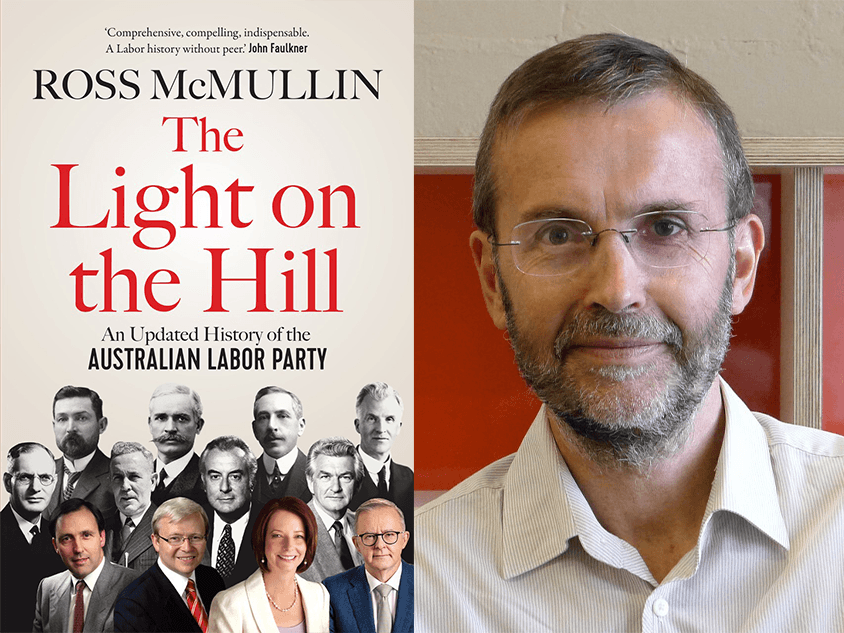
This is an edited extract from the updated edition of The Light on the Hill: An Updated History of the Australian Labor Party by Ross McMullin (Scribe), out from 30 June.