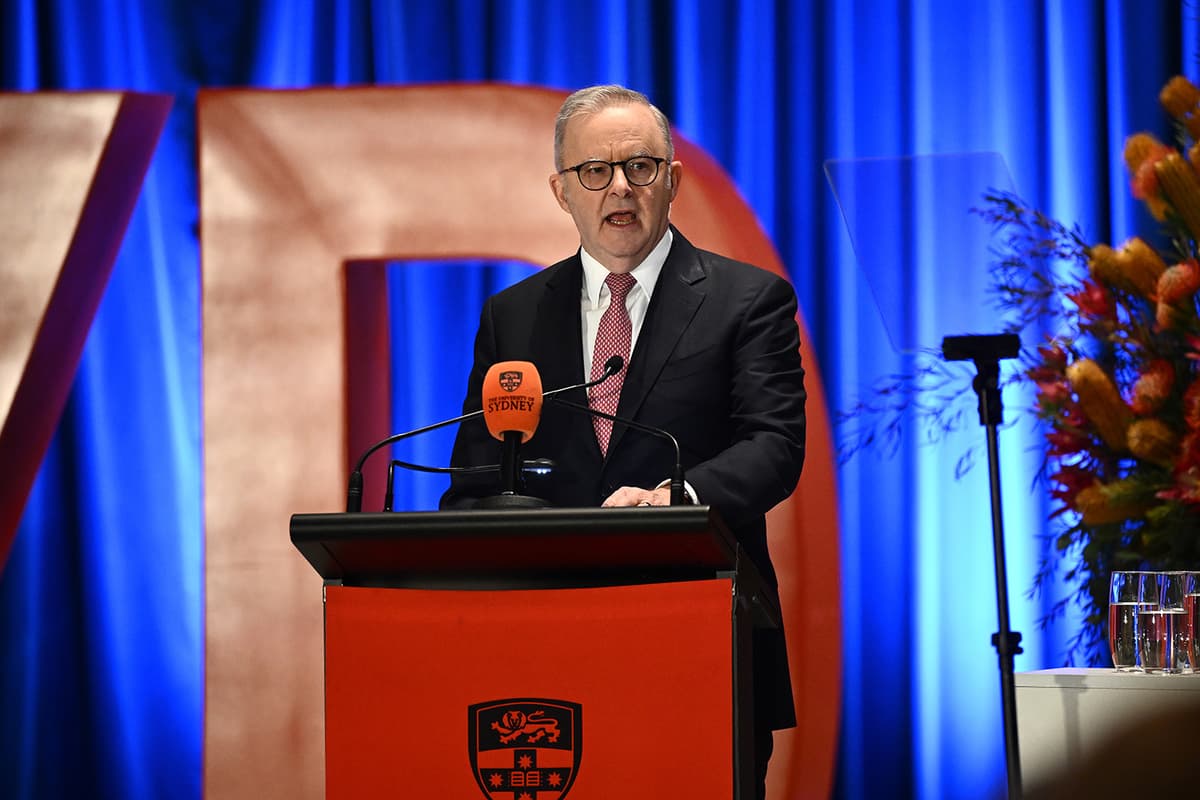
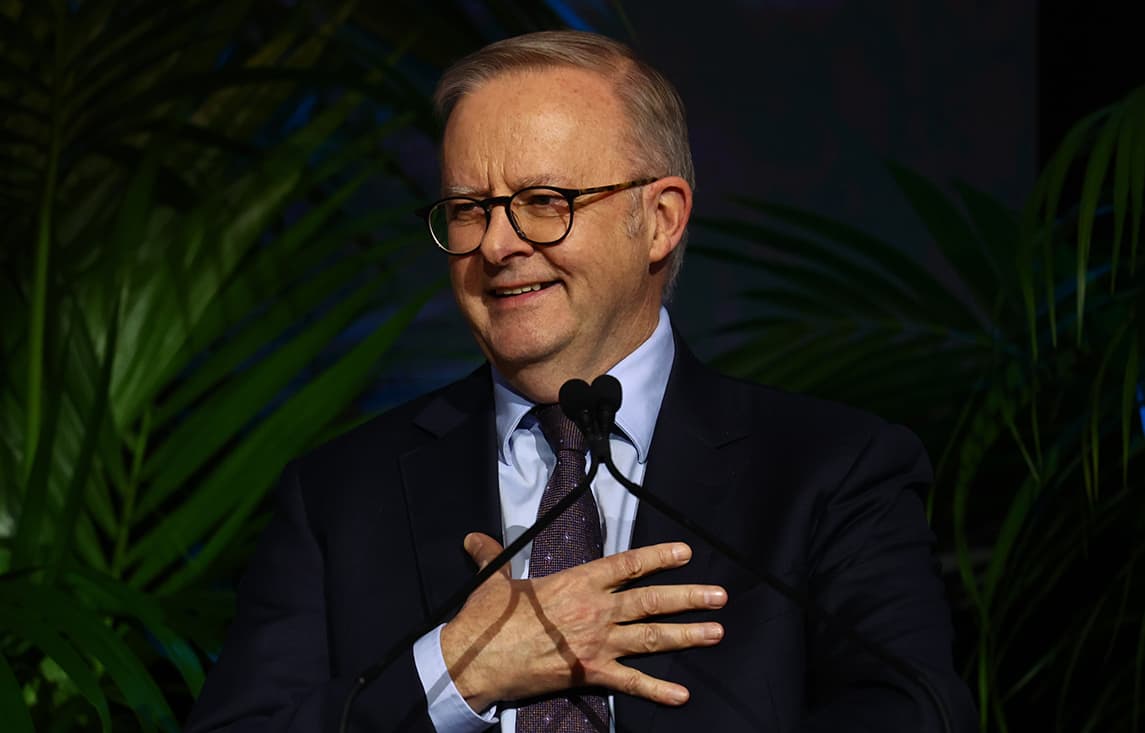
On Wednesday Anthony Albanese sent a clear message to AI developers: we see what you’re doing, we know the value of our assets, and we’re not giving them away.
“Consider what international investors look for”, he challenged them, “and then think about what we have”, listing high-quality universities and research, workforce diversity, low unemployment, financial and systems integrity, as well as sunlight, open space, natural resources, rare earth minerals and affordable renewable energy. Characterising a competitive market in which “the world is queuing up to invest in Australia”, he also touted our “advantage of geography” including proximity to “the fastest growing region of the world in human history” in South Asia.
“And – underpinning it all”, the PM emphasised, is Australia’s “stable democracy”. Albanese was deliberate in presenting this stability in its full historic context, trumpeting a catalogue of world-first civic achievements including the minimum wage, the eight-hour day, the secret ballot, free and fair elections, and women’s right to vote and stand for election. For companies often described as being bigger than governments, the prime minister underscored that, no matter how big your bank balance, political stability is becoming quite the rare earth resource of its own.
So will Australia capitalise on these advantages? Or will all our world-leading civic achievements remain in the past?
Anticipating this speech, the arts and media industry mobilised fast to ensure there’d be no weakening of the copyright protections that are crucial to Australia’s civic and cultural strengths.
On this point, Albanese was strong and clear: “No company should use Australian books, music, art or news to build or train AI without the artist’s control… That includes the artist’s control of the price and value of their work. Anything less, is theft.”
This, however, is precisely the scenario that’s long faced rights holders. Theft has already taken place. It’s on the record. It’s at global industrial scale. And it’s boasted with impunity. Theft is the basis of those bigger-than-governments billions.
Referring to data centres, the prime minister said: “We cannot revisit this issue after companies have built whatever they want, wherever they want, and try and then re-open negotiations.”
But AI developers have already built whatever they wanted wherever they wanted, by accessing whatever they wanted however they wanted. They refuse to pay for what they’ve stolen, they refuse to change their business models, and rather than entering into negotiations within Australia’s clear copyright laws and licensing frameworks, they persist instead on reframing the issue as one of complexity and confusion.
The time to revisit this issue is yesterday; the time for action is now. Our culture and our democracy are at stake.
That the prime minister recognises this as nation-building work is explicit in his speech. In aligning AI action with more recent civic innovations such as Medicare, superannuation and the social media ban, Albanese highlighted the consequences for our identity and data sovereignty as well as for the economy.
The scope of the new Office for AI is substantial: it will create and legislate Australian standards on “mandatory requirements for large AI data centres, including… energy and water, with strong copyright protections for Australian creators.” Bringing together the work of multiple ministries, it will “ensure that investment in AI benefits the Australian people, is aligned with our values, and advances our national interests.”
This, of course, is the realm of cultural policy – and just in time, too, given Australia’s first ever national cultural policy to survive into a next term of government is currently under review.
The AI challenge to Australian culture and democracy requires ambitious policy convergence with cultural policy at its focal point. With the Office for AI, we now have a key tenet of cultural policy elevated to the office of the prime minister, affirming its centrality to policy-making in this area.
“Imagine the difference it would have made if these limits had been put in place when the world first grasped the risks of these platforms”, the prime minister remarked, referring this time to social media; it’s in the AI space that we can’t afford to have regrets.
Meanwhile, action is being taken all over the world to put those limits in place. To redress environmental damage, New York has recently become the first US state to ban new data centre developments. To redress emotional dependencies and promote “social stability”, China has just banned AI companions.
Knowing the value of our world-leading strengths – across education, research, workforce diversity, unemployment, financial and systems integrity, elections systems, natural resources and the environment – means regulating AI’s impact with ambitious scope.
This means requiring AI developers to respect Indigenous Cultural and Intellectual Property, compensate rights owners for past theft, license all intellectual property use by securing consent and paying for the work, and ensure opt-out provisions for rights exploitation are not the default – for starters.
A cultural policy approach should also take in psephology, elections systems and political communications – because the impacts of AI on Australian democracy are already here, and imagining that our “stable democracy” is not at risk from unregulated AI is unrealistic. It’s time for Australia’s democratic intelligence to confront artificial intelligence with responsible policy and ambitious vision.
In the prime minister’s prophetic words: “This is about Australia shaping the future, rather than letting the future shape us.”
Esther Anatolitis is a writer, creative strategist and national arts leader with more than two decades’ experience shaping Australia’s cultural and public policy landscape.