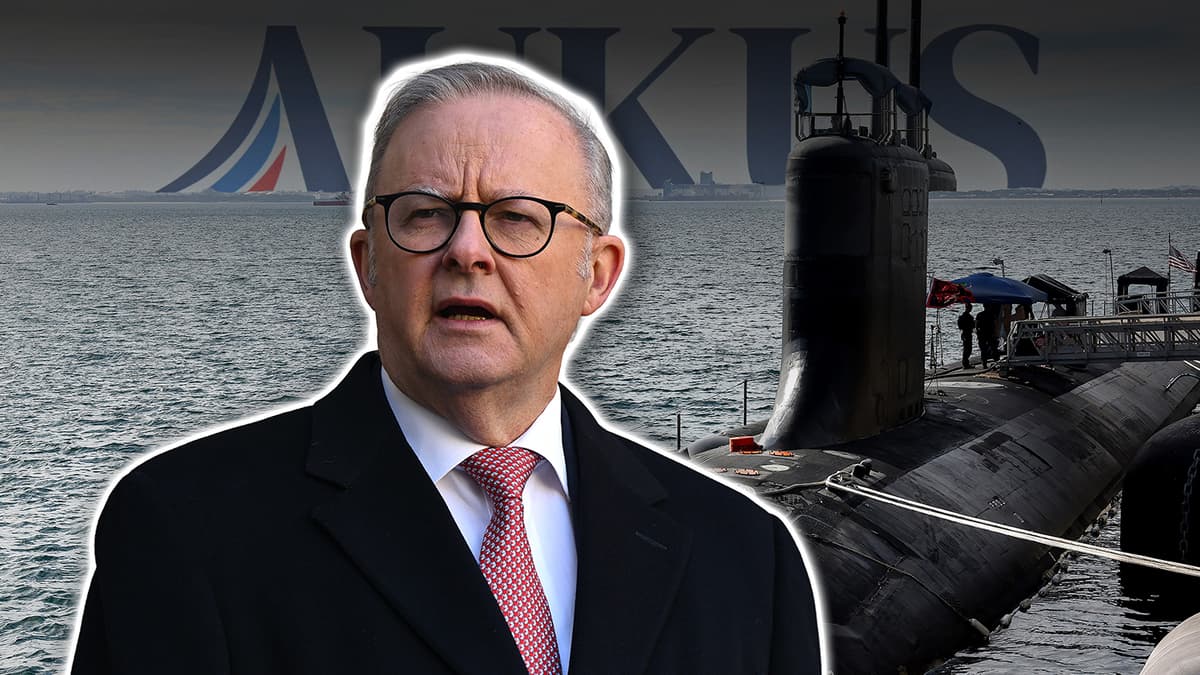
When Prime Minister Scott Morrison decided to replace the French Barracuda Attack-class program with nuclear-powered attack submarines (SSNs), he directed his quest to Australia’s two senior Five Eyes partners. In doing so, he ignored the most obvious and least disruptive solution.
Switching to the French nuclear-powered Suffren, part way through the existing program with France, would have provided a sound transition to SSNs. Suffren was the reference design for the Attack-class with a similar platform size. As well as being more affordable than the bigger US and British submarines to be acquired under AUKUS Pillar One, Suffren is also better suited to Australia’s operational requirements. Unlike the AUKUS submarines, it does not rely on US technology and would provide the RAN with a sovereign strategic capability.
However, Morrison had no interest in acquiring a sovereign capability. His choice of submarines was driven by his desire to harden Australia’s strategic posture towards China and integrate Australia’s SSNs with the US fleet. Rather than admit that, however, he stated that French SSNs were ruled out because their need for periodic refuelling would require Australia to establish a nuclear industry. He claimed American or British submarines, which employed life-of-ship, sealed reactors, did not have this disadvantage.
Morrison’s statement was extremely misleading.
French submarines require refuelling every decade because they have the benefit of using low-enriched uranium (LEU) fuel. By contrast, British and US submarines can operate for 30 years without refuelling because they are the only ones still using fuel enriched to the weapons-grade level of 97 percent.
Australia already has a nuclear industry with a well-established capacity to manage LEU fuel throughout its life cycle. It has been operating reactors at suburban Lucas Heights since 1958. Its current LEU reactor, which produces medical isotopes, is refuelled on-site after each operating cycle. Spent fuel and waste are managed strictly according to international protocols.
With initial support from France, Australia would be capable of refuelling the Suffren, managing the spent fuel and ultimately disposing of the waste. On the other hand, were Australia to assume stewardship of the high-risk fissile material contained in US or UK submarines through its life cycle, it would face major, perhaps insuperable, challenges. These are related to proliferation, security and safety.
If Australia were granted an exemption from the Nuclear Non-Proliferation Treaty to use highly enriched uranium (HEU) for naval propulsion, we would be exploiting what is widely regarded as a loophole in the NPT. Australia would be the first signatory nation to do so and would establish a dangerous precedent. It could also compromise our ongoing advocacy for non-proliferation in the Indo-Pacific. By contrast, South Korea’s new SSN will use LEU fuel.
Secondly, transporting and storing the HEU fuel would also raise serious security concerns. A reactor core containing sufficient fuel to propel a submarine for 30 years could theoretically provide enough weapons-grade fissile material to produce up to 25 nuclear weapons. The cores, which exhibit no major handling issues before the reactor ‘goes critical’, would make an attractive target for malign State or non-State actors.
Between three and five reactors will eventually be required in Adelaide for installation in SSN AUKUS submarines. It would be unprecedented for material that is only ever transported for short distances within national borders in a heavily armed convoy to be shipped halfway round the world. Storing the reactor cores would then see the shipyard converted into a heavily armed military exclusion zone, while the workforce would require security clearances at the highest level.
Thirdly, there are also particular safety concerns with managing HEU fuel. Sealing the reactor for life is no panacea; indeed, it would exacerbate the problem in the event of a malfunction. Dismantling a sealed reactor is a protracted and hazardous task but it has been necessary on several occasions with the British PWR2, which powers the Vanguard- and Astute-classes of submarine. While the new PWR3 reactor that will equip SSN AUKUS has benefited from US design assistance, who with any degree of certainty could rule out the possibility of a future reactor malfunction?
If an RAN submarine lay in a dockyard with a damaged reactor, perhaps leaking radiation, it would be Australia’s sovereign responsibility to redress the situation. Further, under our treaty with the UK on AUKUS Pillar 1, Australia will be responsible for eventually defueling the submarine, dealing with the weapons-grade spent fuel and ultimately disposing of the high-level nuclear waste. Managing weapons-grade fissile material through its life cycle requires a level of industrial capability generally possessed only by countries with experience in nuclear weapons production and disposal. With superior submarines fuelled by LEU available, Australia should not seek to acquire this capability.
There are two significant impediments to Australia acquiring SSNs under AUKUS Pillar One.
First, the US Navy’s Director, Naval Nuclear Propulsion Program, will need to accredit Australia’s capacity to deliver the highest level of nuclear stewardship. It would be difficult for even a dispassionate observer to certify Australia’s ability to manage weapons-grade fissile material. The US Director is not a dispassionate observer. Since America’s sensitive nuclear submarine technologies were first shared with Britain nearly 70 years ago, the Director has seen off all other aspirants. America has never sold a complete SSN to another country. The US Navy is extremely keen to acquire a submarine base on Australia’s west coast, but it has no enthusiasm for selling SSNs to Australia.
Secondly, once these issues are better understood, it seems unlikely that the government will be granted a social licence to acquire submarines that use weapons-grade fuel. Indeed, a sustained campaign of opposition could not only damage the government’s electoral position but put an end to any prospect of Australia acquiring nuclear-powered submarines at all.
This would be unfortunate. There is a strong case on strategic and operational grounds for the RAN to acquire a force of SSNs. But we need to look at more appropriate platforms, powered by LEU fuel. Two options should be considered. The French Suffren is a capable, in-service submarine, but production of its reactor may soon cease. The other possibility is the South Korean SSN now being designed, with US approval, which could be well suited to Australia’s requirements.
There are strong arguments for the government to move quickly and cancel the AUKUS Pillar One submarines. An option better suited to Australia’s means and requirements is almost certainly available.
Michael Keating AC and Jon Stanford formerly worked together in the Department of Prime Minister and Cabinet, where Dr Keating was Secretary.