The construction crews are working overtime at Mulligans Flat Woodland Sanctuary in the Australian Capital Territory. Armed with federal emergency funding, workers are assembling 16 specialised isolation pens.
The goal is noble and urgent: to shield endangered eastern quolls from the catastrophic threat of the H5N1 high-pathogenicity avian influenza.
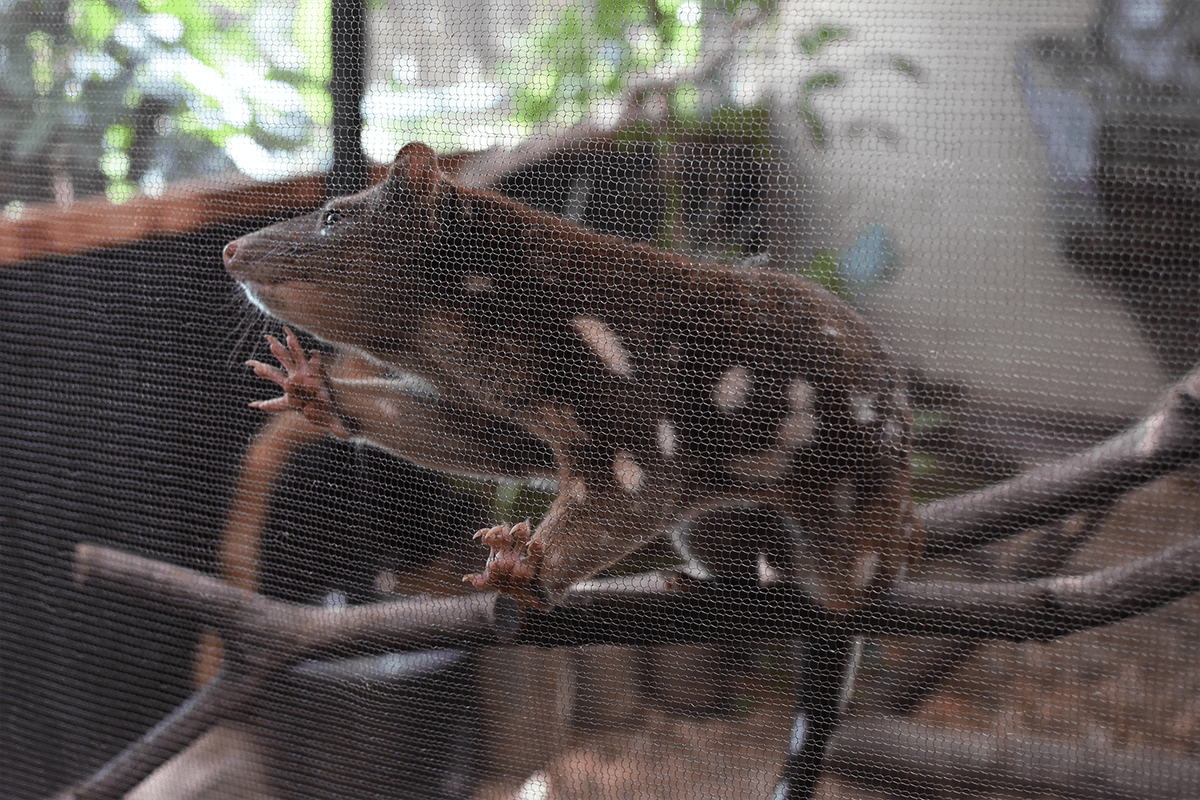
These carnivorous marsupials were wiped off mainland Australia more than six decades ago, then painstakingly brought back inside predator-proof sanctuaries. Yet their habits make them especially exposed. Quolls scavenge. Dead and dying birds are part of the menu, which means a bird flu outbreak is not a distant headline for them; it’s a direct threat.
Across the country, sanctuary managers’ instinctive response has been to harden the edges.
When a danger is airborne and hard to see, it feels rational to pull inward, isolate the site and defend your own patch of dirt. But that response can be dangerously comforting.
If we bet everything on a handful of isolated strongholds, we set ourselves up for the kind of collapse that happens all at once.
Real resilience requires a different shape of thinking: not ‘each sanctuary for itself’, but a connected system that spreads risk across the broadest possible geographic range.
In the bird flu era, survival depends on turning individual sanctuaries into an intentionally linked network that shares the job of keeping a species alive.
Right now, we are putting too many ecological eggs into too few baskets. Concentrate an endangered species in one location, and you create a single high-value target for a contagious virus.
Once the virus is introduced, dense captive populations can be brutally vulnerable. If one or two sanctuaries hold most of a species’ genetic future, a single breach could wipe out years of painstaking conservation work.
There is another problem underneath this risk, one Australia has tolerated for too long. Fox and cat control has too often been treated as a ‘nice to have’, rather than a central component of wildlife survival.
When feral predators dominate the landscape, they force native animals into islands, some literal, some fenced. Sanctuaries become fortresses not because managers love walls, but because outside the fence can be lethal. That reality limits conservation’s ability to scale up quickly beyond the fence. Eastern quolls show the stakes clearly.
The species survived only because fox-free Tasmania protected a remnant population. Over the past decade, many organisations have helped return quolls to fenced sites across Victoria, New South Wales and the ACT. But these mainland populations remain small and vulnerable.
If H5N1 enters a sanctuary population, the bottleneck tightens fast. Coordination across organisations and state and territory borders would make it possible to identify unused sanctuary sites, move cohorts of quolls into them, and manage those populations collectively. Coupled with funded, coordinated, long-term predator suppression outside the fences, the mathematics of extinction begins to change.
Sanctuaries have often operated as friendly competitors, each vying for donations, sponsorships, visitors and grants. Success has been tallied inside the fence line: how many animals are held, how polished the visitor centre looks, or how exclusive the breeding program appears on paper.
Bird flu makes that way of measuring achievement feel dated. The new standard cannot be ‘we protected our animals’. It has to be ‘the species stayed alive’, even if the credit is shared.
A national inter-sanctuary framework should now become the blueprint for biosecurity and genetic survival. Managing a species as a true meta-population means data sharing as a norm, not a favour. It means consistent quarantine protocols across facilities, and wildlife-transfer pathways that do not get choked by slow, duplicative bureaucracy when time matters.
Funding for new invasive species management tools is also urgently needed. Physical barriers can help in the short term, but they do not solve the larger, network-wide risk.
With highly pathogenic avian influenza now on the Australian continent, piecemeal action within our conservation system gives the virus openings to exploit.
If managers retreat behind individual fences while the predator crisis outside continues unchecked, Australia’s most vulnerable species remain exposed to single-point failure.
We can, however, do two things at the same time: strengthen the physical boundaries that protect wildlife, and dismantle the institutional boundaries that keep organisations apart.
It is the only shield we have that can realistically prevent extinction.
Rob Brewster is the Rewilding Manager for the Invasive Species Council, specialising in landscape-scale ecological restoration and the protection of native Australian wildlife from feral predators and emerging biosecurity threats.