Each year, the Dust Diseases Tribunal of New South Wales hears well over a thousand asbestos-related compensation cases.
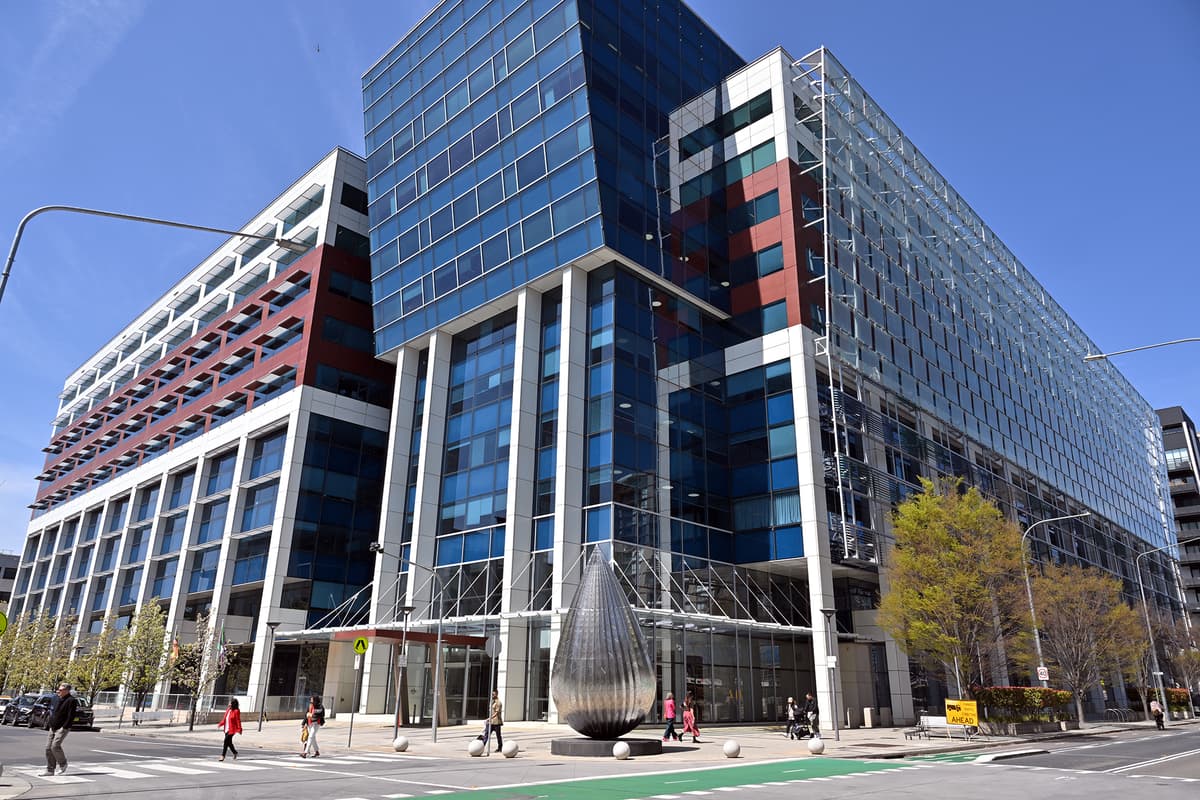
Located in John Maddison Tower on Sydney’s Goulburn Street, the court is small compared to others in the state: it has a president, three full-time judges, two acting judges, a registrar, and a few registry staff.
Between them, this small crew is responsible for administering common law compensation for the damage caused by asbestos, the largest industrial tragedy in Australia’s history.
Nearly all the cases in the Dust Diseases Tribunal involve James Hardie, the Australian asbestos firm that held a near-monopoly over the industry. Founded as a tannery firm in Melbourne in 1888, the firm switched gears in the 1910s it transferred its headquarters to Sydney and began to get interested in manufacturing asbestos products. From WWI to the 1980s, when Australians began to turn against asbestos due to its toxicity, James Hardie was one of the country’s largest companies.
Today, James Hardie is trying to rehabilitate its image from its new headquarters in Dublin and Chicago.
The Australian wings of the business – called Amaca and Amaba – primarily exist today to manage its finances in order to fund future compensation cases at the Dust Diseases Tribunal. They are often joined in these matters by Wunderlich, another Sydney-based asbestos firm, and the Colonial Sugar Refinery (CSR), which ran the mine at Wittenoom, Western Australia.
Surprisingly, they are not joined by the Commonwealth or state governments (especially the NSW and WA Governments).
The state pumped millions of dollars into the Australian asbestos mining and manufacturing industries between the 1940s and 1980s in order to subsidise the construction of cheap fibro housing in postwar suburbia. It also directed the industry’s production of asbestos products in service of the Commonwealth Government’s wartime and post-war goals.
The local asbestos industry would have died quickly without government subsidisation. In its thirty-years of business, Wittenoom, the largest asbestos mine in Australia, never once turned a profit. It existed entirely on payouts from the Commonwealth and WA Governments.
At least 2000 people have died due to their exposure from at Wittenoom.
Ask any solicitor who specialises in asbestos compensation, and they will tell you the Commonwealth and state governments should be joined as defendants alongside James Hardie, Wunderlich, and CSR.
But instead, the state has dodged its liability to those Australians killed or affected by asbestos, and the burden of compensation costs have been placed entirely upon asbestos firms.
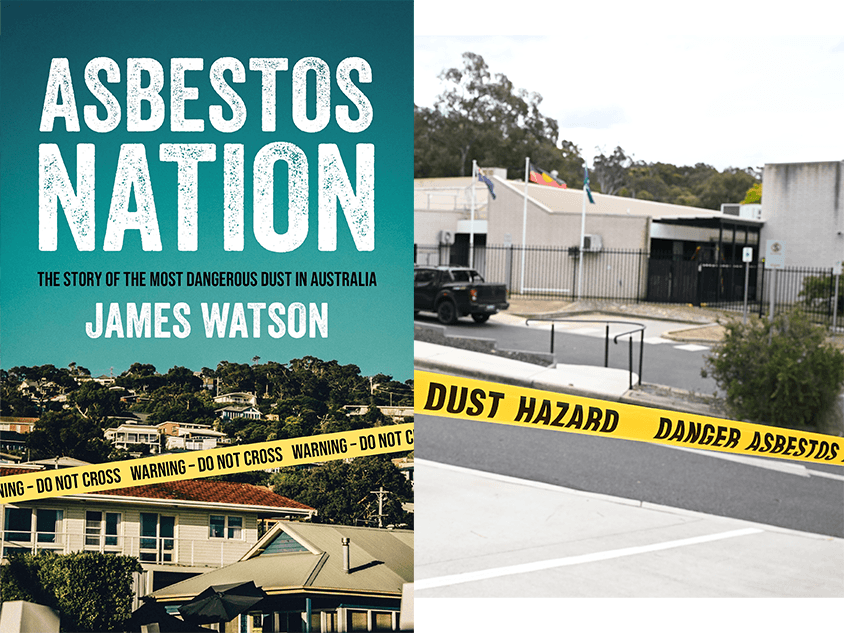
My book Asbestos Nation: The Story of the Most Dangerous Dust in Australia, published by Monash University Publishing, tells this previously untold story about the state’s involvement in the asbestos industry. It covers asbestos’ long history in Australia, from the mining in the colonial period, to asbestos’ role in the post-war suburban boom, to present-day asbestos scandals.
Below is an extract from the book that details how the state redirected the asbestos industry during World War II.
***
The origins of Australia’s asbestos boom lie in the war, which established the commercial and corporate relationships between asbestos manufacturers and the Commonwealth. Asbestos became a key wartime material across the world once governments realised that manufacturers could line their planes, ships, outfits, and shields with asbestos-fibre cement and, as a result, make them impervious to fire damage.
In December 1942, at the Green Hills Range in Liverpool in Sydney’s west, members of the Commonwealth’s Department of Home Security and the Department of the Army exploded asbestos cement sheet walls with TNT to see if the material provided an effective defence against enemy bombings. The final report found, disappointingly, that ‘the degree of this protection is slight’. Instead, asbestos was much more effective as a shield for the Royal Australian Air Force’s Beaufort bombers and for the Royal Australian Navy’s destroyers against fire outbreaks caused by enemy attack, or as a shield for firefighters trying put out fires caused by bombing raids, as it proved useful in Darwin in 1943.
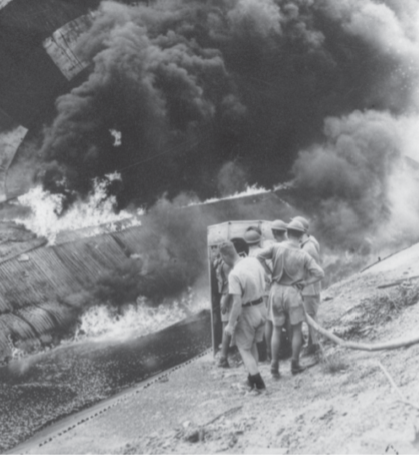
Photo: Navy personnel use an asbestos shield in their attempt to put out a fire caused by the 1943 air raid on Darwin.
Midway through the war, the Commonwealth took control of the manufacture, sale, and use of fibro, forming monopsony power. This control was one element of the Commonwealth’s wartime and reconstruction encroachment into private manufacturing through the newly created ministries of Munitions and Aircraft Production. In September 1943, the use and manufacture of fibro were ‘frozen’ – that is, placed under the control of the Department of Munitions under the National Security (General) Regulations Act 1939; and in April 1944 fibro sheets and pipes were placed under the control of an Essential Materials Order, transferring power to the Department of War Organisation of Industry.
Asbestos firms tried to keep up with the state’s demands by increasing productivity through capital investment and wage bonus schemes, such as Hardies’ 1942 bonus for workers who produced 2.5 times their expected output during the war. They also increased their productivity by rushing production lines: at Hardies’ Camellia factory, for example, workers often complained to the foreman that the camouflaged fibro sheets they were making were too poor quality to be sold, only to be told ‘put them in, they’re only for the soldiers’.
Across the board, wartime demand rapidly increased the manufacturing industry in Australia. Between 1939 and 1944, the labour force increased from roughly 615,400 to 834,100, output almost doubled, and more than 2000 new factories were built across the country. Most of the increase in manufacturing was driven by the state, with private capital investment (as a percentage of GDP) dropping from 4.5 per cent in 1938 to 2 per cent by 1942. Australians were encouraged to raise money for the cause through public campaigns for war loans – campaigns in which asbestos played its part.
On 14 March 1945, in the final months of the war, Chief Petty Officer H.P. Richens donned an asbestos suit outside the Commonwealth Bank in Martin Place, Sydney, and let himself be soaked in petrol and set alight in front of the lunchtime crowd. Thousands looked on as navy seamen with hoses then rushed in to extinguish the flame. A month later, on 16 April, a senior fireman walked down Angel Place laneway while engorged in flames, protected only by his asbestos suit. The stunts were in support of the third Victory Loan, and the sight of a man on fire became a regular event for Sydney’s bankers walking by to their next appointment. They were also demonstrations of asbestos’ effectiveness in protecting the lives of Australia’s military men and women.
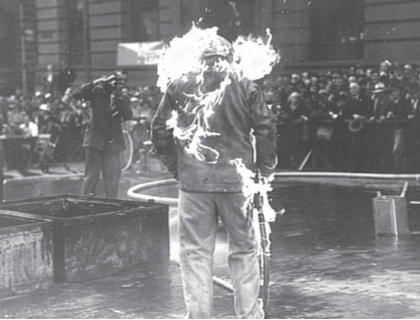
Chief Petty Officer Richens lets himself be set alight for the war cause, Martin Place, Sydney, 1945.
Wartime demands for asbestos raised the question of domestic supply. In 1940, the Department of the Interior oversaw another survey of asbestos deposits on the Australian continent, but this one was just as fruitless as the 1916 survey, despite some interest in a deposit at Tennant Creek in the Northern Territory. With no viable large-scale asbestos mines in the country, manufacturers had to turn to overseas imports to fulfill their demand, with the prime minister’s office coordinating with domestic manufacturers, foreign and domestic mines, state governments, and the heads of state in Canada, Rhodesia (today Zimbabwe), South Africa, India, the Netherlands, and Belgium to ensure Australian manufacturers had sufficient wartime supply. Overseas, the US and UK governments took similar controls to secure their asbestos stocks.
Australian firms, as a result, became dependent on asbestos imports during the war. Before 1939, asbestos importation was relatively minimal: only 9250 tons of raw asbestos were shipped into Australia in 1938 (5400 from Canada, 2100 from Rhodesia, and 1500 from South Africa). By 1941, James Hardie alone was ordering 10,000 tons of raw asbestos a year from Rhodesian producers alone, and telegramming the Department of Trade and Customs to coordinate the release of even more supply from the London firm Raw Asbestos Distributors ‘who controls practically whole Rhodesian output’. Understanding the importance of imports to the domestic asbestos manufacturing industry, the Commonwealth exempted asbestos fibre imports from tariffs through to the 1950s (a rarity in a country as protectionist as Australia).
Rhodesia supplied most of Australia’s asbestos fibre imports during the war, but afterwards Australian firms came to rely primarily on Canadian and South Africa producers for their supply. Not only were the mines in these countries larger than Australia’s, but the quality of their fibre was much higher than that found in Australia, and their cost much lower due to the location of their mines near railway lines and shipping hubs (as well as South African firms’ almost exclusive use of black and coloured labour under the country’s apartheid regime).
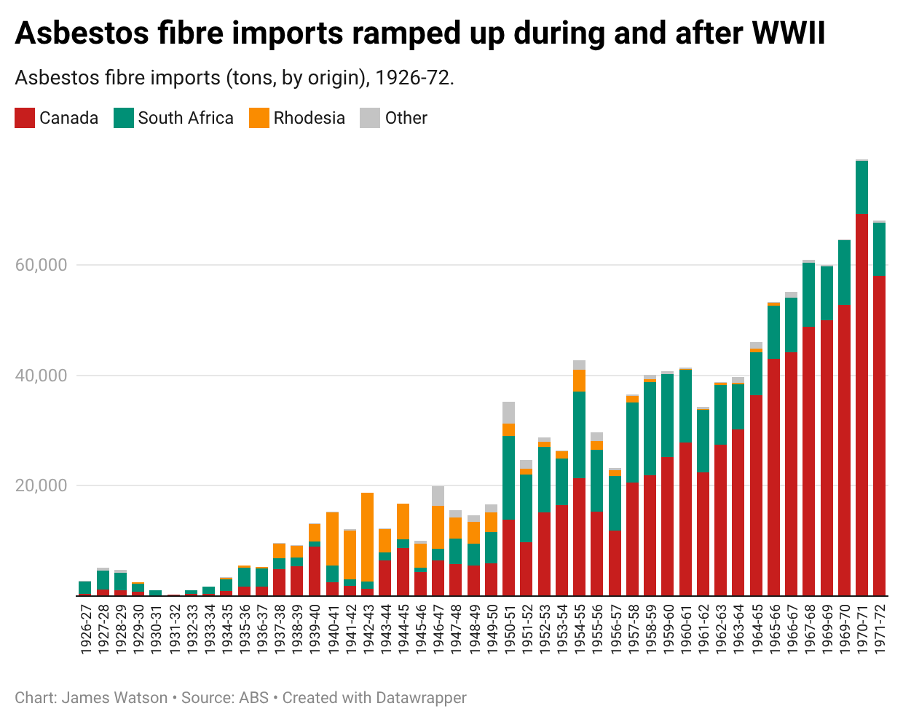
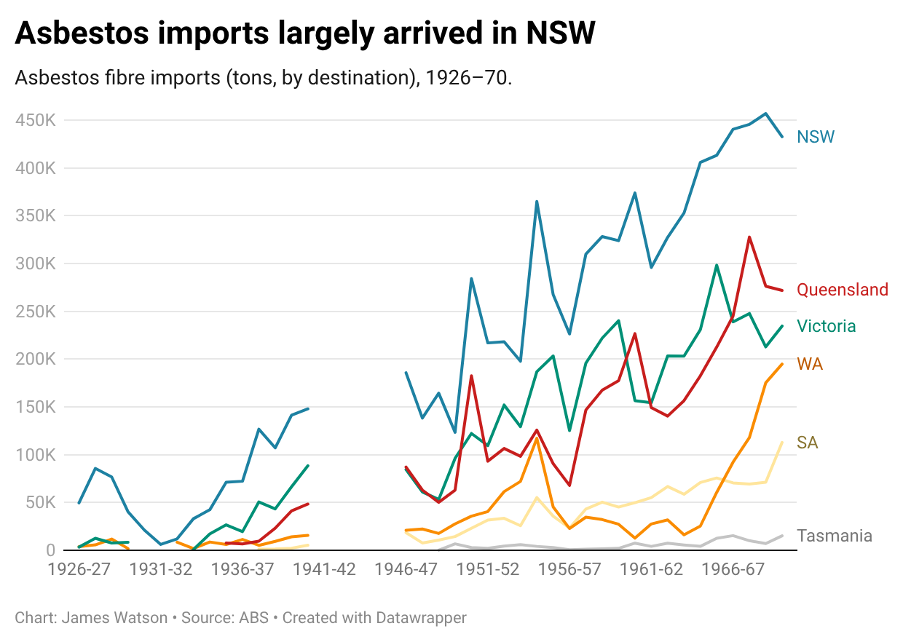
Most of these shipments arrived at Sydney’s Darling Harbour, where wharf workers would enter the ships’ hull and leave with hessian bags filled with asbestos fibre on their backs and load them onto the back of trucks to be driven to James Hardie’s fibro factories in Camellia, Wunderlich’s factory in Redfern, or CSR’s factory in Pyrmont. Behind Darling Harbour, Port Melbourne and Port of Brisbane followed as the second- and third-largest destinations of asbestos imports, though their numbers never quite got close to New South Wales’ astonishing consumption of asbestos throughout the rest of the century.
Imports were supplemented with domestic production, with mines at Woodsreef, Baryulgil, and Wittenoom in northern Western Australia revitalised through private investment and public subsidies. In the 1930s, asbestos mining had still not developed much from the small-scale and undercapitalised mining ventures of the colonial period. Asbestos mining in the Hamersley Range in the mid-1930s, for example, was by hand, with roughly 150 to 200 prospectors cracking open the land and then tearing apart the rocks to pull out asbestos fibres, their largest instruments of technology being their pickaxes for cutting and their donkeys to transport their hessian bags of asbestos.
WA Assistant State Mining Engineer J.S. Foxall half-jokingly described these solitary miners as ‘the great asbestos rush’, knowing no one was going to become rich from such informal operations. Serious capital investment seemed to be on its way when the mining magnate Lang Hancock signed the lease on acres of land at Wittenoom Gorge in 1938, but, as was the case with asbestos manufacturing, it would take a war and state intervention to kickstart asbestos mining in the Pilbara.
With the war creating a sudden, dramatic leap in global demand for asbestos fibre, the WA government saw an opportunity to subsidise the creation of an industry town in the north-west of their state. The historian Lenore Layman has described this policy as one part of the WA government’s ‘development ideology’ in the 1940s. In 1944, WA premier John Willcock advised Prime Minister John Curtin on the need to create ‘a permanent industry’ among the ‘vast and valuable Blue Asbestos deposits in this State’, and asked for the Commonwealth’s help in developing a domestic production industry that would sell to domestic and American manufacturers.
By this point, Hancock had already transferred his Wittenoom leases to CSR. Founded in 1855 as a sugar mill in Sydney, before expanding to cane sugar from Queensland and the Pacific, CSR entered the building material business in 1935, and it entered the asbestos business not long after that: in 1941, it began manufacturing asbestos-based sheeting; in 1942, it began asbestos mining near Zeehan, Tasmania; and in 1943, it purchased the Sydney-based Asbestos Products Pty Limited. That same year, the firm acquired Hancock’s Wittenoom leases through its Australian Blue Asbestos (ABA) Limited subsidiary, created in April 1943, which would manage the Wittenoom mine until its closure in 1966.
Willcock’s 1944 proposal caught the eye of John Dedman, minister of the Curtin government’s new Department of Post-War Reconstruction. Throughout the war and up until Labor’s removal from power in 1949, Dedman frequently kept memos on government surveys of the Wittenoom deposits and the use of asbestos as a building material. Just as asbestos had been a key material during the war, the Department had already identified it as essential for the construction of public housing after the war.
In July 1947, Prime Minister J.B. (Ben) Chifley wrote to WA premier Ross McLarty that the Commonwealth would subsidise CSR to develop an ‘indigenous supply of an important raw material’ that would be used for the ‘present housing shortage’. The Chifley Labor government also reduced sea freights on imported asbestos passing through the port at Fremantle by half, and committed to the construction of fuel depots, road infrastructure, water supply, a school, a hospital, and housing under the Commonwealth State Housing Agreement (CSHA) at Wittenoom.
On the other side of the country, the asbestos manufacturing industry was starting to resemble a cartel. James Hardie and Wunderlich had already entered an agreement to not cut prices of asbestos cement sheets by 1933, and were in the process of dividing up metropolitan and regional stockists in Victoria. State cooperation created a space for this cartel to flourish through technical development and economies of scale.
As founder Ernest Wunderlich lay on his deathbed, his firm was tripling asbestos cement production to fulfil the Commonwealth’s wartime demands, opening new asbestos cement plants in Rosehill, Sydney, and Birkenhead, Adelaide, the latter co-owned with James Hardie, all the while paying shareholders a 14 per cent dividend. The war had expanded Wunderlich from a Sydney-and Melbourne-based firm into a nationwide enterprise, employing 1800 workers across factories, tileries, refractories, metalworks, and mines in all states.
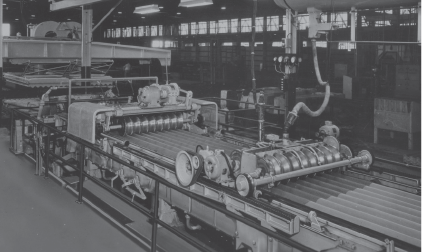
Wunderlich’s Durabestos factory in Redfern, Sydney, 1940s.
Asbestos firms took pride in manufacturing asbestos products for the war effort, though they were never fans of the John Curtin Labor government and its control over its wartime output. On 16 July 1943, Hardies co-director Jock Thyne Reid addressed his staff in Melbourne, saying that while the firm has ‘[a]s a matter of policy … determined ourselves to supply defence and essential services first’, he was concerned by the Curtin government’s ‘continuous attack’ on ‘private enterprise’, and he encouraged his staff to vote for the Country Party–United Australia coalition in the upcoming August 1943 federal election.
Nonetheless, once the war was over, they were happy to publicise their contribution to the cause: James Hardie and Wunderlich floats appeared in Victory Day parades, and the phrase ‘Hardibestos went to war’ featured in James Hardie newsletters as a celebration of the Hardibestos brake linings used in Beaufort bombers. ‘Suffice it is to say that the Beaufort did a grand job in the Pacific War’, went one article featured in the intra-company newsletter, Trimmings, ‘and, therefore, why should we not modestly claim some little credit for our efforts’.
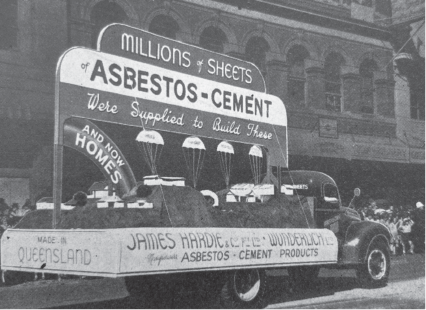
James Hardie and Wunderlich asbestos-cement float in Victory Day Procession, Brisbane, 1946. In the diorama, fibro used to construct wartime technology is repurposed for housing.
A company history published in the 1950s suggested James Hardie’s continuing business during the horrors of war in Europe was something heroic in itself. As the Germans blitzed London in 1940, three Hardie board members travelled from Sydney to Adelaide to establish a cement works. Though their travel could not be further from the carnage in London, the historian described their action as ‘typical … of their British faith that, even while German armies occupied almost all Europe and the very fate of England appeared in the balance, these three men went confidently about extending their Company’s activities’.
Reframing war profiteering as ‘performing one’s duty’ made for good advertising. But perhaps the excitement in these pages spoke of the firm’s knowledge that the war had set the groundwork for a behemoth of an asbestos industry to emerge and reshape the nation’s built environment in the postwar years. In his 1943 speech, Reid told his staff that ‘[t]here is a popular misconception that the end of the War will be a signal for an easing off of effort … I think we have ample authority to justify us in realising that this will by no means be the case’.
This is an edited extract of ‘Asbestos Nation: The Story of the Most Dangerous Dust in Australia’ by Dr James Watson, available now.
James Watson is a Postdoctoral Research Fellow at The Australia Institute. James Watson is a historian of nineteenth- and twentieth-century Australia. A graduate of the Australian National University’s School of History, he has written on the intersections of politics, economics, and social movements for The Guardian, History Australia, and Labour History.