

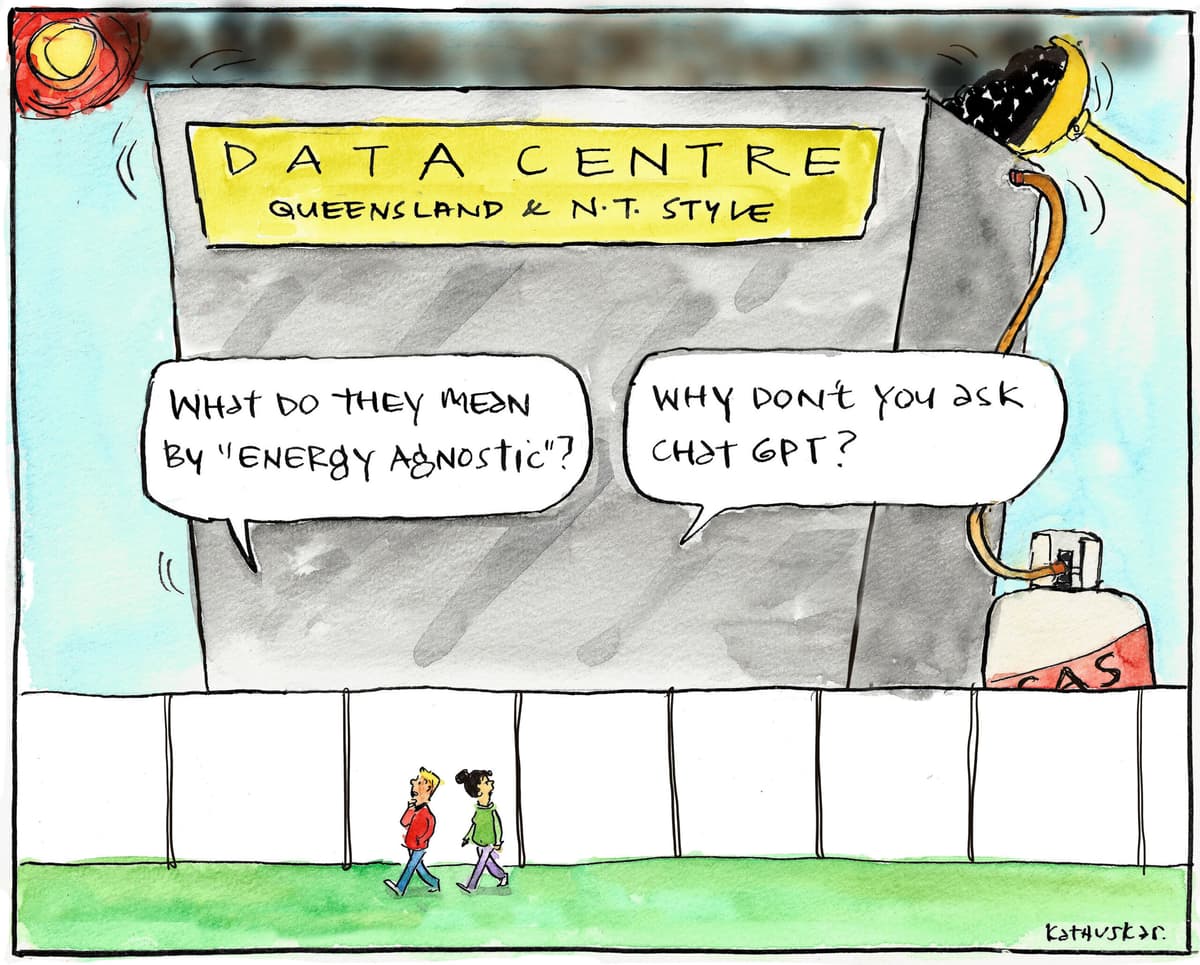
National Cabinet has just made its choice on how Australia's AI boom gets powered. The Albanese Government went into this week's meeting insisting new data centres will be powered by renewable energy across the nation. And yet, the government came out of the meeting with a communique that drops that requirement all together.

Fri 28 Aug 2026 10.33 AEST

Photo: AAP Image/Dean Lewins

On Monday, Australian Energy Producers (AEP) - the lobby group representing the foreign owned gas giants that export 80% of Australia’s gas - welcomed the Coalition’s announcement to help them export even more of Australia’s finite gas resources by cutting environmental protections and increasing subsidies.

National Cabinet has just made its choice on how Australia’s AI boom gets powered.
The Albanese Government went into this week’s meeting insisting new data centres will be powered by renewable energy across the nation.
And yet, the government came out of the meeting with a communique that drops that requirement all together, opting instead for a “flexible” national approach that no longer locks operators anywhere in the country into renewables. Instead, it is locking in more gas and coal.
Queensland and the Northern Territory didn’t wait to see how flexible the approach was: both governments stated outright that their data centres can run entirely on coal and gas. Queensland says its state-owned grid gives it a “technology-agnostic” right to burn whatever fuel keeps the servers running.
The Northern Territory has set aside 185 hectares near Darwin for a data centre that could draw up to 2 gigawatts, more than six times Darwin and Katherine’s combined peak demand, running on gas from the Beetaloo Basin. Twelve data centre proponents are already circling the Territory, eyeing everything from rural blocks to cattle stations.
This is the fossil fuel industry’s next lifeline, dressed up as a tech boom, greenwashed with offsets, and it is a national precedent, not a two-state problem.
AI data centres are set to become one of the most power-hungry users on our grid. The Energy Market Operator expects data centres energy use by 2036 to be roughly seven times what it is today. In NSW alone, 44 proposed data centres are sitting in the development pipeline, totalling 11.4 gigawatts, equivalent to nearly four Eraring power stations. One proposed campus at Kemps Creek would alone generate 1.3 million tonnes of emissions in 2032.
Now take that scale of demand and meet it with coal and gas – especially where there is state-owned coal and gas generation and transmission, rather than renewables – as Queensland and the Northern Territory have said they will do, and the rest of the country is now free to follow. That is not incremental new demand on fossil fuels. It is a fresh, government-endorsed reason to keep coal and gas generators running longer and harder, at the same time as Australia is supposed to be winding them down.
Last year, the Albanese government signed the Belém Declaration on the Transition Away from Fossil Fuels, and Australia remains bound by its Paris Agreement commitments to cut emissions economy-wide. Locking in new coal and gas demand for a booming data centre industry at is the transition going backwards.
It is hard to see the sense in walking away from that fight. Federal Labor had a rare, fully costed political opening to mandate renewable power for data centres and to have it out with the Queensland and Northern Territory Governments over who pays for higher electricity prices, and the polling was already in its favour.
A YouGov survey of 1,624 Australians commissioned by the Climate Council found 82 per cent agreed governments should insist new data centres pay for the additional renewable energy and storage needed to match their own electricity consumption, and seven in ten backed strict, mandatory energy and water standards for new data centres. Most respondents already worry about the climate pollution that comes with powering data centres on coal or gas, and 67 per cent see the sector as both a grid risk and a reason power bills will rise.
Quality research, analysis, explainers and factchecks from experts you can trust.
That is not a fight Federal Labor was likely to lose. It is a fight the government chose not to have, with the Energy and Climate Change Ministerial Council due to meet on this very issue next week. Queensland’s opposition to clean energy rules puts David Crisafulli’s government out of step with its own voters. National Cabinet’s retreat puts Anthony Albanese’s government out of step with them too.
Here is where it gets worse. Even when these facilities pollute, Australia has built a system that lets big emitters pretend they haven’t.
The Safeguard Mechanism covers around 200 of the country’s largest industrial polluters and lets them buy unlimited carbon credits instead of cutting emissions at the source. Australia Institute analysis of the Safeguard Mechanism found reported emissions cuts have relied so heavily on offsets that Australia has likely pumped far more greenhouse gas into the atmosphere than the official accounting shows.
Offsets have been scientifically discredited as a substitute for genuine abatement, yet they remain the get out of jail free card that lets the scheme’s biggest emitters keep expanding.
Gas and coal-fired data centres are walking straight into that release valve, wherever in the country they end up being built. Beetaloo gas, Queensland-owned gas generation, whatever else fills the gap now that National Cabinet has stepped back from a national renewables requirement, the emissions from all of it can simply be offset on paper, while the atmosphere carries the increasing emissions.
And there will be no shortage of pollution permits to buy. The same government that just handed coal and gas a seat at the AI table is proposing to allow public native forests to become carbon offset projects, letting state governments generate carbon offsets from their native forests.
Australia Institute research, Koalas for Coal, sets out how the Great Koala National Park – the first cab off the rank in this proposal – has been turned into exactly this kind of carbon offset trading chip: a park promised unconditionally since 2015, now made conditional on becoming a carbon offset that would allow the coal and gas industry to cause more pollution than it otherwise could under the Safeguard Mechanism.
A national green light for coal and gas-fired data centres, a Safeguard Mechanism that lets them use dodgy offsets to get out of admitting to more pollution, and allowing native forests across NSW, Tasmania and Queensland to be used as a cheap new supply of the carbon offsets that will allow some epic cooking of the books – and climate.
We have already watched this trick fail once. The government scrapped Climate Active, its “carbon neutral” certification scheme, after EnergyAustralia admitted in a settlement with Parents for Climate that offsets don’t undo the harm of burning fossil fuels. That admission should have ended the era of dodgy offsets. Instead, we are about to hand the same rort to the most power-hungry new industry in the country.
Louise Morris is Head of Fossil Fuel Transition at the Australia Institute, with 20 years’ experience encompassing climate, energy, forest protection, and law reform in the not-for-profit sector, and federal politics.


