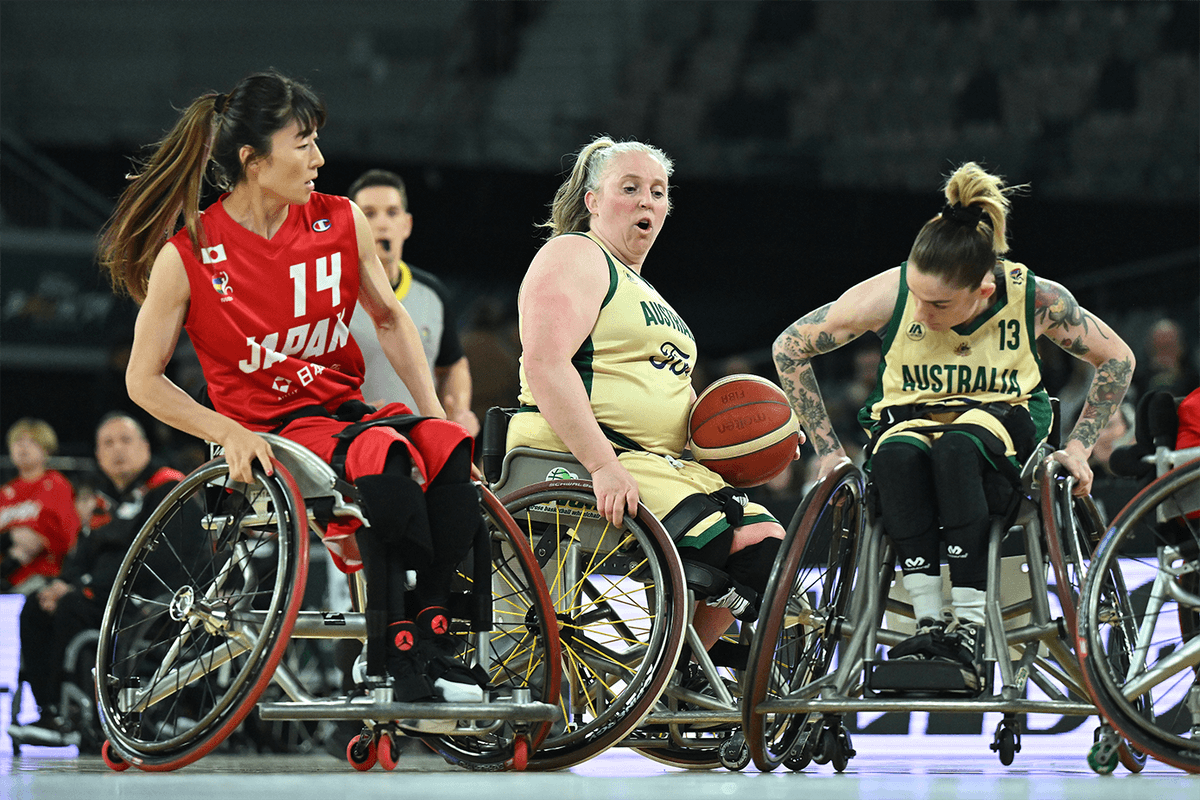
Australia is investing more in Para sport ahead of Brisbane 2032, and that is a good thing.
For many years, high-performance disability sport was not funded equitably. The additional investment is important and overdue. Disability Sports Australia (DSA) is a founding member of Paralympics Australia and we want that part of the system properly resourced.
However, recently, our Australian Sports Commission (ASC) participation funding was cut from $217,000 to $135,000. We were one of several organisations to receive reduced investment following a smaller funding envelope.
This is about recognising the full picture.
At the moment, just 14 per cent of people with disability participate in sport each week.
For most people with disability, sport is not about chasing a high-performance pathway. They want the opportunity to take part in their own community, in whatever way they choose.
That might be competitively, socially, volunteering, coaching or simply finding a club and people they feel connected to.
Yet it is still extraordinarily confusing for a person with disability to navigate sport. There are so many organisations, different options and uncertainty around whether someone should be playing a mainstream sport, a disability-specific sport or where they should start.
We also need to be careful about what we assume participation looks like. It will not look the same for everyone.
If our definition is too narrow, what we design, measure and fund can become too narrow as well.
That matters for organisations working behind participation too.
DSA is a bit of an anomaly in Australian sport. We do not govern a sport, and we do not focus on one particular impairment or disability.
We work across sport and disability, building the capability of the system and connecting people into opportunities often delivered elsewhere.
We might engage thousands of participants, but their participation might ultimately happen in a school, through a teacher, at a club or through another organisation. Our role is often to enable that opportunity rather than own it.
The impact might ultimately show up somewhere else. That makes it harder to measure, but it does not make it less important.
That question has become particularly relevant for us.
Get our newsletter
Quality research, analysis, explainers and factchecks from experts you can trust.
I do not blame the ASC for reducing our funding. The framework was applied correctly, and we recognise the challenge the Commission has in trying to assess very different organisations consistently.
The question for me is how we continue to evolve those measures as the sport system increasingly asks organisations to collaborate and build the capability of others.
Government has an important role, but if grassroots disability sport is going to be sustainable, we cannot continue to expect government to fund it alone. Business, philanthropy and sport all have a part to play.
We also have a responsibility to make grassroots sport for people with disability easier to understand and more attractive to invest in.
As an ambassador for Pay What It Takes, I also believe we need to recognise the full cost of creating participation.
The less visible work, including training, accessibility, systems, people and relationships, is often what makes the visible participation possible.
If we want a stronger grassroots system, we need to make that value clearer and build a more sustainable mix of government, commercial and philanthropic investment.
None of this is an argument about taking money away from Para sport.
Through discussions with Paralympics Australia, we have both recognised that for the system to work, there needs to be a strong grassroots and community participation system alongside high performance.
We need both parts of the system to be strong.
Australia is now developing its first National Disability Sport Action Plan. That is an important opportunity to examine what is working, where the gaps remain and what needs to change to make sport more accessible and connected for people with disability.
Ultimately, participation matters for what it can provide beyond competition. Sport can create social connection, improve health and independence, and create opportunities for people with disability to become coaches, volunteers, officials and administrators.
That is the legacy I want us to be thinking about as we head towards Brisbane 2032.
By then, I hope we are celebrating incredible Paralympic performances. But I also hope more people with disability can take part in sport in the way they choose, in their own communities, with a stronger system around them to sustain that participation.
If 2032 changes who gets to participate, not just who gets to compete at the highest level, that will be a legacy worth celebrating.
Ayden Shaw is Chief Executive Officer of Disability Sports Australia.