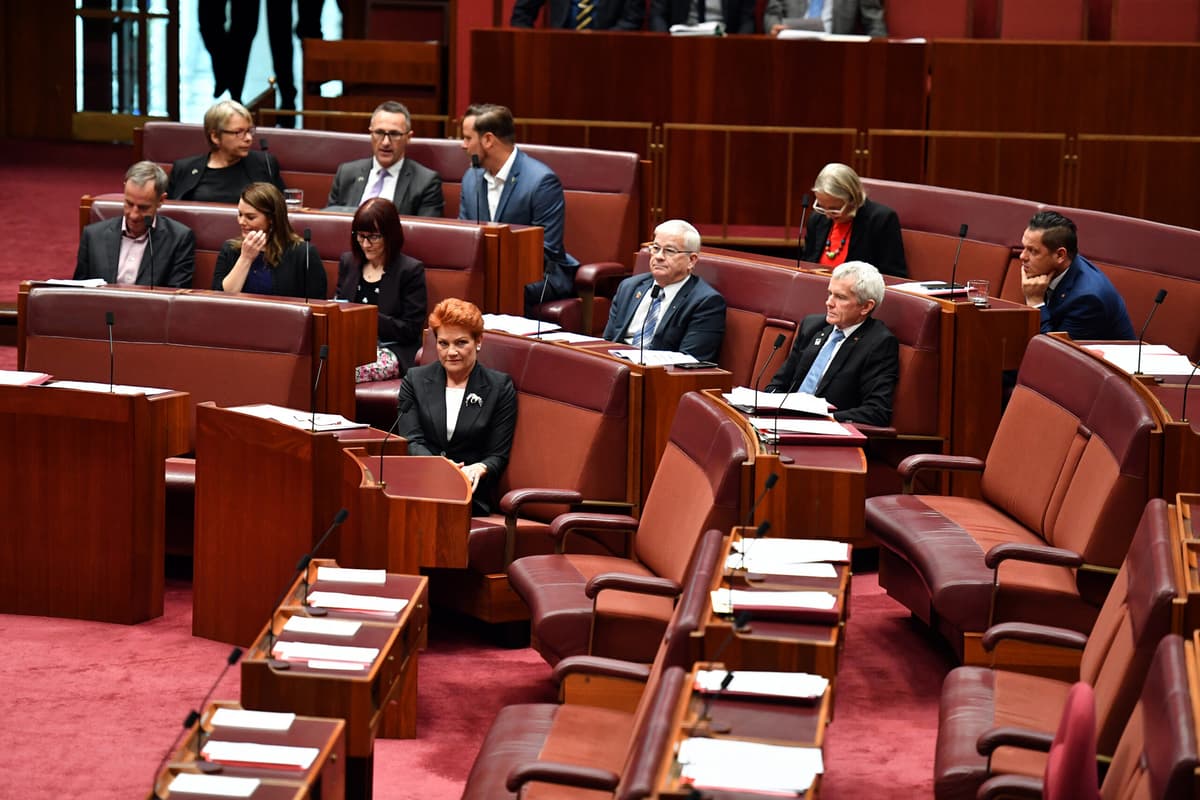
On the 10th of September 1996, two very different politicians rose at the same time to give their first speeches to Parliament.
Newly elected Green Bob Brown spoke in the Senate. The senator talked about global inequality, climate change, gun control and an end to native forest logging. He proposed stronger freedom of information, restoring foreign aid and supporting democracy around the world.
Pauline Hanson was a former Liberal candidate who won the seat of Oxley despite being disendorsed just before the election for her comments about Aboriginal Australians.
She told the House of Representatives that Australia was “in danger of being swamped by Asians” and said a truly multicultural country “can never be strong or united”, giving Ireland and Papua New Guinea as examples. She called for compulsory national service and an end to all foreign aid and said child support was too generous to custodial parents.
Brown joined one Greens colleague, while Hanson sat as an independent. She founded One Nation the next year. The major political parties – Labor, Liberal and National – were ascendant. In 1996, they won 86% of the vote. It was 66% at last year’s election, and the latest polling aggregate has them at 49%.
The Greens and One Nation have become fixtures of Australian politics. The Greens have almost always had more electoral success and many more parliamentarians than One Nation.
There are over 40 Greens state, territory and federal parliamentarians. One Nation boasts 17. It is the first time since 1998 that it has had more than 10 parliamentarians. Polling suggests One Nation will win more seats at upcoming state elections. Whether the party will hold onto them is another question; historically, about half of One Nation’s MPs defected from the party.
The Greens have often held the balance of power in the Senate and in state upper houses. They have at times done so in lower houses: taking ministries in Tasmania and the ACT and negotiating with the Gillard Labor Government. Ministries have eluded One Nation, but some in the Liberal–National Coalition are open to power-sharing arrangements should the minor party win more seats.
A week may be a long time in politics, but many topics Brown and Hanson covered three decades ago remain live. Hanson’s scepticism of the United Nations found an echo in Prime Minister Scott Morrison’s talk of “negative globalism”. Immigration remains contentious, even within One Nation.
Brown’s speech, too, raised unresolved issues. Decades after his warning on climate change, Australia is still opening new gas and coal mines. Brown was concerned about “some hundreds of billionaires” while 1.3 billion people lived on less than a dollar a day. Now the world has its first trillionaire in Elon Musk. Even after the Port Arthur massacre, Brown quoted politicians who didn’t see the point of gun control. But there was more national unity in 1996 than in 2026; despite the Bondi Beach massacre, some state governments have rejected gun buybacks and caps on firearm ownership.
There has been movement. In 1996, Brown defended Northern Territory laws that gave people the right to die with dignity. Those voluntary assisted dying laws were struck down by the federal parliament, and it was only last month that the NT finally passed new ones. It will soon be legal across Australia.