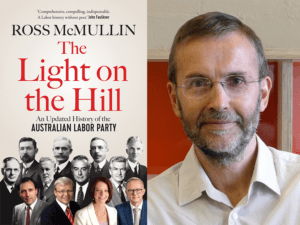
Approaching the centenary in 1991 of the Australian Labor Party – one of the oldest political parties in the world – the National Executive of the Party undertook to encourage an historian of Australia to write a comprehensive history. To this end, they appointed a committee of Party elders to select the historian and to give encouragement and support. Among the elders were Frank Crean (Victoria), ‘Johno’ Johnson (New South Wales), Kim Beazley (senior) (Western Australia), and Geoff Virgo (South Australia). The committee was chaired by the ALP National Secretary, Bob McMullan. Bob had asked me to attend its meetings as a historical adviser.
‘Johno’ came to the meeting wondering why we were meeting at all, as the New South Wales Party was prepared to offer their preferred historian. Though a federal entity, it was amusing to watch as state loyalties emerged. It was quickly apparent that the group would not accept a New South Wales historian being foisted on them. So, it was agreed that the committee would advertise, calling for expressions of interest. We assembled a suitable and impressive shortlist, and then the real fun began. With strong support from Frank Crean, a young Melbourne historian, Ross McMullin was selected.
McMullin then had one book to his name, Will Dyson: Cartoonist, Etcher and Australia’s Finest War Artist, Angus and Robertson, 1984. It helped the committee’s estimation of him that his book had been named the winner of The Age Book of the Year Award. The committee was also impressed by McMullin’s youth and by the enthusiasm for the task that he had demonstrated in interview. I knew McMullin, slightly, and told the committee that I expected him to do an excellent job. Publication of the book was also put out by the committee for bids. The winning publisher was Oxford University with a generous royalty divided between the Party and the author.
McMullin threw himself into the task, promising the committee that he would have the manuscript completed in time for publication in 1991. I read the manuscript when finished, assuring the Party elders that the historian had done a first-class job. Frankly, I was astonished by the depth of the research, the completeness, and the Australia-wide coverage of the account. But to my mind, the best thing about the book was its readability. It easily met the committee’s determination to have a book which rank-and-file branch members could read with pleasure and profit, as so many did, judged by the sales. We never met again after I had assured the committee that The Light on the Hill: the Australian Labor Party 1891-1991 had achieved all the committee’s expectations and ambitions. I had greatly enjoyed spending time with such a remarkable collection of Labor Party elders.
What impressed me about the book then, as it does now, was its searing honesty and the shrewd appraisal of the main characters. Of course, wartime Prime Minister John Curtin, in the chapter entitled ‘Dangers and Problems Unprecedented and Unpredictable’: The Curtin Government 1941-1945’ is rightly treated as a national hero. But the reader first meets him in 1916 when he is a passionate campaigner against conscription. His health suffered, and he was admitted to a convalescent home in 1916. McMullin quotes Frank Anstey, a federal member for the seat of Bourke, Melbourne, writing to encourage Curtin: ‘the man who has carried his crucifix and climbed his Calvary is a better man than he who never touched the stony road of suffering.’ Readers may wonder how the Party produced such men.
While a centenary history will celebrate achievement, success and the Party’s contribution to the development of the nation, McMullin does not flinch from the disasters and wrong turns. The chapter ‘Sad Days for the Party’: Another Big Split, 1950-1960’ makes for hard reading for a ‘true believer’ but it tells of a Party in turmoil, heading towards possible extinction.
Who, now, would give much thought to Stan Keon or Jack Mullens, both federal members who walked out on the Party. Here is McMullin’s characterisation of Mullens, who was soon forgotten by history: ‘a large, genial, urbane but furiously bigoted man given to florid eloquence and anti-communist zeal’. This is typical of McMullin’s approach. Readers become well-acquainted with every character who enters his text.