The Greens' recent leadership change from Larissa Waters to David Shoebridge was both rapid and polite. But while the change might have come as a surprise, what is more predictable is the hand wringing from much of the commentariat and the Prime Minister about whether the Greens should be 'populist' or 'pragmatic', and whether they should act like a ‘party of government’ or a ‘party of protest’.

Fri 2 Oct 2026 21.42 AEST
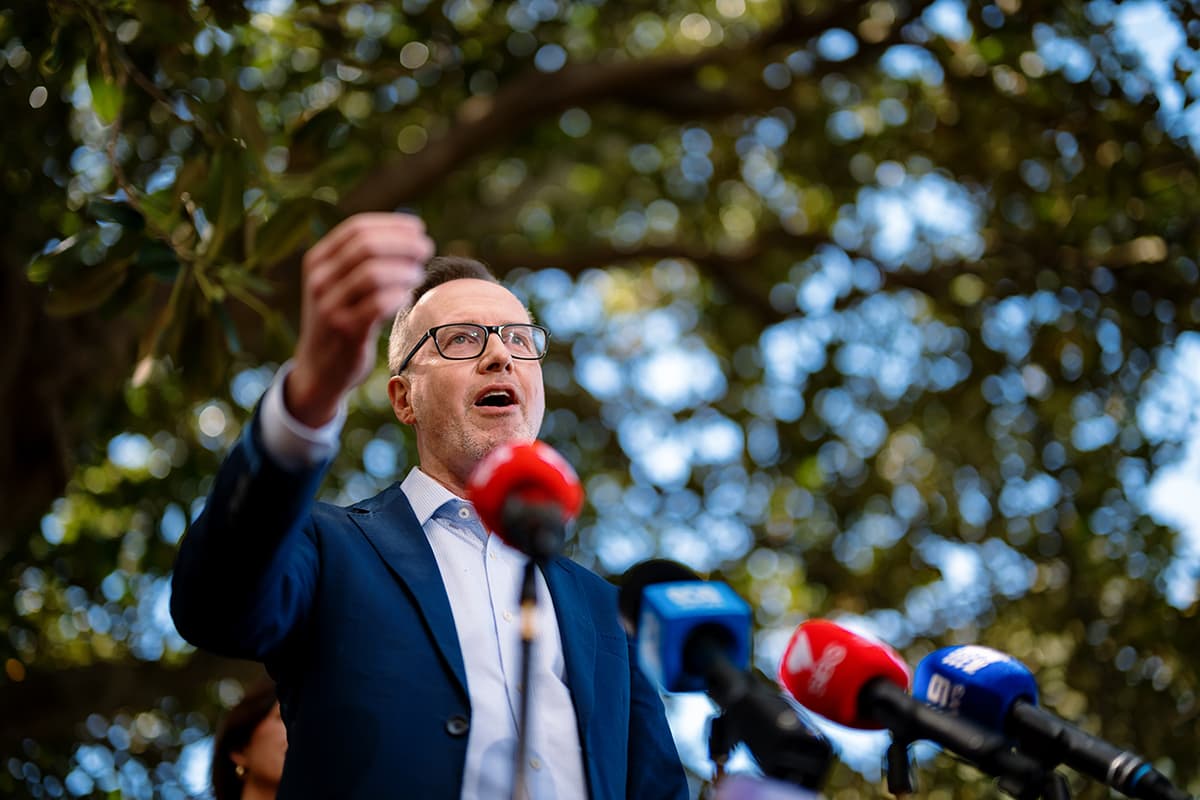
Photo: Senator David Shoebridge speaks to media during a press conference announcing the new leadership team of the Australian Greens (AAP Image/George Chan)


The Greens’ recent leadership change from Larissa Waters to David Shoebridge was both rapid and polite. But while the change might have come as a surprise, what is more predictable is the hand wringing from much of the commentariat and the Prime Minister about whether the Greens should be ‘populist’ or ‘pragmatic’, and whether they should act like a ‘party of government’ or a ‘party of protest’.
Have you ever heard that question asked of Pauline Hanson’s One Nation?
David Shoebridge has taken on one of the most powerful roles in Australia, at the midpoint in the Albanese Government’s second term. To be clear, as the balance of power party in the Senate, when the Prime Minister can’t get Angus Taylor to support his proposed laws, his next call is, quite literally, to the Greens.
While the PM may take comfort in the fact that Angus Taylor is so receptive to much of Labor’s legislative agenda, for example, his recent cuts to the NDIS and his weak efforts on gambling reform, much to his frustration sometimes his Cabinet and party room push him to do things that even Angus Taylor won’t support.
And that’s when he needs the Greens’ 10 votes in the Senate to combine with Labor’s 30 to get the minimum 39 votes he needs to pass a bill through the Senate.
Obviously, Anthony Albanese would like the Greens to hand those 10 votes over for free, and obviously both the Greens elected representatives and their voters want them to extract a more progressive price. And that’s where David Shoebridge’s job becomes so interesting.
The Australian media have never given the Greens the attention their voter base or their significance in the Senate seems to warrant.
The latest Newspoll had the Greens on 13 percent and the Coalition on 19 percent, but no one expects the Greens to get two-thirds of the coverage afforded to the Coalition. Likewise, while the Greens have 10 senators to One Nation’s four, no one expects the Greens to get more than twice as much coverage as the proudly far-right ‘party of protest’.
But that’s not a new problem, and it’s not going to change. Blaming the media is worse than shouting at clouds – at least the clouds aren’t full of people who like tax cuts and seem to hate most of what the Greens stand for.
Politics 101 suggests you should never take advice from your enemies, so unless Shoebridge thinks the commentariat and the Prime Minister are secretly cheering him on, he would do well to ignore most of the ‘advice’ he is receiving from them.
The next step is to avoid the banal binaries of ‘principle vs pragmatism’ and ‘protest vs progress’ and instead focus entirely on showing voters that what really matters to them is what also matters to your party. To be clear, that approach is not easy or uncontroversial, but it is much better than taking advice from newspaper columnists who will never vote for you, working for newspapers whose readerships are perhaps the only thing falling faster than the major parties’ primary vote.
All parties have to develop a clear sense of what is most important to the voters who are important to them, what is best for the country as a whole, and then come up with a clear way to communicate those decisions so that voters can see you are serious about fighting for them. Of course, that’s a lot easier said than done.
Quality research, analysis, explainers and factchecks from experts you can trust.
Telling a seasoned politician that they have to pick their battles carefully is as useful as telling a chess player to think carefully about their next move. But for outside analysts looking in, and voters deciding who to vote for, it is impossible to see the thought process behind the decision-making: meaning the visible decisions themselves are the political strategy. Put another way, actions speak much louder than words, and how an MP or Senator actually votes matters infinitely more than the motivations behind them.
While no one will blame the Opposition for being oppositional, and no one will blame Pauline Hanson for leading a protest party, the Greens, like the Democrats before them, will come under enormous pressure to do little more than tweak and amend the legislation that this Labor Government can’t talk the Coalition into passing.
Being in the balance of power when Anthony Albanese’s Labor Government is trying to be more progressive than Angus Taylor’s Coalition can stomach, is a mixed blessing for the Greens.
Such relevance forces the media to reluctantly pay at least some attention to them while providing them with a unique opportunity to show voters what their principles and priorities really are.
But it’s no accident that such choices are often far from easy.
If the Prime Minister is good at politics (and he clearly is) then, as he did with the recent vote to create more carbon offsets, he will go out of his way to put decisions in front of the Greens that will divide them — not just from their voters, but from each other. But in professional politics complaining about being wedged by your opponents is about as helpful as complaining about the media.
It’s not yet clear which battles the Greens will choose to focus on, and how they’ll choose to communicate those choices under their new leadership.
But two things are clear.
First, even though the cost of living, greenhouse gas emissions and the threats from AI are soaring, the Greens vote has been flatlining as scared and frustrated voters have flooded to Pauline Hanson’s ‘protest party’.
And second, the only way the PM can do something that is ‘too progressive’ for Angus Taylor, is with the support of the Greens.
Only time will tell whether Albanese can crush the progressive ambition out of the Greens, under the weight of other people’s expectations of their pragmatism, or whether Shoebridge can use the Greens’ ability to demand more from Labor to show voters that we, as a nation, are only ever just a day away from voting for a gas export tax, or free dental care.
One thing is for sure: these days, even the media have to admit that who you vote for really matters.
Dr Richard Denniss is the co-CEO of the Australia Institute.
Advertisement