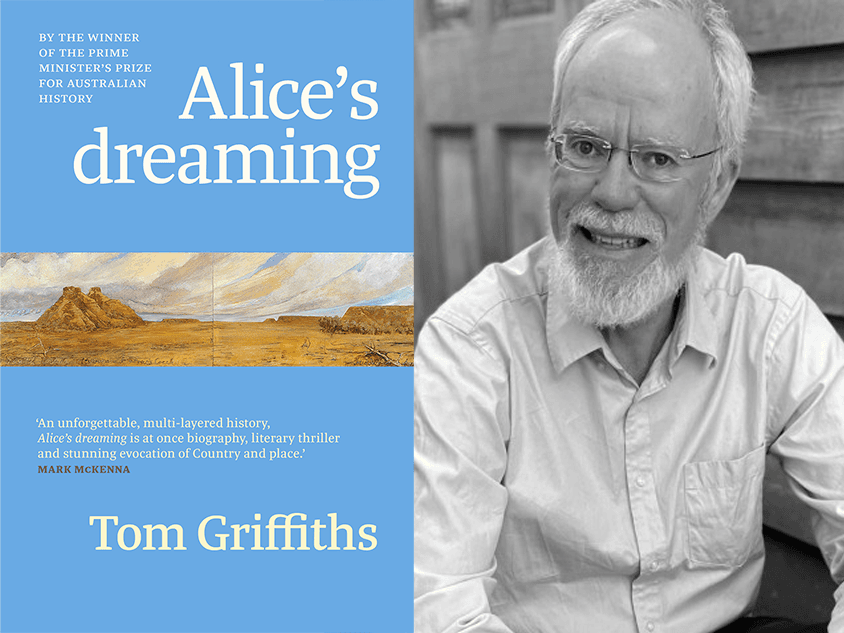
This is an intriguing and surprising book, of deep and current importance. Tom Griffiths, one of Australia’s very best historians, tells readers in his Prologue that, aged fourteen, he found a book in his school library, by Alice Duncan-Kemp, called Where Strange Paths Go Down. Of course he did and of course he read it. What were the rest of us doing?
In the first part of the book, ‘Alice in Wonderland’, we meet the person who carries the whole story. Alice Duncan, as she was before her marriage, was born in Charleville, Queensland, on 3 June 1901. Her father William and mother Laura had bought the lease for Mooraberrie, where, on the large property in the Channel Country, they ran cattle. Her elder brother, David, died in 1903 and her father, William, died in 1907, leaving her mother to run the property and to raise her three daughters.
Also in 1903, while crossing the flooded Bulloo River in a buggy, a tree branch fell across the sleeping Alice who, remarkably, survived unharmed. Two Indigenous property workers, travelling with the family, believed that Alice, a young white girl, was the reincarnation of Yammacoona, the Earth Mother. Hence Alice had a revered place in the lives of the local Indigenous population.
Alice, even as a little girl, was a careful observer who clearly remembered the many lessons Indigenous women gave her in Aboriginal lore, stories, law and meanings. She had access to Aboriginal culture that few others, outside that world, have ever enjoyed. It is intriguing that the reader knows the names and the personalities of all the Indigenous people in Alice’s life.
Have readers ever before been introduced not only to the complexity of the way of life of Aboriginal people but come to know some of them intimately? Moses Yoolpee is an outstanding person in the book. Educated, possibly at Scotch College, Melbourne, he spoke impeccable English, knew white ways from close indoctrination and observation, but walked 1600 kilometres home, so that he could be on his own Country.
Moses ‘explicitly rejected the supposed superiority of European civilisation , courteously telling James Warby, manager of Mooraberrie: “We don’t want your civilisation, we have a very ancient culture of our own”’. This is the major theme of this book and its most important statement.
The numbers of people on Country at the time of white invasion were substantial. Alice told Dr L.P. Winterbotham, honorary curator of anthropology at the University of Queensland, that the ‘old hands’, that is, the white pioneers, claimed that there were upwards of 12 000 -15 000 people ‘living and hunting off six hundred square miles of country and living well’. As Tom Griffiths writes, ‘two shires today [Barcoo and Diamantina] have a few hundred people in each. The Mithaka had thousands’.
Alice was an unusual young girl, writing down, in detail, the Indigenous knowledge she had received. This formed the basis of her first book, Our Channel Country (1933). Published, enthusiastically, by Angus and Robertson, the book did moderately well for such a book, selling 5 500 copies. It gave Alice Duncan-Kemp a recognised name, acceptance as someone who had rare insights into Aboriginal life, and a lifetime interest in writing. Three further books followed, all drawing on her substantial archive. Tom Griffiths follows the development of this archive, first organised and curated by Alice’s daughter-in-law, Dawn Duncan-Kemp, a librarian-archivist and subsequently by Lorraine (‘Rainy’) McKellar and Will Kemp. The archive is of real significance to Australian anthropology.
Then we turn to the next section, ‘War and Peace’, (note that the titles of all four sections of this book are book titles). No surprises here. The Native Mounted Police take centre stage as they rampage, murderously, among Alice’s beloved people who told her the story: ‘hundreds were shot down miss . . . [they] said we were polluting water and spearing cattle, and shot us down like unwanted dogs’. Readers who are acquainted with David Marr’s remarkable, Killing for Country, which Griffiths describes as ‘[Marr’s] saga of relentless colonial violence’, will know what to expect. It is, again, heart-breaking.
But here there is hope. In an exciting and unexpected chapter, ‘Treaty’ Griffiths writes of a peace ceremony, held in May 1889, performed close to Mooraberrie’s borders, encouraged by George Debney, which brought about the end of the frontier war in Mithaka country. It was a traditional Indigenous ceremony with few, if any, European features, without documents, signatures or gifts. Because of this the colonial government could ignore it. To accept a treaty as a means of ending a war would have been to admit the existence of the frontier war which, to this day, is still a contested concept. So while the treaty put an end to the slaughter of native peoples, truth-telling lost out. This chapter shows how it might have been with greater honesty and greater awareness from the invaders.