America’s embrace of a different kind of politics is a huge strategic opportunity for Australia – not just in our relationship with the United States, but at home as well. The Australian government can now back its words with action and create the new rules-based order that our new world requires.

Thu 5 Nov 2026 17.04 AEDT
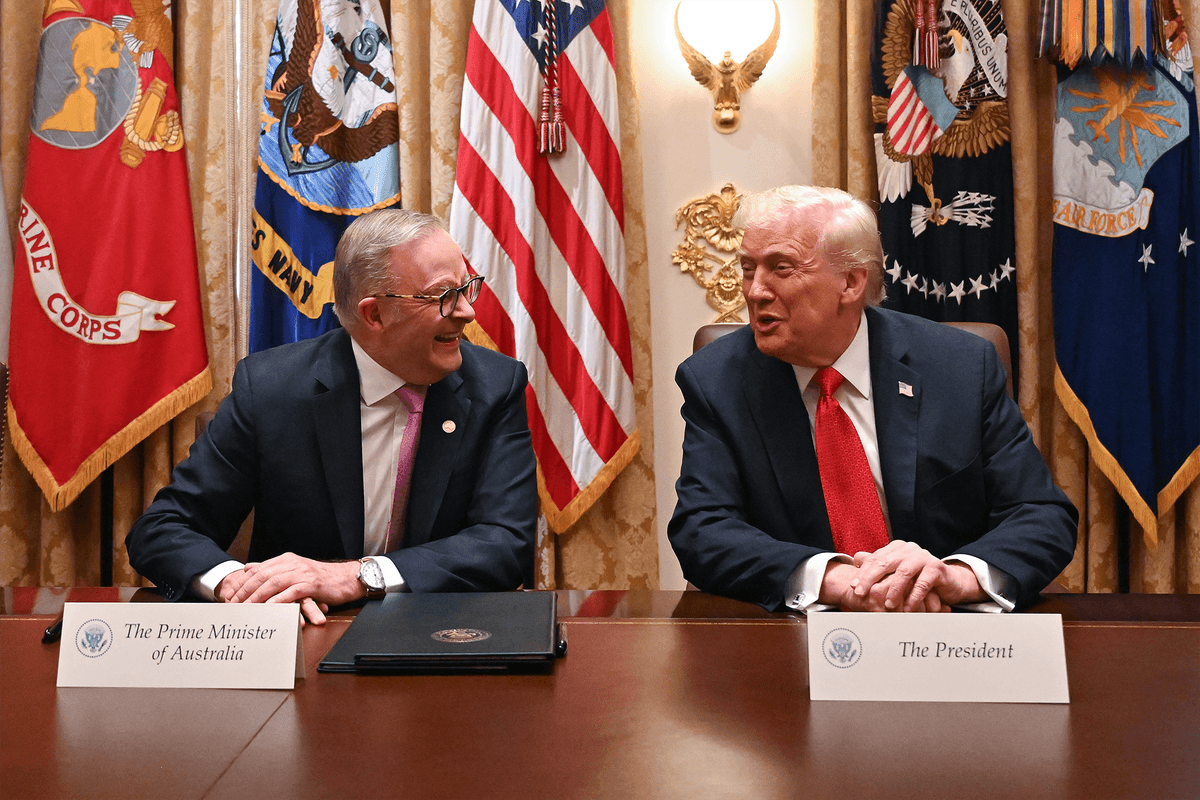
Photo: AAP Image/Lukas Coch


In the United States, voters have overwhelmingly rejected Donald Trump’s version of America. The rejection of Trump is the rejection of what he stands for and what he does.
America’s embrace of a different kind of politics is a huge strategic opportunity for Australia – not just in our relationship with the United States, but at home as well. The Australian government can now back its words with action and create the new rules-based order that our new world requires.
In the last two years, Australia’s approach to the United States has been single-minded: avoid Trump’s wrath at nearly all costs. And if that demanded more deference, then they have basically always been up for it – no matter how cringe. That is the result of decades of ingrained and unquestioned institutional habit, added to by a desperate desire to keep the AUKUS submarine deal intact.
That blinkered approach was always risky. It’s clear that no matter how much you give Trump, he’ll take more. And it meant that the Australian government was entirely reactive, jumping whenever Trump looked sideways at us. It meant never (or barely) standing on principle even as Trump assaulted the very things the Australian government described as central to Australia’s interests. Things like keeping inflation down, or the US-Australia Free Trade Agreement, or peace in the Middle East, or the defence of Ukraine – all of them dependent on the “international rules-based order”.
Now, that approach has been exposed as both pathetic and wrong-headed. It blinded the Australian government to the possibility that America might revitalise itself, severely limited the relationships it built in Washington, and has left it scrambling, once again, to build relationships with a new generation of leadership in the Democratic Party from scratch. It’s a new generation with which the current government is more ideologically aligned – or at least should be – but one that will now remember that in its time of greatest need, its allies in Australia went missing.
Australian progressives and small-l liberals (so often a dirty word in America, but there we are) ran for cover. Talk about shared values. Instead of supporting democratic institutions and standing up to Trump’s assault on the rule of law, the Australian government and particularly those in the closeted national security “community” cosied up to the worst version of America. A version that is now, we can finally hope, in retreat.
It is entirely possible to recover from this blinkered and visionless approach, but it will take the kind of work the Australian government is not used to doing, a diplomatic capability we don’t have, and a willingness to really understand what has just happened in America. None of those things are in place right now. They will have to be built from the ground up. That will require some uncomfortable self-reflection on and by the leaders of this government.
The Deputy Prime Minister and Defence Minister in particular has been at pains to ingratiate himself with the Trump administration – especially the Secretary of War. And with the war not going so well, that same Secretary will now rightly face the scrutiny of a new Congress – possibly even removal from office. Hegseth’s violent, racist vision for American power has been comprehensively rejected by an American electorate that has re-asserted the value of diversity, equity, and inclusion. But that vision was embraced by Marles, who called Hegseth a “good friend”.
The Deputy Prime Minister, and a Prime Minister who pursued grinning selfies with a deeply unpopular and dangerous President, risked Australia’s future relationship with a post-Trump America. They narrowed it down to a few people, all in the Pentagon, the defence industry and the White House, and as good as ignored everything else. Marles could soon be totally adrift in Washington. That is entirely the result of his choices, and those of the government he helps to lead. Different choices were always available to them.
Australia’s leaders made the choice not to foresee or plan for the reinvigoration of the Democratic Party and American politics more broadly. They might have hoped for something like that, but they did not prepare for it, invest in it or understand what it would mean, and they did not consider how it might change our relationship with America – or how America itself might change.
Quality research, analysis, explainers and factchecks from experts you can trust.
That means there is considerable work to do, and Australia is well behind the starting line. This government might begin with that reflective understanding of what has just happened. They might notice, for example, the renewed and reasserted power of former President Barack Obama, and how he has so clearly made himself a central authority figure to that new, vibrant generation of the Party that has emerged.
Unlike some of his Party contemporaries, Obama has seen where power is shifting both internally and externally – and he is helping to direct it. It was very telling to see the former president step into the spotlight in the final weeks of the campaign, stumping for Abdul El-Sayed in Michigan, Jon Ossoff in Georgia, and James Talarico in Texas. All young, progressive candidates with a focus on making people’s lives better and on re-establishing the rule of law at home and abroad. In Michigan in particular, Obama decisively supported a candidate sweeping to power on the back of a comprehensive rejection of America’s role in the destruction of international law, particularly in its support of the Israeli government.
This could all signal a slow but dramatic change in American strategy. As the domestic landscape changes, so too will America’s place in the world. It will not be a return to the “normal” of the Obama years, but it will have its echoes. If it were to think strategically, the Australian government might understand how Obama will likely be decisive in who is anointed as the next Democratic presidential contender. It might have a plan not just for how to be part of a new progressive network of alliances, but for how Australia might play a role in shaping it. It might be ready for a 1945-like strategic moment, and a new president ready and able to dramatically reimagine the global order and America’s role in it, and how Australia might play a role commensurate with its power, as Evatt did.
For Australia, that means getting ready now for what might happen in two years’ time – and how to respond to what may happen in Trump’s “lame-duck-with-a kick” period. That means preparing to deal with a vicious and vindictive president while simultaneously preparing for a possibly radically changing America. It is a rare and delicate strategic moment. One which this government is shaping up to miss entirely.
Americans are trying to tell us that opposing authoritarianism – and pointless, expensive, illegal wars – is both popular and necessary. That apparently was not clear to the Australian government, even as Canadian Prime Minister Mark Carney demonstrated at home and internationally the political utility of divergence.
Is the Australian government ready to see it now? And then is it ready to stand up and act?
The midterm results make it clear that pandering to the far right – at home and abroad – gets you worse than nowhere. Really acknowledging economic insecurity and explaining what you’ll do about it wins enormous political support. A transformative political opportunity can be created by those with enough ambition and imagination.
The question Australians watching this American renewal might ask ourselves is: what exactly is the point of this government if it isn’t able to seize this moment?
Dr Emma Shortis is a historian and writer, focused on the history and politics of the United States. She writes regularly for Australian and international outlets and appears regularly on radio and television. She is Director of the Australia Institute’s International & Security Affairs Program.

