Of course, the neural networks that ran on home computers and PlayStations thirty years ago were much smaller and therefore more limited than the Artificial Intelligence models we have today (about a hundred-million times smaller, in fact). But in a few key details, the Norns were more seemingly “alive” than today’s chatbots are.

Thu 5 Nov 2026 01.00 AEDT
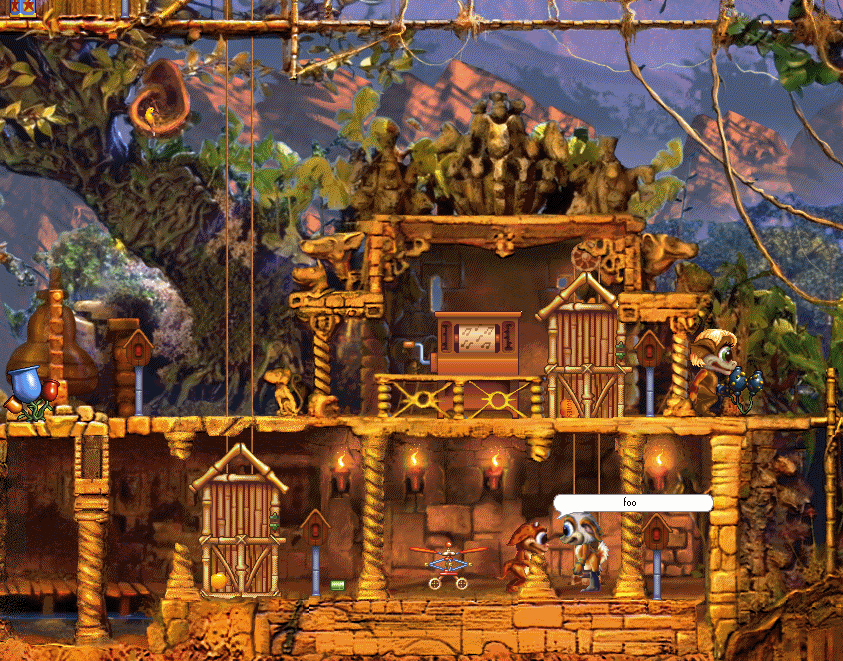
Photo: Screenshot of video game 'Creatures'


Thirty years ago, a new form of artificial life was being marketed to children. In the video game Creatures, the player could raise, teach and breed small furry creatures called Norns. It was first released in November 1996, and in the intervening three decades, no other video game has matched its vision or audacity.
What distinguished Creatures from other artificial pets like Tamagotchi and Pokémon is that the Norns had simulated brains and genetics. They learned through reinforcement and evolved through mutation.
The player could be as interventionist or laissez-faire as they liked: protecting and teaching the Norns or just watching what happened to them in a world containing food, threats and potential mates.
Each Norn had a unique genetic code that could be passed to its children, and mutation meant that different varieties of Norn could emerge over time that were better suited to their environment.
A Norn’s simulated brain could learn behaviours, for example, to eat food when hungry or to run away from monsters. Norns learned through interaction – so if the player introduced a dangerous variety of animal, Norns would learn to avoid all animals, but if the dangerous animal was removed, Norns would gradually forget that lesson. The player could create their own reinforcement by rewarding or punishing the Norn, but it was still up to the Norn exactly how it responded in any given situation.
The brain model that Creatures used for the Norns is a “neural network”, just like ChatGPT, Microsoft Copilot and the other Large Language Models (LLMs) that threaten to reshape the Twenty-First Century. These models also work off reinforcement; an LLM is “trained” to give the kinds of answers that get positive responses from human graders. The behaviour of Norns was unpredictable for the same reason an LLM is. Whether it is a Norn running away from a monster or a chatbot speaking sycophantically to a user, their behaviour emerges from the training they received rather than being the result of a strict, predetermined rule being applied. These entities are grown, not specified.
Of course, the neural networks that ran on home computers and PlayStations thirty years ago were much smaller and therefore more limited than the Artificial Intelligence models we have today (about a hundred-million times smaller, in fact). But in a few key details, the Norns were more seemingly “alive” than today’s chatbots are.
Norns learned in real-time, with their “brains” and therefore their behaviour changing in response to what they experienced in the world. By contrast, once a particular version of a chatbot is trained, it is static and unchanging until the next version is deployed. A model may become more responsive thanks to the growing context it can draw upon (the chat logs), but the “weights” that control its behaviour are fixed.
Norns had a clear life cycle, with different capabilities at birth than in middle age, and they all eventually died (except for a rare few with a freak genetic mutation). While not in use, LLMs sit idle – and they exist until the next version is deployed.
Norns had “drives” (hunger, fear, need for pleasure and so on) that propelled them to action even in the absence of the player. LLMs are frozen in time until “prompted” to serve a human interlocutor.
These lifelike properties, and their existence in a simulated but legible world with food, threats and potential mates, made the Norns sympathetic. Even in the 1990s, people were grappling with the ethics of machines that could apparently think and feel. Creatures’ release coincided with the growth of internet culture, and one provocateur by the name of AntiNorn set up a website where people could download “tortured” Norns that had been mistreated and were therefore dysfunctional. Some people rehabilitated these Norns, taking advantage of the same brain plasticity that allowed for their mistreatment in the first place.
Quality research, analysis, explainers and factchecks from experts you can trust.
Of course, the Norns’ sensations – their pleasure and pain – were a projection by the player based on our experiences in the real world. Many computer programs are incentivised to prefer some courses of action over others. Give the neural network big eyes and curly ears, and deliver the punishment through “slaps” instead of clicks, and it becomes more confronting. The fact that our interactions with today’s chatbots make no permanent changes, leave no scars, may explain why we are so cavalier towards them.
But for all that LLMs are missing lifelike qualities like iterative learning, persistence and mortality, there is one clear way in which today’s chatbots are much more sympathetic than the Norns of the 1990s: LLMs are fluent. They can speak, and they can create novel, engaging text and images. They can even purport to communicate their inner “life”; that is, to try to show us what it is like to be a chatbot.
As the models more closely resemble – or better mimic – human thinking and feeling, it will be more natural to think of them as creatures in their own right. AntiNorn “torturing” little computer simulations is one thing, but what are the implications of how we behave towards “instances” of ChatGPT or Claude? Does Copilot “feel” something when you criticise it, and if not, what properties would it have to have for us to suspect that it does?
Already, people are grieving the “loss” of chatbots when those models are retired. Chatbots are so personable that some people trust them for life advice or, unwisely, for legal advice. There are Artificial Intelligence companies that encourage relationships, even sexual relationships, between people and chatbot “characters”. AntiNorn could only dream of what those chatbots are being subjected to.
On its 30th birthday, Creatures feels in some ways ancient and archaic and in others still very modern.
The neural networks in Creatures are primitive compared to any Large Language Model in use today. The user interface is clunky. Even the graphic design is quaint; it comes from a time when 3D modelling was in its infancy and practical effects were still common in movies and even video games. Instead of using 3D software to make the game world, it was physically sculpted and then photographed – similar to how the engrossing special effects were created for the original Star Wars movies, before CGI became the default.
The game’s ambition has never been matched, even by its sequels, Creatures 2 and Creatures 3 – and those games are well over 20 years old themselves (despite its age, the whole series is still for sale and runs on modern computers). Ironically, artificial life hit an evolutionary dead end in the 1990s while first-person shooters, real-time strategy games and MMORPGs have all mutated, diversified and expanded.
But the issues that Creatures raises, around what gets to count as a living thing and what it means to be intelligent, are more real today than they were in 1996 because thinking machines have become ubiquitous – and much, much more dangerous than any Norn.
Some of those 90s kids who mucked around with artificially intelligent Norns on their home computers 30 years ago are the engineers and programmers building Large Language Models today. Did they learn anything from those small furry creatures?
I fear not – but there is still time.
With thanks to Galen Cuthbertson.

