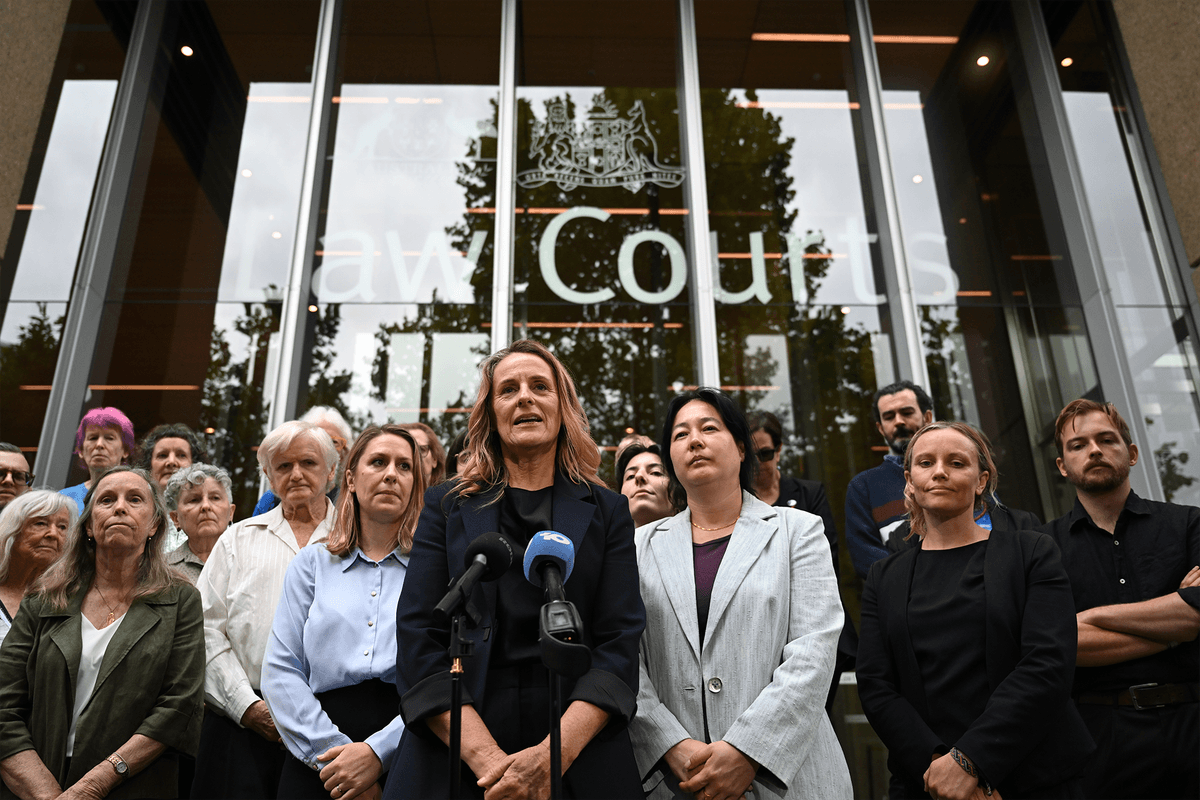
On the weekend, hundreds of Australians took to Newcastle Harbour to protest Australia’s climate hypocrisy: ramping up gas and coal exports even as it claims to be a “climate leader”. But the peaceful protest, which was pulled off without incident or even any arrests, happened against the best efforts of NSW Police.
Last week, the police went to the Supreme Court in a last-minute effort to block the climate protest. The court knocked back the application, but the overreach from authorities is a reminder of just how limited protest rights have become in Australia. Organisers shouldn’t have to find lawyers and argue their case in the Supreme Court just to defend their right to protest.
Paddle for the Planet is an all-ages on-water protest where people in kayaks and canoes and on surfboards head into Newcastle Harbour. It is organised by Rising Tide, a grassroots climate action group focused on non-violent direct action. Newcastle is the world’s largest coal port, making it an obvious location to draw attention to Australia’s climate hypocrisy at this week’s global climate conference.
NSW Police tried this week to deny Rising Tide permission for the public assembly. It is not the first police overreaction to a Rising Tide event. In August, NSW Police were ultimately forced to drop charges against 125 protesters that were levelled following a 2024 protest.
The legal threat to protest organisers was compounded by NSW Police seeking costs if a prohibition order is granted. Organisers could have been required to pay the police’s legal fees for going to the Supreme Court for judgement.
Governments use the threat of costs orders to discourage political participation. “Transparency warrior” Rex Patrick was threatened with up to $150,000 in costs after seeking information about where the federal government plans to store nuclear waste. After pressure, the Albanese Government made a partial concession: Patrick would only be exposed to costs of $20,000 for defending his right to access government information.
The decision by the NSW Supreme Court is welcome, but it should never have come to this. As governments become increasingly anti-protest, the courts have been left as the last defenders of civil rights. The NSW Government earlier this year attempted to further restrict protest rights, only for the Court of Appeal to rule that their attempt violated speech protections in the Australian Constitution.
Australian governments have apparently forgotten that Australia has a proud history of disruptive protest, from the suffragists campaigning for equal rights and the dockworkers who blocked iron exports to fascist Japan in 1938 to the anti-Vietnam War marches where people turned out in the hundreds of thousands.
Get our newsletter
Quality research, analysis, explainers and factchecks from experts you can trust.
Governments fear mass protest because it works. The Minns Labor Government in NSW did everything in its power to stop the march for Palestine across the Sydney Harbour Bridge last year. Organisers estimate that 300,000 people marched. One week later, the Albanese Labor Government announced that it would recognise Palestinian statehood.
Around the world, repressive governments have experienced major election losses in the face of mass protests. The Serbian government, accused of beating and abducting its critics, lost the October parliamentary election after a record turnout. US President Donald Trump, who celebrated one of his supporters allegedly punching a protester, was handed a bruising defeat in the midterm elections after two years of “No Kings” protests drawing attention to his executive overreach and unpopular policies.
The threat of violence hangs over Australian protesters from police as well as private citizens. In 2025, Neo-Nazis injured five people in their attack on Camp Sovereignty in Melbourne, an Aboriginal protest site. On 26 January 2026, a man allegedly threw a homemade bomb at an Invasion Day protest, an apparent terrorist attack that provoked little national soul-searching or even much media attention.
Hannah Thomas was at risk of losing an eye after she was violently arrested at a pro-Palestine protest last year. The arrest was unjustified, and NSW Police were forced to drop the charges against Thomas. The senior constable responsible for the arrest has been charged with assault and recklessly causing grievous bodily harm.
This year NSW Police attacked those protesting the visit of Israeli president Isaac Herzog. Police punched protesters, pepper-sprayed crowds and dragged away Muslims as they prayed quietly. A member of Parliament claims police punched her in the head and shoulder. A police officer was caught on body camera saying he “fucking pumped that cunt” and “Then I punched him in the head when he was down”.
NSW Premier Chris Minns said those horrified by footage of apparent police brutality should consider “the full context” and that no one “set out to cause offence” – while his own Labor colleague said the police response had been “totally over-the-top”.
For all the criticism of lawless protesters, it is the NSW Government and NSW Police who show a shaky understanding of the law. The failed attempt to stop a peaceful flotilla of boats and surfboards in Newcastle Harbour is just the latest example of government overreach.
Bill Browne is Director of the Democracy & Accountability Program at The Australia Institute.