In a Territory where women are being killed, families are losing their homes and maternity services are disappearing, the Country Liberal Party has found a much easier enemy.

Fri 20 Nov 2026 11.26 AEDT
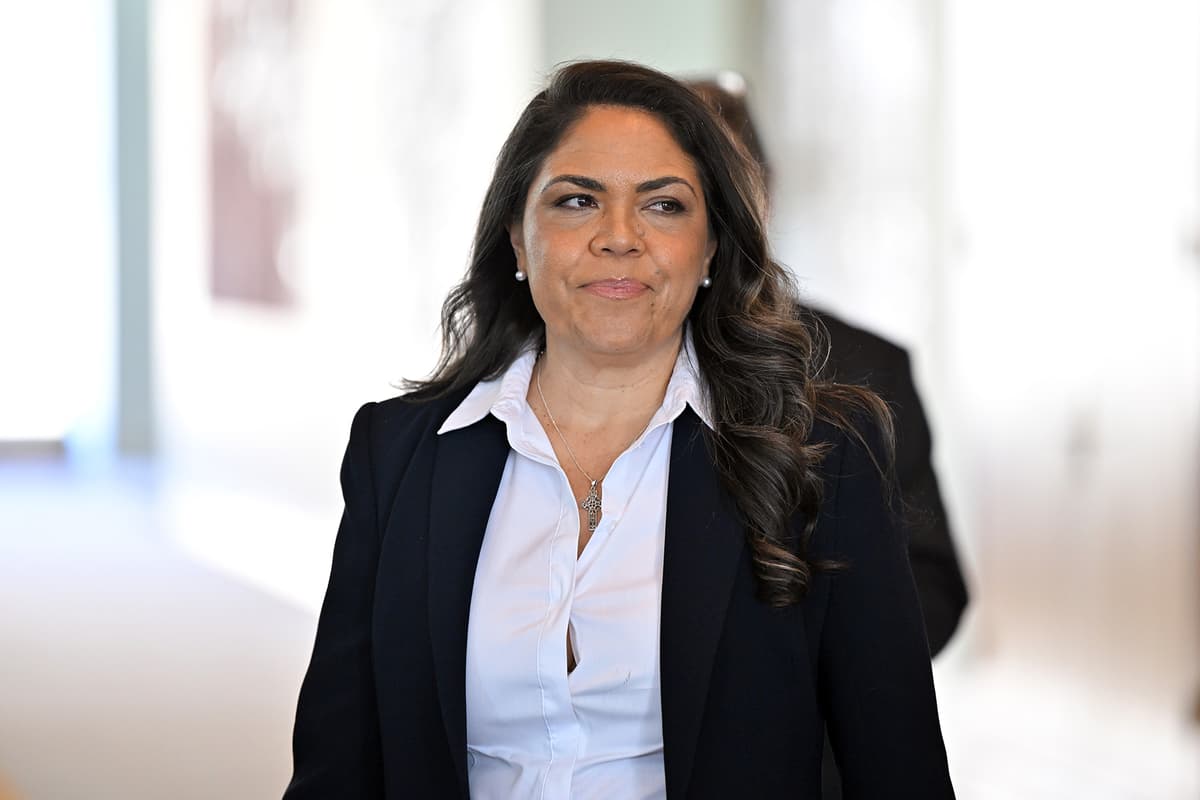
Photo: Jacinta Nampijinpa Price arrives to speak to journalists at a press conference at Parliament House (AAP Image/Mick Tsikas)


In a Territory where women are being killed, families are losing their homes and maternity services are disappearing, the Country Liberal Party has found a much easier enemy.
She walked out of a so-called women’s safety event, turned 180 degrees, and made a gesture towards peaceful LGBTQIASB+ protestors that I can only interpret as “suck my cock”.
This was the behaviour of Northern Territory Senator Jacinta Nampijinpa Price on Saturday 7 November, at the Country Liberal Women’s Branch hosted Sall Grover in Darwin. Grover founded Giggle for Girls, an app found to have unlawfully discriminated against transgender woman Roxanne Tickle. Her appeal failed, the High Court refused special leave to appeal, and she was ordered to pay $20,000 in damages, including $8,000 in aggravated damages for her behaviour towards Tickle.
Yet here she was, being presented as a defender of women’s rights.
Price and Grover emerged from the event to pose for photos holding a flag displaying their biological definition of a woman. Across the road, a small group of gender-diverse and queer protesters had gathered. After posing for a photo with the protesters in the background, Price turned towards them and made a crude, two-handed gesture towards her groin. The irony of using a gesture so deeply rooted in masculine dominance and misogyny was apparently lost on her.
The politics are dangerous. The Country Liberal Party government has launched a war against minority groups. What happened outside that event reeks of the political environment in the Northern Territory and, more widely, the rise of the far right across the country.
Why, in a place where women face the worst violence in Australia, are politicians trying to convince us that transgender women are the threat?
In 2024, the Northern Territory coroner delivered findings into the deaths of four Aboriginal women, exposing devastating failures in the systems meant to protect them.
The inquest documented an intimate partner homicide rate seven times the national average. Between 2000 and 2024, 87 women were killed in domestic violence-related homicides, 82 of them Aboriginal women.
In the past two years, at least two transgender women have been killed by intimate partner violence. In a community as small as ours in the Northern Territory, those deaths raise alarms about the epidemic of violence we are facing.
But the calls for men to stop killing us do not differ between cisgender and transgender women.
The CLP professes to be about making the NT safer, but they recently closed YiSSA, Darwin’s largest short-stay accommodation facility, displacing hundreds of residents, including children. They opened a makeshift facility 100kms from Darwin that just 23 people relocated to.
Over 300 others moved into public, community or transitional housing. Others returned to communities or moved into overcrowded homes wtih family. At least 100 people remain unaccounted for.
For women escaping violence, losing safe accommodation is a matter of life and death.
Yet Sall Grover and the CLP believe the more urgent threat is a transgender woman using a bathroom.
But what about Territory women giving birth in hospital bathrooms? That is not because transgender women are occupying the space. It is because the CLP is obsessed with investing in punitive justice rather than our crumbling public health system.
Darwin Private Hospital closed its maternity ward in 2025, and the Territory’s last private obstetrician subsequently closed her practice. Women have been pushed into the public system with little additional resources or funding. They have fewer choices about where and how they give birth. Birth registrations in the NT fell by 6.2 per cent in 2025, while nationally they increased.
Women are raising concerns about maternity services, continuity of care and the pressure on an already stretched public health system.
Nearly a year ago the NT government also stopped providing puberty blockers and gender-affirming hormone treatment to new patients through the public health system, leaving young people and their families with fewer healthcare options.
These are children who deserve care, not political persecution. According to Orygen’s survey, up to 92 percent of transgender and gender-diverse young people have experienced suicidal thoughts at some point in their lives.
Then there is the Chief Minister’s fascination with transgender prisoners.
Quality research, analysis, explainers and factchecks from experts you can trust.
Lia Finocchiaro declared that people assigned male at birth should be housed in men’s prisons, even if they had transitioned. She presented this as a necessary measure to protect women.
There was just one rather inconvenient detail.
At parliamentary estimates, the Corrections Commissioner Matthew Varley said women who are deemed at risk, usually of suicide or having a mental health episode in both Alice Springs and Darwin, are held in “at risk cells” which are in the men’s facility.
Read that again.
While the Chief Minister wanted you to believe transgender women in prison were the threat, the system was placing its most vulnerable women often in mental health crisis in male cells.
It is difficult to imagine a clearer example of the difference between protecting women and protecting a political narrative. But this kind of politicking does have a name: moral panic.
It works by turning a small, often marginalised group into a symbol of everything society is supposed to fear. The threat does not have to be widespread. It just has to feel real enough for people to demand protection and forget empathy.
And once people are frightened, politicians, like those in the Country Liberal Party, attempt to offer themselves as the solution. It is the same narrative we see playing out with migrants and First Nations children across Australia right now.
The far right uses this concept alongside securitisation. Political leaders frame an issue as an urgent threat to public safety – migration or youth crime – making measures that might otherwise seem discriminatory appear necessary.
In this case the government does not have to demonstrate that transgender women are responsible for violence against women. It only has to convince enough people that they might be. And while the public argues about a threat that has not been established, the government escapes scrutiny for the dangers we already know exist.
Women are being killed. Families are losing safe housing. Children are being removed. Maternity services are disappearing. These are not hypothetical dangers, they are facts.
But fixing them requires funding beyond the election cycle. As opposed to creating moral panic, which only requires voters that will fall for propaganda.
This is a global strategy. Anti-trans campaigns have become leverage for conservative movements and the far right, often under the banner of protecting women and children. But let’s be real: transgender women, according to the ABS, make up just 0.3 per cent of the Australian population. They are hardly the group overwhelmingly threatening women.
The fear of transgender women is rooted in the very misogyny women have spent generations fighting. It begins with the idea that our bodies determine our worth, or worse, our power in society.
For centuries, women’s biology was used to justify excluding us from education, politics and public life. Yet here we are, watching a movement claiming to defend generations of women’s liberation by reaching for the same biological argument used to deny it. Our physical form surely cannot be the argument on which we base our safety.
Once we accept that someone has the authority to inspect, categorise and police women’s bodies, every woman becomes subject to those rules. This is not women’s liberation. It is policing our rights. It sets us all back.
This week, a politician elected to represent Territorians appeared comfortable using a sexually degrading gesture towards women. Not a single mainstream media organisation covered it, despite many covering Grover’s arrival in the NT.
If a male politician had done this, how would we have responded?
The reality is we don’t need another culture war. We need a government willing to confront the dangers women actually face. Those dangers are not trans women.
(A)manda Parkinson is a multi award-winning photojournalist based in the Northern Territory. Their work focuses on politics, justice and human rights.
Advertisement


