From time to time, the Canberra bubble bursts and we get to see politicians who are real and share our vulnerability and humanity. Australia’s politicians are increasingly facing death threats and other expressions of frightening anger. They are scared and they are not alone.

Mon 23 Nov 2026 10.28 AEDT
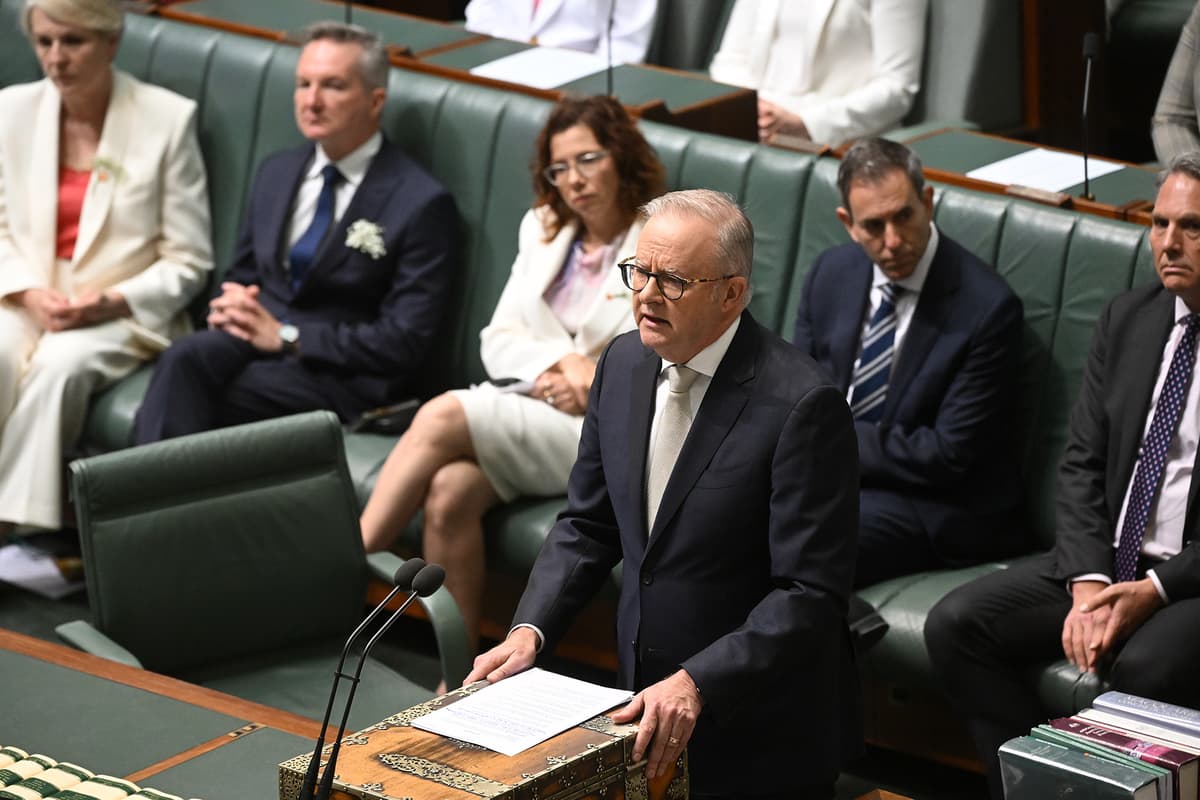
Photo: Prime Minister Anthony Albanese delivers a tribute for Independent member for Indi Helen Haines (AAP Image/Lukas Coch)


From time to time, the Canberra bubble bursts and we get to see politicians who are real and share our vulnerability and humanity. When a white Land Cruiser mowed down popular independent politician, Helen Haines, the divide between politicians and the community collapsed- at least, for a time. The horrifying incident prompted a genuine and authentic outpouring of grief – both by the community and the politicians who represent them. Politicians spoke from the heart about their distress at what happened to Haines and their anxiety that something similar might happen to them.
Within hours of the news, an emotional Prime Minister Albanese told the ABC’s Sarah Ferguson:
“The concern, if you look at anyone’s social media feeds and look at the comments, people will say things that they would never say face to face. But the temperature has undoubtedly been increased, not just here in Australia, of course.”
Was Albanese too quick to attribute blame to social media for what happened? Undoubtedly. The driver has since denied any deliberate act and the police investigation and criminal proceedings have a long way to go. We may not know what prompted the incident for quite some time, if ever.
Nevertheless, the Prime Minister’s reaction conveyed an anxious truth about modern politics. Australia’s politicians are increasingly facing death threats and other expressions of frightening anger. They are scared and they are not alone.
In the last 12 months in Germany, offences directed at politicians and political candidates rose 40 percent. Britain has seen two members of parliament murdered in the last decade.
Back in Australia, the Australian Federal Police have recorded a quadrupling of threats against federal politicians since 2020. AFP chief Krissy Barrett has noted that in 2024–2025, “the AFP received 951 reports of harassing, nuisance, offensive and threatening behaviour against high office holders, federal parliamentarians, electorate offices, and protected establishments”. In 2025-26, it rose to 1067. “A very significant number of our priority cases would have an online component,” she said. “The internet [is] one of the most potent incubators of extremism.”
In the days before the violent attack on Helen Haines, Liberal Party frontbencher, Angie Bell, told the Federal Parliament that Small Business Minister, Anne Aly, a Muslim who has previously been the subject of criminal threats, should be “stoned in the square”. Aly then received 19 online death threats. Two days after the attack on Haines, an incident occurred at the electorate office of WA Labor MP, Hannah Beazley, resulting in criminal charges being laid. On that same day, police were called to the electorate office of Minister for Communications, Anika Wells, after threats were allegedly made to staff, resulting in the temporary closure of the office, pending a security upgrade.
In the last month, three men were charged by police over separate threats to politicians and government officials, and another three were sentenced by courts.
Last year, Australian Security Intelligence Organisation Director-General Mike Burgess, warned that politically motivated violence was among the agency’s fastest growing security concerns, driven by “grievance narratives, conspiracies and online echo chambers”.
Quality research, analysis, explainers and factchecks from experts you can trust.
Politicians share the grim business of dealing with an increasingly angry and frightening chorus with many others. Abuse, death threats or assaults are routinely directed at teachers, journalists, children, women, First Nations people, Jewish, Muslim, Chinese and Indian communities, professional sports players, the queer community, nurses, ambulance officers, doctors and hospital staff, amongst many others.
To understand why this is happening, it pays to follow the money.
Social media is the one industry dominated by a handful of giant corporations that profit from death threats, fraud, racist abuse, gendered violence, incitement to terrorism and addiction. Social media is now the most popular source of news and information and has evolved into a refuge for the worst dimensions of humanity. The more harmful material that spreads online, the more attention people devote to it and the more profit the industry generates.
Social media has been used to incite what the ICJ has determined to be a genocide in Myanmar, live broadcast a mass killing in New Zealand, facilitate child sex grooming and stoke terrorist attacks and other acts of violence. In 2015, an online terrorist based in Florida incited a jihadist attack on me. He was later arrested by the FBI and imprisoned for 10 years for planning to bomb a commemoration ceremony for victims of 9/11. Big Tech social media companies have commercialised the production of rage and inciting violence across the globe.
The impact of online degeneracy on our lives is neatly demonstrated by the experience of our teachers. Studies from Monash University and the University of Adelaide have found a rise in “misogynistic radicalisation” of boys in school, a product of their consumption of online manosphere material. Teachers are reporting being subjected to sexual harassment, degrading behaviour and violent threats.
For several years, the Prime Minister has been calling for “the temperature” of political debate to be dialled down, pleading for politicians and those in the media to show leadership in their behaviour. Such calls will not have any real effect because they are no match for the social media rage machine.
This week the Federal Parliament will decide whether to curb the rising tide of rage and violence when it considers passing a new digital duty of care law. The legislation would impose a legal duty on social media behemoths to proactively prevent their platforms from harming users by hosting dangerous content including child sex abuse and terrorist material. While the current bill addresses gendered hate speech, inexplicably it will greenlight other forms of hate speech including racism and homophobia. Indeed, the legislation may have the unintended consequence of encouraging more online racist and homophobic hate speech.
Federal politicians are not in a bubble on this issue. They have skin in the game just like the rest of us. The choices they make this week will determine whether the rage machine can be tamed.
Josh Bornstein is the Director of Corporate Regulation at the Australia Institute.
Advertisement


