Politicians are rethinking how Victoria’s house of review, the Legislative Council, is elected – with implications for how fair and representative the state’s elections are.
Incremental change could make the system less fair and proportional, whereas a larger change could make it much fairer and more proportional.
How does the Victorian system currently work?
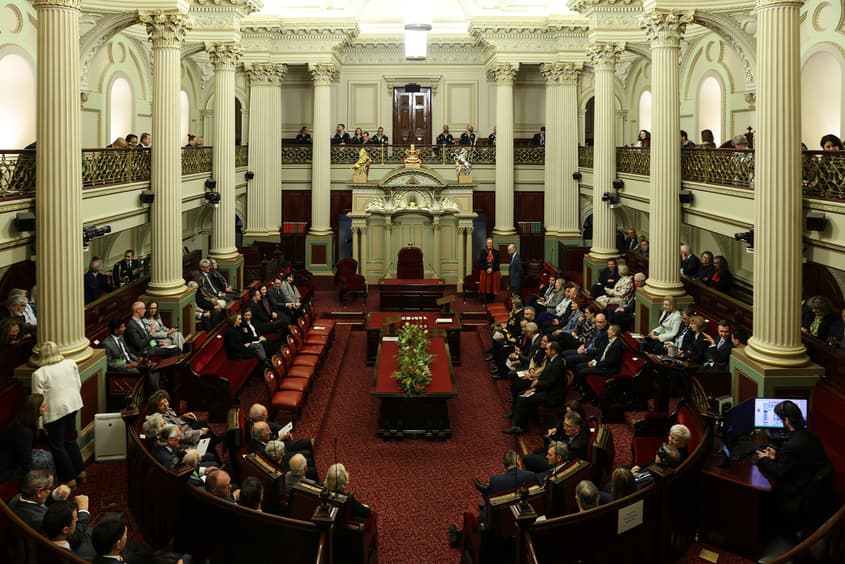
There are two houses of Parliament in Victoria: the lower house, the Legislative Assembly, with 88 local members, and the house of review, the Legislative Council, with 40 representatives of the eight regions of Victoria.
The Legislative Council is the state’s equivalent of the Australian Senate, as senators represent states and territories rather than local electorates.
Who forms government is decided in the Assembly (where Labor holds 54 of the 88 seats), but new laws must pass the Council (where Labor holds just 15 of 40 seats).
The Legislative Council is elected via a method that has fallen out of favour elsewhere in Australia: “group voting tickets” (GVT).
In GVT, those voting above the line have their preferences distributed according to the instructions of the group that they voted for. Since most people vote above the line, preferences are mostly distributed according to agreements between political parties.
What’s wrong with how the Legislative Council is currently elected?
There are two concerns.
Dividing the state into regions makes elections less proportional: Each region elects five members proportional to the vote, so a party with two-fifths of the vote in a region is guaranteed two of the region’s five seats.
It is hard for a small party with wide but shallow support to break into the Legislative Council, even if they win say 5% of the vote. In other states, 5% would elect two parliamentarians.
Under GVT, minor parties can partially overcome this problem by coordinating. Imagine three parties with 5% of the vote each (15% total). If they direct preferences to each other, they can make it very likely that one of them wins a seat – though they cannot guarantee which one.
Group voting tickets encourage deal-making instead of voters expressing their own preferences: GVTs direct voters’ preferences according to deals between groups rather than the preference of the voter. You can either laboriously number “below the line” or vote “above the line” and trust that the party you vote “1” will assign preferences responsibly.
This is also a strength. A political party will vet other parties before preferencing them and may have a better idea of their true positions.
GVTs also prevent votes from exhausting prematurely and coordinate the minor party vote so the number of minor party representatives elected is closer to their vote share.
Nonetheless, GVTs are vulnerable to exploitation. Political parties with attractive names have reportedly been formed to “harvest” votes and redirect them to another party.
Far-right provocateur Avi Yemeni has proposed creating a “Free Palestine Party” that would trick left-wing and Muslim voters into preferencing right-wing parties.
In practice, it’s doubtful Mr Yemeni will find enough members to register the party.
But even a genuine party might strike deals with ideologically different parties for electoral advantage, though most voters would allocate preferences differently if doing it themselves.
What is a fairer alternative?
A simple, fair way to abolish GVTs while improving proportionality is to elect the upper house from a single state-wide electorate. NSW, South Australia and Western Australia all elect their upper houses this way.
With 40 seats up for election in Victoria, winning one seat would require 2.4% of the vote, attainable for minor and micro parties and independents. Victoria’s current division into eight regions means the quota for election is 16.7%.
There is a concern that the low quota encourages speculative micro parties with little individual hope of being elected, leading to unwieldy ballot papers. This issue exists with GVTs as well, and could be addressed in other ways, as Western Australia did when it replaced regions with a single state-wide electorate.
What are the prospects of reform?
Abolishing GVTs requires a vote of Parliament, but abolishing the eight regions requires a referendum.
When the Victorian Electoral Matters Committee looked at this issue, they recognised that “Eliminating group voting tickets without changing the electoral structure is likely to make it harder for smaller parties to be elected”, yet still argued for GVTs to be abolished immediately while regions would, at best, go to a vote years later.
Election analyst Malcolm Mackerras has warned that “the machines of Victoria’s big political parties: Labor, Liberal, Nationals and Greens … want to cherry-pick between the two characteristics of the present system”.
Once GVTs have been abolished to the benefit of larger parties, they will have little incentive to continue with the second part of the reform and abolish the regions.
It would be unfair to abolish GVTs while the region structure remains. Both reforms should happen together.