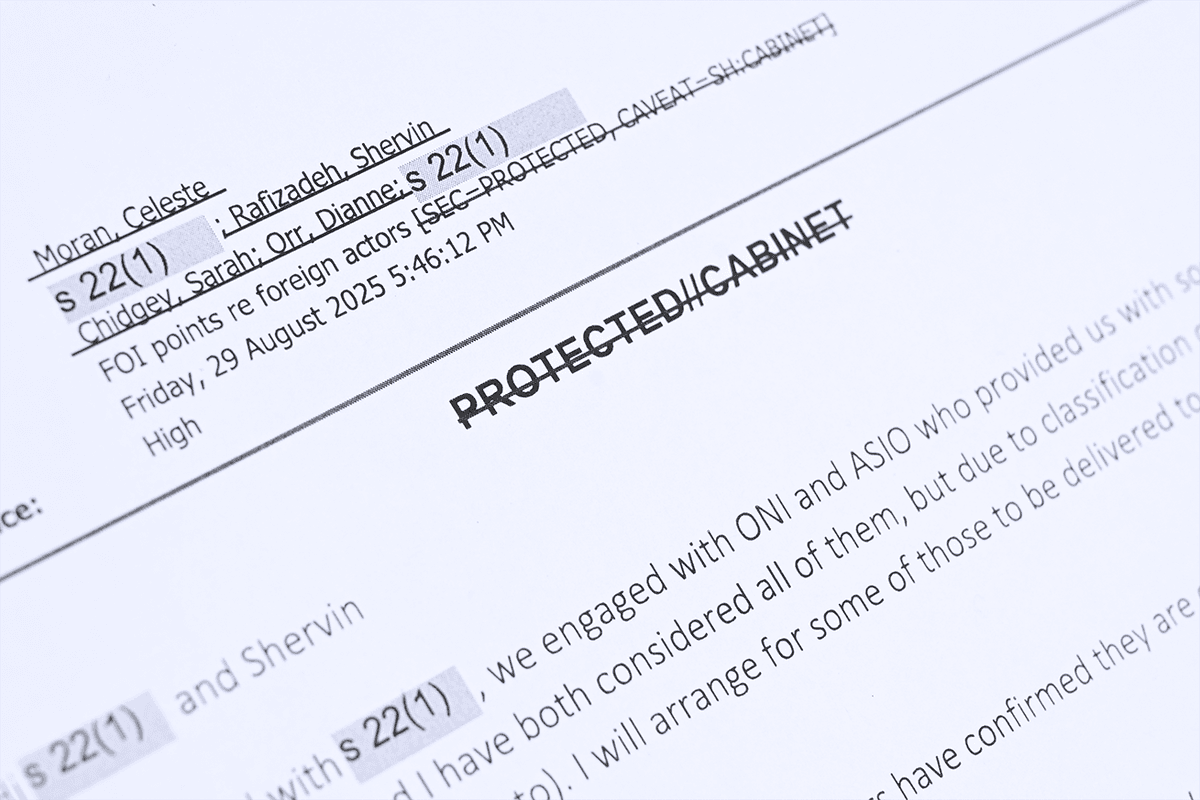
I wrote earlier this year about the power of freedom of information (FOI) laws – how individuals and journalists alike use them to expose shady government behaviour.
And the hits just keep coming.
Here’s nine things Australians found out this year thanks to freedom of information and right to know laws:
1. SA Voice to Parliament election not advertised well
The ABC revealed several failures when advertising the SA Voice to Parliament election, with many South Australians unaware it was even taking place.
2. Unfit for purpose NT youth mental health ward still operating
FOI laws gave the ABC access to documents that revealed the Northern Territory’s only youth mental health impatient ward was operating, despite being unsafe and not fit for purpose, posing an “unmanageable” risk to patients and staff.
3. Queensland Museum sponsored by fossil fuel giant Shell
Queensland Museum was exposed for covering up a sponsorship from fossil fuel giant, Shell, following the release of documents under the state’s information disclosure scheme. After charging more than $2,200 in application fees, Queensland Museum released 21 documents and 27 partial documents – refusing access to 454 pages of material. Scrutiny by the state’s Information Commissioner might mean that Queensland’s right to information laws have more to deliver.
4. Victorian sexual misconduct reports not referred for Working with Children Check review
According to documents obtained by the ABC, 10 substantiated sexual misconduct reports were not referred for Victorian Working with Children Check review. The power to not make those referrals is discretionary, but former commissioner Liana Buchanan told a parliamentary inquiry last year that she would only decide to not refer cases “in circumstances where there were no sexual elements to the conduct whatsoever”.
5. Suspected overdose every two weeks at Crown Melbourne
Data obtained from Ambulance Victoria showed that paramedics were, on average, called to the Crown Melbourne for a suspected overdose every two weeks in 2024 and 2025. Less than a fortnight ago, the ABC reported that there were 59 call outs during that period, but that no action had been taken by the Victorian government to curb them.
6. Minimal planning for Tasmania’s fish deaths
The Bob Brown Foundation recently used Tasmania’s Right to Information legislation to expose the state’s handling of salmon deaths and the EPA’s oversight of the 3,000 tonnes of dead fish. The ABC reported last week that “Tasmanian regulators were having to chase the trail of mortalities … with minimal planning for an environmental event of such a scale.”
7. Tasmanian government enterprises defy own government’s transparency request
A day after the fish deaths expose, ABC reported that Tasmanian Government Business Enterprises (GBEs) had “defied” the Premier’s request to create disclosure logs documents obtained under the state’s Right to Information laws. According to Minister for Business, Eric Abetz, of the 15 GBEs identified, nine didn’t even respond to the requests.
8. Attorney-General’s Department deliberately delayed the release of documents to dodge Senate scrutiny
The Canberra Times revealed that the Attorney-General’s Department had delayed the release of documents sought by The Australia Institute under freedom of information, to escape facing tricky questions at the last Senate Estimates. As the Canberra Times reported, “the department charged with administering the Freedom of Information Act delayed the broad release of documents obtained under the legislation, to do with a controversial effort to overhaul the FOI Act itself.” How ironic.
9. Treasury “takes out the trash” on Fridays
Commonwealth Treasury was caught by the Guardian Australia “taking out the trash” on Fridays – nearly half of the FOI applications released were at the end of the week. What’s more, Treasury was found to not even have a policy for dealing with FOI requests.
—
These news stories show that FOI plays an important role in Australian democracy, but governments too often drag their feet on releasing information that the public is entitled to. The ABC reported in April that requests for documents from Victoria Police are now slower than at any point in its history, with those seeking access now facing a nine-month wait.
Across the country, FOI laws play an important role in Australian democracy: they allow the public to access information about the governments that represent them. These news stories from just the past six months show that the grind never stops.