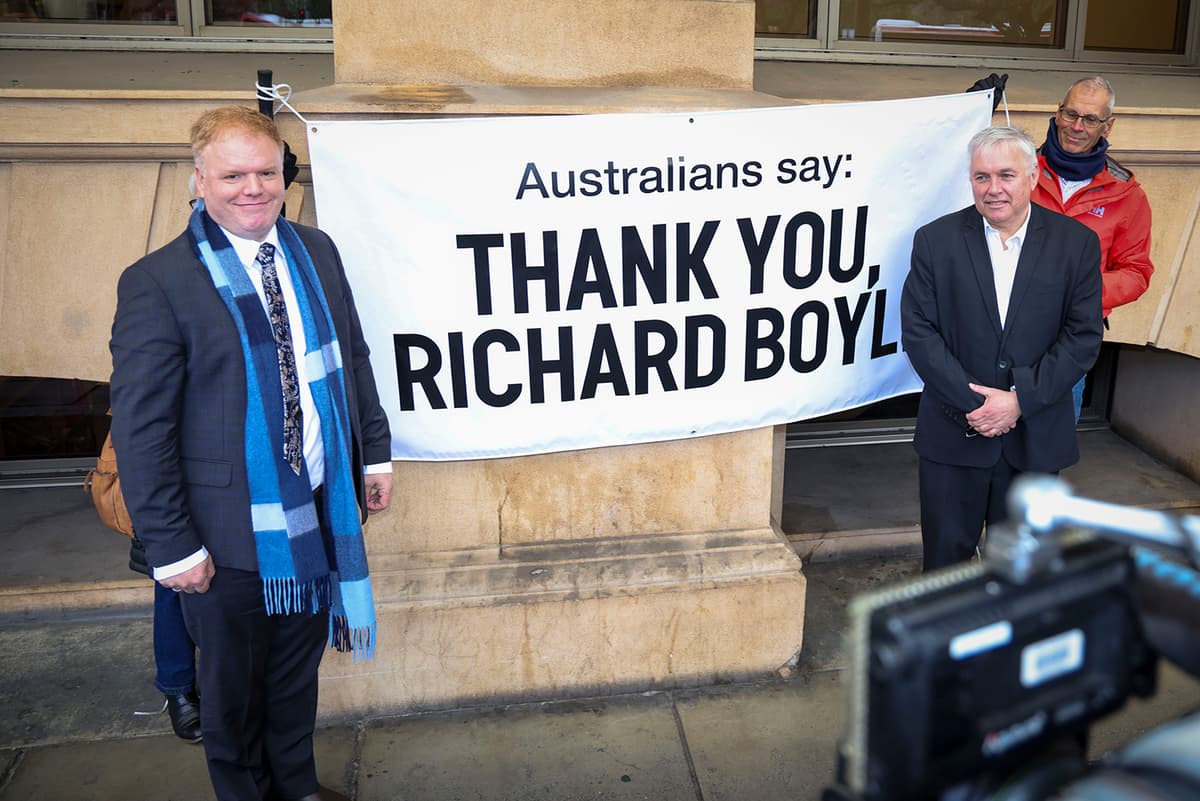
Former Australian Taxation Office (ATO) whistleblower Richard Boyle has spoken publicly about his decade-long ordeal, saying it left him with “complete and utter psychological destruction”.
Speaking at the fourth National Whistleblowing Symposium, Mr Boyle reflected on facing jail after exposing what he described as “absolutely appalling” debt collection practices at the ATO in 2017.
“It was heinous,” he said. “I feel that this situation that I blew the whistle on was really the tax office version of Robodebt.
“It, no doubt, caused suicides.”
A Senate inquiry is examining the Whistleblower Protection Authority Bill, introduced to Parliament in February 2025 by crossbench MPs and senators.
The bill, backed by Senators David Pocock and Jacqui Lambie, along with independent MPs Andrew Wilkie and Dr Helen Haines, would establish an independent federal body to receive whistleblower disclosures, enforce legal protections and safeguard people who expose corruption and wrongdoing in government and business.
Mr Boyle originally faced 66 charges but, after a seven-year legal battle, struck a deal with prosecutors and pleaded guilty to four criminal offences relating to recording and disclosing protected information, including covertly recording private conversations and documenting another person’s tax file number.
“I had no doubt that my actions … stopped this action [unethical debt collecting] dead,” he told the audience.
“And that was very worthwhile for me to do.”
However, he said the toll on family and friends was “indescribable”.
“I was really suffering from what could only be called a complete and utter psychological destruction. It’s not pretty,” he said.
In its Senate inquiry submission, the Human Rights Law Centre pointed out there are currently nine different whistleblower laws in operation, noting whistleblowers may “have to navigate multiple contradictory disclosure regimes”.
“We have seen firsthand the negative impacts that piecemeal and complex whistleblowing laws are having on transparency and accountability in Australia,” said author Kieran Pender.
The organisation also said there had not been a single successful decision for a whistleblower under the primary federal public or private sector laws.
“High-profile cases of prosecutions against whistleblowers have had a chilling effect on others,” he said.
“Whistleblowers should not face the risk of criminal penalty in speaking up in the public interest.”
Most Australians support the idea behind a dedicated protection authority.
A national survey by the Australia Institute found more than four in five (87 per cent) Australians support or strongly support stronger legal protections for whistleblowers.
“In Australia, whistleblowers who have exposed alleged war crimes or the unfair treatment of small businesses face years of jail time,” said Bill Browne, Democracy & Accountability Director at The Australia Institute.
The survey also found four in five (84 per cent) Australians would support the introduction of a whistleblower protection authority and four in five (81 per cent) think that whistleblowers make the country a better place.
“Protections for whistleblowers are overwhelmingly supported by voters of all political stripes, from the Greens to One Nation,” said Mr Browne.
Transparency International Australia said in its submission that “loopholes, inconsistencies and poor enforcement mean that even legally protected whistleblowers often face retaliation, with few remedies in practice”.
Despite the enormous toll, Mr Boyle said he would do it again.
“Every whistleblower does have a fire in their belly and maybe a little belligerence,” he said.
“But it’s good belligerence. It’s belligerence for the purposes of truth-telling and making sure that actions of any institution, whether it’s private or public, doesn’t result in harm to the community.”