A third top level recruitment process is under way for the National Anti-Corruption Commission – to appoint a new commissioner and deputy commissioner following the resignations in May of Paul Brereton and Nicole Rose, both two years short of their five-year terms.
Wed 26 Aug 2026 16.47 AEST
Photo: AAP Image/Mick Tsikas


A third top level recruitment process is under way for the National Anti-Corruption Commission – to appoint a new commissioner and deputy commissioner following the resignations in May of Paul Brereton and Nicole Rose, both two years short of their five-year terms.
The first two processes – in 2022 and 2023 – were characterised by secrecy. Even members of parliament’s NACC oversight committee, the PJC-NACC, were given little information on how the recruitment was conducted. The jobs were publicly advertised but then the shutters came down.
In acknowledgement of the profound public disappointment in the NACC’s performance to date, following Brereton’s resignation Attorney-General Michelle Rowland promised a more transparent recruitment process and a “reset” of the beleaguered organisation:
I’m engaging across the parliament to look at ensuring … that there is transparency of the merit-based process … [and] also realising there is an opportunity here to reset the Commission and to ensure there is public confidence in this very important institution. (Bold added.)
This investigation, based on documents released under Freedom of Information, shows that nothing of substance has changed. The secrecy that characterised the two earlier recruitment processes looks set to be repeated. The government appears just as intent on evading scrutiny and oversight of this crucial third recruitment process.
Despite having been repeatedly advised by integrity experts to establish a recruitment process at arms-length from government for the top NACC roles, the Albanese government has chosen to stick with the ‘merit and transparency’ guidelines that have been in place since 2008.
These guidelines were strongly criticised by Lynelle Briggs in her 2023 “Jobs for Mates” report.
The current attorney-general, Michelle Rowland, appears to have led members of the NACC oversight committee and respected integrity advocates to believe that the latest recruitment process is a marked improvement – because there will be an “eminent” independent person included on the government-controlled selection panel.
Yet we can reveal that the first recruitment process also featured an eminent independent member on the selection panel.
Not only was this information kept from the public, it was also withheld from the PJC-NACC.
“It’s extraordinary as a member of the Parliamentary Joint Committee on the NACC to be finding this out three years after the event and only through an FOI,” Greens Senator David Shoebridge told us.
Despite Rowland’s promises of increased transparency, the government has refused to disclose – even to members of the PJC-NACC, which is bound by confidentiality – the names of the people it has appointed to the selection panel.
Integrity expert, and former counsel assisting the NSW ICAC, Geoffrey Watson SC, told the committee he was “absolutely shocked” when advised the government would not be telling the committee who’s sitting on the selection panel.
I’m absolutely shocked. I did not know they’re not going to tell you who’s on the selection panel…
Even if there were good reasons not to make the identity of the people on the selection panel public, surely there are no good reasons whatsoever to keep it secret from this joint committee. I just would not be able to understand that. … This committee has got an incredibly important role. You’re representing all of us when you’re sitting there. … You should be given as much information as possible.
At the 26 June parliamentary hearing of the PJC-NACC, deputy secretary of the attorney general’s department Sarah Chidgey said the selection panel for the current recruitment would comprise three or four members, with the final number not decided.
While the panel would include an “eminent independent person”, Chidgey stated that it would be “inappropriate and problematic” for the person’s name to be made public, citing the potential for that person to be possibly influenced.
When deputy chair of the committee, Victorian independent MP Helen Haines, and Senator Shoebridge both responded that eminent people were very experienced in dealing with that, and insisted the name be made public, Chidgey said only that the department “may” consider releasing the eminent person’s name after the appointments had been made.
We asked AG Rowland as well as the PJC-NACC chair, Labor MP Kate Thwaites, whether the government would be telling the committee the names of the panellists. Neither responded.
We asked Senator Shoebridge shortly before publication whether the committee had been told the names. He said it had not been.
Two recruitment processes were required to fill the positions of Commissioner and three deputy commissioners (DCs) because of an intervention by then attorney-general Mark Dreyfus.
The FOI documents show that Dreyfus initially directed that three permanent DCs be appointed, but after the selection panel had recommended three suitable candidates, Dreyfus changed course and instead hired two permanent DCs – Nicole Rose and Ben Gauntlett – and a temporary ‘acting’ DC – Jaala Hinchcliffe, former head of the Australian Commission for Law Enforcement Integrity.
An additional recruitment process was later required to hire a third permanent DC.
For both processes, the attorney-general’s department, led by secretary Katherine Jones, appointed a selection panel whose members decided on and interviewed a short-list of applicants, then recommended suitable candidates to the attorney-general.
The first recruitment process began in October 2022. Some 17 people applied for commissioner while 94 people applied for one of the three DC roles.
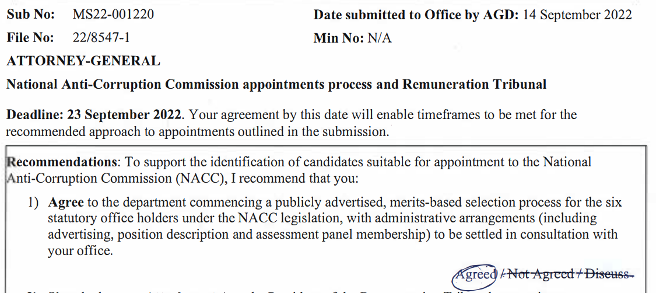
The six NACC office holder positions to be advertised were: Commissioner, three deputy commissioners, chief executive and Inspector.
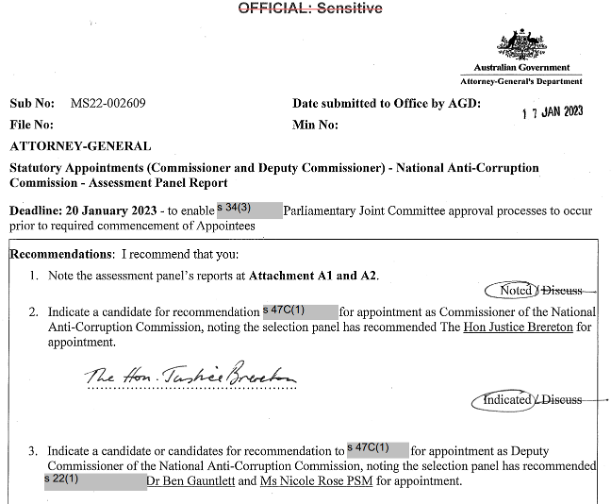
The selection panel recommended three people for appointment as permanent DCs.
The second process to hire a third permanent DC began in July 2023 and 50 people applied.
The first recruitment process had included an eminent independent member on the panel, but the second did not. We asked the Attorney-General’s Department the reason for the different approaches. It did not respond.
As has been reported, it was during this second process that Dreyfus tried to install then NSW Supreme Court Justice Stephen Rothman as the third DC. Rothman had been a Labor candidate for a Sydney seat in 1984, and contested Labor preselection for a different NSW seat in 2003; both unsuccessfully. He was widely known in NSW for his long-term party and union connections.
The PJC-NACC, which is tasked with vetting the attorney-general’s nominated candidates, raised objections to the nomination.
Led by its then chair, the late Labor senator Linda White, the committee believed Dreyfus and his department had given them insufficient information on Rothman, and failed to properly vet him. Senator Shoebridge said they were given “sanitised” documents. Rothman subsequently withdrew his candidacy.
Dreyfus then proposed Kylie Kilgour, who was approved as the NACC’s third permanent DC by the PJC-NACC in January 2024.
We obtained via FOI the names of the seven people who sat on the two selection panels. Aside from the sole external person, all panellists were senior government officials.
A separate set of documents, also obtained via FOI, revealed that four of those seven people – including the eminent independent person – declared actual or perceived conflicts of interest.
The first selection panel:
The merit and transparency guidelines require the departmental secretary to be panel chair and the APS Commissioner to be included.
Jones, as departmental secretary, was responsible for appointing Davis and McMurdo.
The FOI documents show that deputy secretary Chidgey advised Jones on how to ensure ‘transparency’. She wrote:
“Independence from the APS: Given the standing of the NACC, consideration should be to [sic] including an ‘independent’ voice on the panel from outside the APS. This will also provide assurance around the transparency of the appointments process.”
Quality research, analysis, explainers and factchecks from experts you can trust.
Jones selected former justice Margaret McMurdo as the independent panel member.
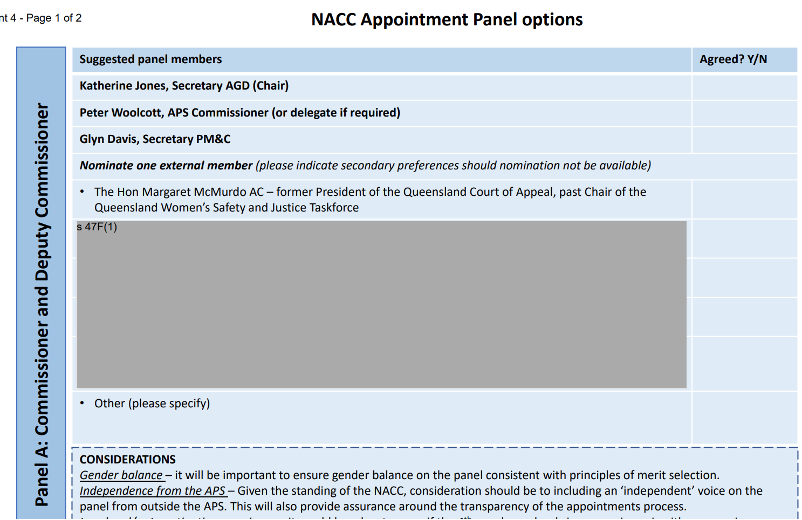
An undated excerpt included in the FOI release, from an unidentified longer document that was not supplied. Note the final point.
Two of the four panel members declared conflicts; whether they were actual or perceived is unknown. McMurdo made multiple declarations regarding the appointments of commissioner and DCs; Woolcott also declared a conflict. The detail of the declarations was fully redacted.
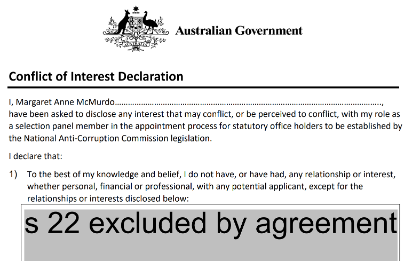
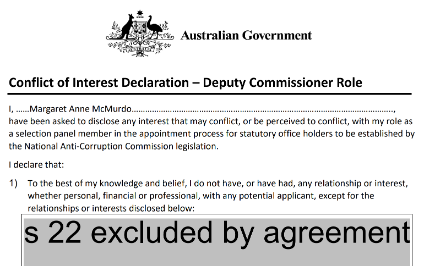
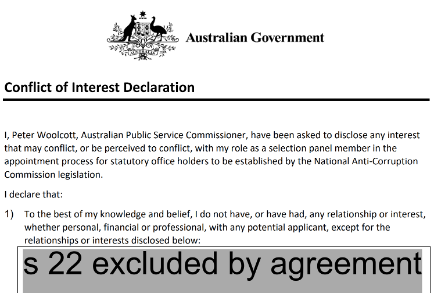
Chidgey’s conflict declaration form stated:
I have had limited professional interactions with (redacted) and (redacted) but do not consider that these interactions could conflict, or be perceived to conflict, with my role as Chair.
The then NACC commissioner Paul Brereton made what appear to be multiple declarations, the details of which were redacted.
The third panellist, the then APS Commissioner Gordon de Brouwer, did not complete a conflict of interest form. The documents say an administrative error meant he had not received the form and that he declared verbally to the panel that he had no conflicts.
On 22 June, Attorney General Rowland issued a media release announcing that applications were open for the positions of commissioner and deputy commissioner:
Applications will be assessed by an eminent panel to determine a shortlist of suitable candidates for the Attorney-General’s consideration and decision. (Bold added.)
The AGD later confirmed there would be one “eminent” independent person on the panel.
Helen Haines, who has been closely involved with the establishment and opening years of the NACC, has been deputy chair of the PJC-NACC since it was formed.
At a hearing held by the PJC-NACC on 26 June, four days after Attorney-General Rowland’s media release, Haines was upbeat:
I’m really happy that the Attorney-General has applied her mind to this — that we’re having a selection panel and that the Attorney-General has instigated this external person to be on this panel. (Bold added.)
It appeared from Haines’ remarks that she may not have been aware that the first recruitment process had included an eminent independent person on the selection panel.
We put a number of questions to Haines to clarify her understanding, but she declined to respond, saying that as deputy chair it was “not appropriate” for her to comment.
Meanwhile, prominent integrity experts, who have been working with governments for decades to establish a NACC, believed the inclusion of an eminent person on a selection panel was an upgrade on previous processes.
The Centre for Public Integrity’s Dr Gabrielle Appleby said:
The Centre for Public Integrity does welcome the government’s commitment as a step forward to a transparent, merit based appointment process.
Within weeks of promising more transparency, Rowland was defending the NACC’s earlier recruitment processes, stating several times that the current recruitment process would be run the same way as previously.
In her media release of 22 June:
The Government is committed to strengthening the NACC, including by continuing to make appointments through an open, competitive and merit-based selection process. (Bold added.)
In the House of Representatives on 1 July:
The Government confirmed that appointments will be made through an open, competitive, and merit-based process, as all the appointments to the National Anti-Corruption Commission have been made. (Bold added.)
The secrecy around NACC recruitment is a deliberate choice of the government, according to integrity organisation the Accountability Round Table (ART).
The ART, which works to strengthen government accountability and democratic practices, is a non-partisan organisation with a board that includes senior legal practitioners, former judges, former parliamentarians and others with substantial experience of Commonwealth integrity arrangements.
Its submission to an ongoing NACC parliamentary inquiry stated:
The omission from the NACC Act of the need for an open appointment process or oversight by an independent body was a choice, not an oversight.
The ART also noted that the government had put in place transparent frameworks for two other integrity bodies – the Australian Human Rights Commission and the Administrative Review Tribunal – but had taken a different approach with the NACC:
These frameworks require published selection criteria, an independent assessment panel, the publication of panellists’ names, an explicit statutory prohibition on ministerial direction of panel members, and prescribed steps before an applicant can be assessed as suitable. The NACC Act framework, drafted by the same government, contains none of these features. (Bold added.)
The ART said that immediate reform is urgently required to restore public trust. It is a statement for which this investigation provides strong evidence.
We put a number of detailed questions to Attorney-General Michelle Rowland and her department for this article. Neither responded.
We put detailed questions to former attorney-general Mark Dreyfus. He did not respond to the questions and directed us to contact the attorney-general’s department.
Michelle Fahy is a freelance journalist/researcher focusing mainly on the secretive connections between the arms industry and government. She has worked with ABC Four Corners, Crikey, The Point, Declassified Australia, and others.
Elizabeth Minter is a freelance writer and editor who worked at The Age for 20 years and at The Guardian newspaper in London for more than seven years.
Jommy Tee is an independent researcher and citizen journalist. He was a former long time career public servant before retiring.

