

While the cameras chased a garland snub, Tuvalu told the world what COP31 must deliver
If you only followed mainstream coverage of the Pre-COP Leaders' visit to Tuvalu, you could be forgiven for thinking the big issue was headwear.
It isn’t always easy to keep up with what’s happening in the US. “Shorter America” is a series where Dr Emma Shortis loops you in on what’s going on in America and shares news and analysis that you can trust.
Fri 2 Oct 2026 11.07 AEST
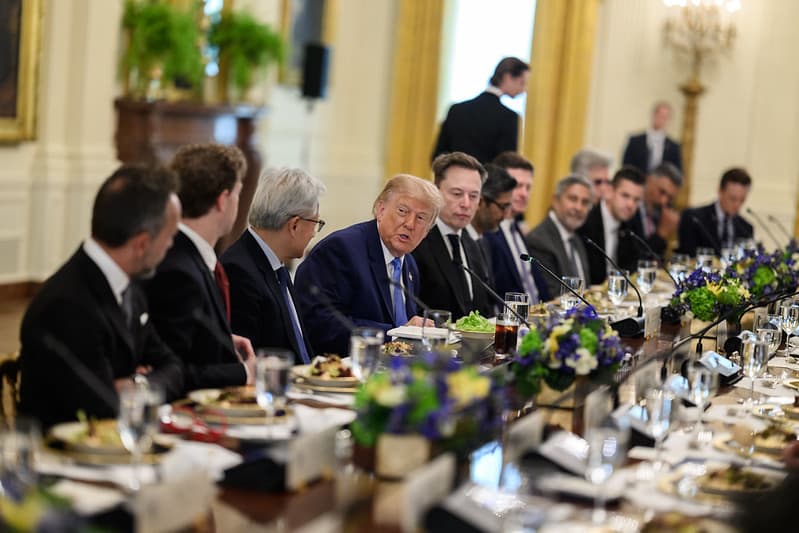
Photo: The White House/Flickr
If you only followed mainstream coverage of the Pre-COP Leaders' visit to Tuvalu, you could be forgiven for thinking the big issue was headwear.
There’s tension in the air at this pre-COP. Tension between Pacific Island states and Australia. Tension over the world leaders who have not turned up. Tension over Australia’s continued expansion of coal and gas, even as it asks to be applauded for its climate leadership. And tension over how to call out a powerful partner whose aid and cooperation you still need.
The former Fox News host Pete Hegseth is at it again, giving an upside-down world version of a Ted Talk on the “State of the Force”. And the state of everything is…grim.
This week:
US Secretary of Defense Pete Hegseth gave another speech this week. And…I’m not quite sure where to start. Or if I even want to. If you’re game, you can watch the full ramble on C-SPAN. If you’re not (fair), the top line summary is that it’s exactly what you’d expect: full of the now all too familiar white supremacy, gender insecurity and radical religious fervour. Oh, and Elon Musk is back in the fold, co-leading “Project Meridian”, a study of the future of warfare. Musk will be joined by head of Anduril (sound the tech dystopia alarm!) and…Newt Gingrich (???).
It’s hard to do straight up reporting on all this, because it is at once so ridiculous and so dangerous. And what’s left of the old national security establishment in Washington DC is really struggling with it. Take this example: a piece in Foreign Policy titled “Everyone Got Pete Hegseth Wrong“. Fair, maybe – there’s certainly an argument that Hegseth was widely underestimated. But then take this line: “What, then, is driving Hegseth? His policy preferences and ideology remain remarkably opaque even at this point.”
Um, wot? Hegseth has told us, repeatedly, what is driving him. That same piece then goes on to say he doesn’t “appear to have an explicit geopolitical or strategic set of principles” but that he’s been busy instead with “culture war issues”. Which are apparently not ideological?
The thing is: Hegseth’s “culture war” is explicitly ideological. This excellent Mother Jones piece covers the depths of Hegseth’s Christian nationalism. We know who Hegseth is and what he represents. And we know, too, that Australian Defence Minister Richard Marles describes that very same man as a “good friend“.
Quality research, analysis, explainers and factchecks from experts you can trust.
Thumbs up, everybody. And then thumbs down, and junk the smiles.
Hegseth is very busy reshaping the United States military in his image, as the Trump administration attempts to reshape the world. Despite the radical change underway – a change we can all see, and that the Australian Prime Minister has explicitly acknowledged – the Australian government is ploughing on, doubling down on the US alliance, full-steam ahead.
This is all driven, as we’ve written before, by old assumptions. Or by, as this great piece (also Mother Jones) argues: by “The Religion of National Security“. That has big consequences for our democracies; partly, as this piece in the Politics and Rights Review suggests, because the “National Security State” might well be “expanding beyond democratic control”, and partly because it blinds too many to the way the world is being reshaped around us. This grim piece in the Boston Review outlines one of the ways that is happening: through Trump’s “Board of Peace”, which is not only illegal, it is an “exit model” from the international legal order “being built in Palestine but [that] may be intended for the world.”
In Australia, though, it does seem as though the conversation is changing – despite the government’s reticence. The ascension of Senator David Shoebridge to the leadership of the Greens may well force more examination of our established national security assumptions. Shoebridge has recognised what is happening in the United States for what it is: we had a very interesting conversation about just that on After America last year.
But of course, don’t hold your breath. As this analysis of foreign policy coverage on the ABC’s 730 by Ette Media, outlines, much of our national conversation is badly lopsided.
That’s nothing new, of course, and it’s certainly not confined to issues of foreign policy and national security. As the brilliant Kate Manne argued in an arresting piece in The Cut this week, it also applies to violence against women, and specifically violence against women on college campuses.
Finally, regular readers will know that I am loathe to recommend an Ezra Klein podcast. But there are exceptions. I was particularly moved by his conversation with Michigan Senate candidate Abdul el-Sayed, who offered a radical reframing of how we talk about all this: “speaking truth to pain“.


