Despite the undeniable numbers, a ‘gas shortage’ is still put forward as one of the most common rationalisations for building massive new gas exploration and extraction sites.
By Ketan Joshi
Thu 11 Sep 2025 15.57 AEST
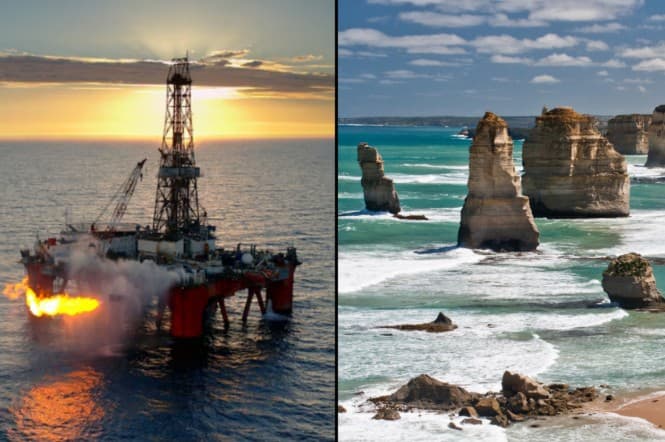


Recently, we published a video showing a huge new gas drilling rig in Victoria, within sight of the 12 Apostles – a globally recognised tourist hotspot. As Dr Emma Shortis says in the video:
“We are putting our coastlines at risk to extract gas we don’t even need. Australia already produces way more gas than we use….Australia doesn’t have a gas shortage. We have a gas export problem”
Despite the undeniable numbers here, a ‘gas shortage’ is still put forward as one of the most common rationalisations for building massive new gas exploration and extraction sites, like the monster off Victoria’s coast.
A little-known data set buried in Australia’s government energy accounts lays it out quite nicely, and quite dramatically.
You may have seen something like this before in our charts, like here. But we’ve discovered recently that you can also zoom down into the state level, and see which regions of Australia have the most significant oversupply problem for fossil gas.
Western Australia and Queensland are Australia’s big fossil gas miners. They produce far more than they consume with the balance exported. The gap between Queensland’s use of gas and its extraction of gas quadrupled a decade ago:
This data shows that while Victoria has recently been presented as ‘needing’ more gas, in fact the state produces far more than it uses. The state provides gas to other states, including exporters, but is regularly criticised by the gas industry for limiting gas extraction, particularly a controversial and broadly hated method known as ‘fracking’.
By contrast, the data shows that SA produces little gas and has been a net taker of gas in recent years. Yet South Australia is rarely criticised for failing to develop enough gas. Perhaps because it is the home of gas company Santos, where the government is “at the disposal” of the gas industry.
Returning to Victoria, while the state’s supplies have been surprisingly strong, the state’s consumption of gas has been declining for years:
Just to be clear: In FY23, Victoria saw its lowest gas consumption since the late 1980s. The last time Victoria used this little gas Dirty Dancing was in the cinemas and Rick Astley tapes were selling fast.
In fact, along with South Australia, Victoria is seeing a plummeting rate of domestic fossil gas consumption – raising the question of why the state is opening new gas exploration sites in highly sensitive areas (let alone exploring for new gas at all):
The key reason gas consumption is declining in these states is that gas prices have gone up. Gas exports have dragged Australian domestic prices up to international levels and customers are sick of it.
This has led to a related reason for declining gas consumption – accelerating electrification, particularly in Victoria where there has been concerted legislative effort to get consumers off gas for residential homes.
Victoria already produces more gas than it uses – it does not need to be scrambling to open up new gas fields; least of all in protected and sensitive areas.

