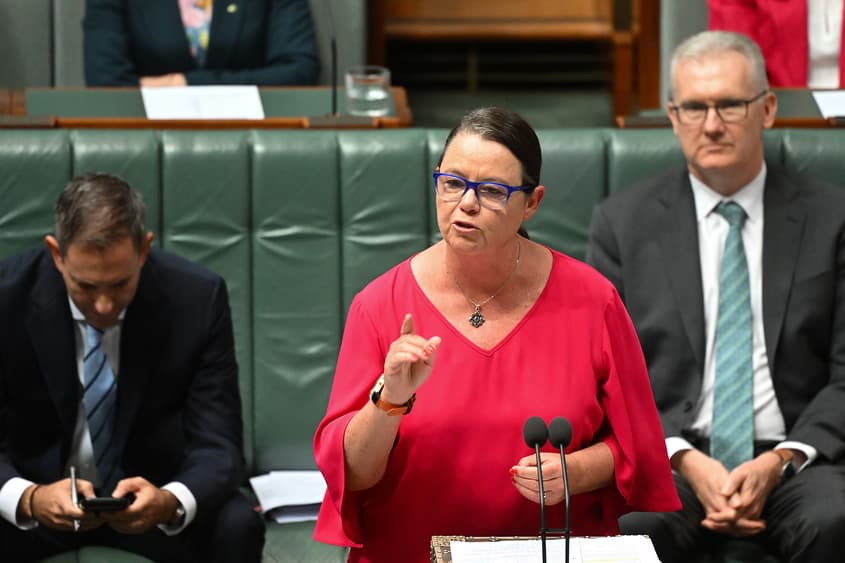
Author of Vulture Capitalism, Grace Blakeley, has told Australian consumers they need to stand up to the huge companies which dominate their way of life.
Wed 10 Dec 2025 15.00
Photo: AAP Image/Darren England


Author of Vulture Capitalism, Grace Blakeley, has told Australian consumers they need to stand up to the huge companies which dominate their way of life.
In a webinar with Australia Institute co-chief executive, Dr Richard Denniss, Grace Blakeley said powerful companies had too many politicians “in their pockets”, which gave them the political power to match their economic dominance.
“What we need to figure out is how to shift the balance of power away from big business, big finance and the politicians in their pockets, and towards citizens, towards workers, towards ordinary people,” Ms Blakeley said.
“That requires policy changes. But it also requires on-the-ground organising … like ordinary people organising into tenants’ unions and taking back power over their landlords; communities organising to take on big developers.”
Ms Blakeley said modern capitalism had reached the point where the world’s biggest companies were so rich and powerful, they could crush rivals and hold creditors to ransom. And those creditors can include anything from a tiny start-up to an entire nation.
In her book, Vulture Capitalsm, she cites the example of a vulture fund buying the debt of the poor African nation of Zambia, then suing the Zambian Government when it inevitably defaulted on that debt.
The end result is that instead of prioritising healthcare, education and infrastructure, the Zambian Government is now, first and foremost, a creditor to a giant global company.
“Large corporations (are) going into poor countries, extracting resources, exploiting unfair international rules to do things like sue the government through these investor-state dispute settlements … rules that embed corporate power at the level of the global economy,” Ms Blakeley explained.
She says the same thing is happening at a national and local level, including here in Australia. Apart from crushing any local competitor – big or small – powerful global companies can dominate the labour market, which takes them into the homes and lives of millions of ordinary workers.
“When you have one big firm that dominates a labour market, whether that’s nationally or even locally, like a big Amazon warehouse moves into a small town and suddenly it’s responsible for 50 percent of employment, that firm can basically dictate conditions and wages to everyone in that area and they have no choice other than to accept it,” Ms Blakely said.
She warned that if good public policy was one solution to the vast power of huge corporations, a big snag is the growing influence these companies have over the politicians whose job it is to deliver that good public policy.
“Our governments have been captured by vested interests that have not just extraordinary economic power but extraordinary political power. Economic and political power are not separate,” she said.
“The money that flows between these two areas – between the state and big businesses and financial institutions – is astonishing. The lobbying that goes on and all of the other small interactions that take place mean that economic and political power are fungible. You can translate one into the other.”
“And because of that market power doesn’t just mean you get to dominate a market and you get to increase your profits. It means you get to shape politics and society much more generally. You’re setting people’s wages. You are determining where investment goes, what we’re innovating in.”
“They massively influence our politics. They influence not just who wins elections but the policies that are available. They influence the media, like what we’re able to even imagine in terms of where society could go next. So, market power isn’t just economic power, it’s also political and social and cultural power.”
Australia Institute co-chief executive, Dr Richard Denniss told the webinar that two good examples of how a handful of big corporations hold too much power in Australia were the nation’s banking and grocery sectors.
“When you’ve got four banks in Australia that have got 80 percent of the home loan market, when you’ve got two supermarkets that have got 80 percent of the grocery market, how can you deny that those firms will have significant political power?”
Dr Denniss says, in many ways, it’s even worse in the mining sector, where Australian politicians are so captured, they queue up to hand over billions of taxpayer dollars in subsidies to multi-national mining giants.
“Our conservatives love shovelling taxpayers’ money on to foreign gas companies,” he said.
He lamented the hypocrisy of politicians worshiping at the alter of the free market, yet happy to offer subsidies almost upon request … at the same time those same politicians appear immediately horrified at the prospect of helping ordinary Australians in need.
“The so called free-marketeers love subsidising the fossil fuel industry. The so-called free marketeers love subsidising our private schools,private health insurance, private hospitals.
“But you talk about increasing unemployment benefits and it’s all “oh, where will the money come from?” Dr Denniss said.
Advertisement

New research shows fossil fuel subsidies will reach $16.3 billion in 2025–26, rising faster than the NDIS. Handouts to mining giants are growing faster than support for Australians with disability.

Independent MP Sophie Scamps has questioned Prime Minister Anthony Albanese about reports that he offered his Liberal–National Coalition rivals extra staff in exchange for their support for the Labor Government’s crackdown on freedom of information rights. To her credit, then Opposition Leader Sussan Ley turned him down on this offer.
For the last decade, Australians have been continually told by the gas industry, media commentators and politicians we have a gas shortage. These claims are almost always used to pressure Australian governments to approve open new gas fields on the basis that the gas is needed to supply Australians and reduce gas prices.