

Mark Carney's speech has drawn international praise, as well as quick retaliation from Donald Trump. It’s a scenario Australia has been desperate to avoid.
Thu 29 Jan 2026 12.00
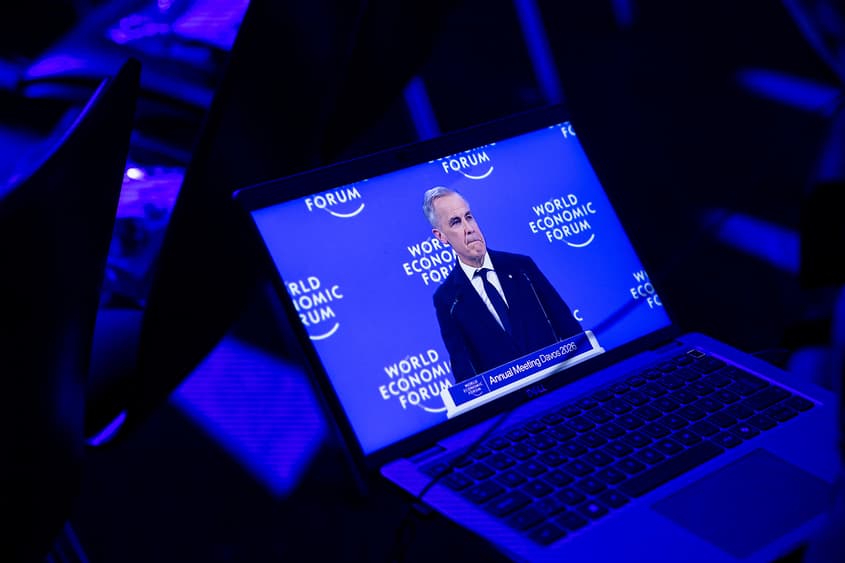
World Economic Forum/Flickr


Canadian Prime Minister Mark Carney’s popularity has surged after denouncing “American hegemony” during last week’s World Economic Forum in Davos, Switzerland.
Mr Carney used his speech at the annual meeting to push back against the Trump administration and declare a “rupture” in the established global order.
“He said it always was a partial fiction,” noted Dr Emma Shortis, Director of the Australia Institute’s International & Security Affairs.
The Canadian leader also urged mid-sized powers to “stop pretending” and unite against economic bullying by unnamed global powers.
“The Trump administration may have killed what remained of the post-war international order, but last week Canadian Prime Minister Mark Carney delivered its eulogy,” Dr Shortis said on the Australia Institute’s After America podcast.
In the speech – delivered to the world’s political, economic and intellectual leaders – PM Carney warned “the old order is not coming back”, adding that “nostalgia is not a strategy.”
“It was an outstanding speech, riveting, I think, from beginning to end,” said the Australia Institute’s International & Security Affairs Advisor Allan Behm.
Mr Behm said the Canadian Prime Minister is “the first one to talk truth to power” and pointed out other allies of the United States “have steered clear of doing anything that could be seen to irritate President Trump”.
True to form, Donald Trump was quick to retaliate, threatening to impose 100 per cent tariffs on Canadian products if Ottawa “makes a deal” with China.
While Mr Carney drew international praise, US Treasury Secretary Scott Bessent claimed on TV that the Prime Minister later “aggressively” retracted some of the comments while speaking with President Trump – something Mr Carney said was untrue.
It’s a scenario Australia has been desperate to avoid, but Mr Behm questions how long Canberra can continue to stay quiet.
“He’s been able to get away with bluster and bullying, including with us and we’ve said nothing about anything.
“To date, we’ve said nothing about anything that matters. We are proud of keeping our powder dry, but you have to wonder whether we’ve got any powder at all, because these things do matter to us, an international rules-based order.
“We’re not investing in it because one of the investments that you have to make is to make sure that you are advocating the rules.”
He pointed out that Mr Carney has “done the rest of the nervous Nellies, and that includes us, another great favour by calling it out in a way that we don’t have to say anything except not our heads and agree”.
Even so, Dr Shortis said she didn’t expect the Australian Government would take decisive action.
“I suspect they won’t take this opportunity to pursue those common interests and values with Canada and with like-minded allies, but will continue down the path of, as they did with Venezuela , monitoring developments and so forth.”
Mr Behm is encouraging the Albanese Government to rethink the controversial AUKUS nuclear submarine deal with the UK and US.
“So much of the mythology around the alliance is that the United States will come to save us if we ever need them. And Trump quite literally said in Switzerland, ‘If we don’t own it, why would we defend it?’
“Nobody cares about something that they don’t own.”
The international relations expert is skeptical about NATO’s future.
“The fact is very few of the NATO countries share values with the President of the United States,” he said.
“But alliances actually are not about values. Ultimately, alliances are about shared interests because interests last, and over time values change.
And what we’ve seen over the last year, certainly the second Trump presidency in particular, we’ve seen the United States forfeit the trust of its allies. Now that is serious because it forfeits the alliances as well.”
While President Trump has walked back his threat to take over Greenland through military force, international relations experts believe the damage has already been done.
“The trust has been broken,” said Mr Behm. “I mean, how are they going to get trust back in there? Trump vacillates; he changes his mind all the time. He’s mercurial. He’s impetuous. Who’s to say that next time he has a rush of blood to the head, he doesn’t reconsider his position and do something quite physical with respect to Greenland?
“You can’t posture like that without there being consequences.”
Advertisement

It isn’t always easy to keep up with what’s happening in the US. “Shorter America” is a series where Dr Emma Shortis loops you in on what’s going on in America and shares news and analysis that you can trust.
While the initial Israeli and US air strikes on Iran are legally very dubious, the pace with which the war has escalated will result in those significant legal issues being set aside – for the time being at least.
Former Greek finance minister and economist Yanis Varoufakis has warned that fascism is re-surging in global politics, with extremist ideas gaining influence even in countries where the far-right is not in power.
Australia’s AUKUS agreement has dragged the country into the Trump administration’s war on Iran with Prime Minister Anthony Albanese accused of obfuscating the country’s involvement.
