

International relations experts are calling on more world leaders to stop “sanewashing” what’s happening in the Trump era.
Fri 30 Jan 2026 12.00
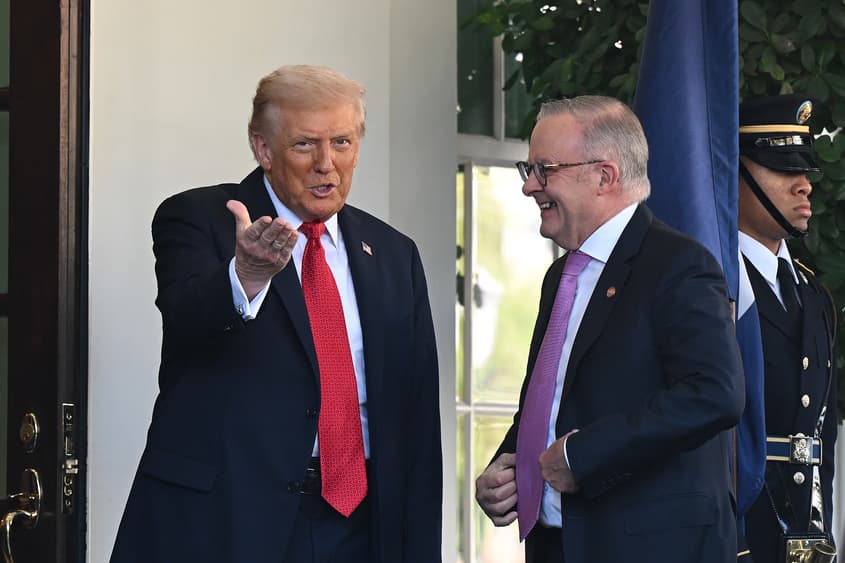
Photo: AAP Image/Lukas Coch


International relations experts have called on more world leaders and media to stop “sanewashing” what’s happening to the world order in the Trump era.
Canadian Prime Minister Mark Carney attracted global attention during the World Economic Forum in Davos, Switzerland, when he denounced “American hegemony” and appeared to take aim at the Trump administration.
While it earned the ire of the US president, the Australia Institute’s Chief Economist Greg Jericho wants more government and business leaders to follow suit.
“For once there wasn’t this sort of, ‘let’s try and sane wash this thing’ and actually point out we are having a pretty big rupture in what’s going on,” said Mr Jericho.
“It’s not just, ‘oh, we’ve got this guy who pushes the envelope a little bit’. No, he’s torn up the envelope, he’s swallowed it, and now he’s sitting on his gold toilet trying to pass through his system.”
Dr Emma Shortis, director of international and security affairs at the Australia Institute, agreed, albeit in less vivid terms.
“He named reality,” she said. “He described clearly to people what we are seeing with our own eyes … which is the Trump administration absolutely and deliberately destroying the international rule of law.”
Speaking on the Australia Institute’s Follow The Money podcast, Mr Jericho said when it comes to Donald Trump “you cannot overstate just how bad things have become”.
In his speech, Prime Minister Carney argued that middle powers – such as Canada and Australia – are not powerless, and need to unite to shape a new world order based on new alliances and interest.
“Middle powers must act together because if you are not at the table, you are on the menu,” Mr Carney said.
President Trump’s “reactive instability” has some countries looking to “decouple” from the US, however Dr Shortis doesn’t foresee Australia being one of them.
“There is much more of an appetite in the Australian community as opposed to the Australian government for thinking through pretty honestly what our relationship with this version of the United States looks like moving into the future,” she said.
Following a familiar pattern, Donald Trump warned of a 100 per cent tariff on Canadian goods following the speech.
However, Dr Shortis pointed out that staying on the President’s “good side” doesn’t always work.
“We know that putting your head down in the sand won’t necessarily insulate you from the worst instincts of Trump. It doesn’t matter how much you give him.
“Australia has literally been over there with $800 million, $900 million checks for the AUKUS submarine deal, and that hasn’t been enough to stop the Trump administration effectively ripping up our free trade agreement, threatening us with tariffs, ignoring our interests altogether.”
Mr Jericho said Canada’s Prime Minister made a good point that not all countries need to be reliant on the US.
“Yes, he threatens all these tariffs, so basically [he’s] threatening to raise prices for Americans. That’s the punishment.
“Because tariffs don’t really hurt Australia too much, we shouldn’t fear getting involved with other trade blocks, whether they involve China, Japan, Europe, and freeze out America until they’re willing to act like adults again.”
Dr Shortis argued that if Canada – the United States’ closest geographical ally – can rethink that relationship and build up other trade agreements, “Australia is perfectly capable of doing the same thing”.
“I think the lesson out of Carney’s speech is that Australia can and should be at the table having these discussions about how to build something new and something better out of the destruction that Trump is wreaking.”
Advertisement
It isn’t always easy to keep up with what’s happening in the US. “Shorter America” is a series where Dr Emma Shortis loops you in on what’s going on in America and shares news and analysis that you can trust.
While the initial Israeli and US air strikes on Iran are legally very dubious, the pace with which the war has escalated will result in those significant legal issues being set aside – for the time being at least.
Former Greek finance minister and economist Yanis Varoufakis has warned that fascism is re-surging in global politics, with extremist ideas gaining influence even in countries where the far-right is not in power.
Australia’s AUKUS agreement has dragged the country into the Trump administration’s war on Iran with Prime Minister Anthony Albanese accused of obfuscating the country’s involvement.
