As American democracy teeters on the brink, there’s been a significant setback for journalism with the Washington Post slashing a third of its staff, including 14 climate change journalists.
Thu 12 Feb 2026 01.00
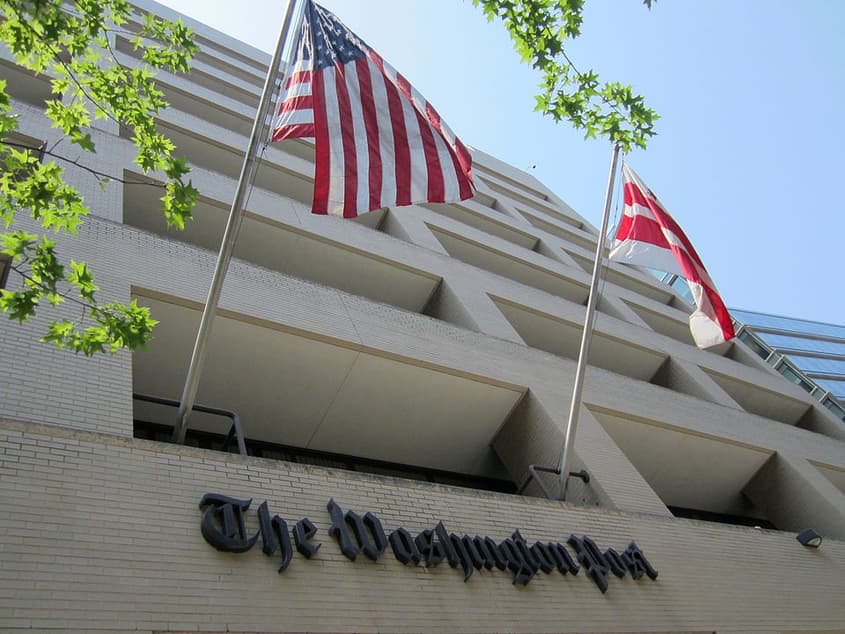
The Washington Post building in Washington, D.C. (Daniel X. O'Neil) Image used under Creative Commons license.


As American democracy teeters on the brink, there’s been a significant setback for journalism with the Washington Post slashing a third of its staff, including 14 climate change journalists.
“Democracy dies in the darkness is the Washington Post’s credo and someone just turned the lights out,” remarked Ben Doherty, Guardian Australia’s senior international affairs journalist.
The masthead was considered a cornerstone of American journalism, having exposed the 1972 Watergate scandal – a story, it says, that changed American politics forever.
Its owner, billionaire Amazon founder Jeff Bezos, has faced intense backlash over the decision to cut more than 300 jobs.
“It’s a dark day for the Washington Post. It’s a dark day for journalism. It’s a dark day for democracy in that country,” Mr Doherty said.
Speaking on the Australia Institute’s After America podcast, he said that this is happening when the need for accountability has never been more critical.
Accountability and transparency – or the lack thereof – are recurring concerns for journalists covering Australia’s $368 billion AUKUS nuclear-powered submarine pact with the US and UK.
“I think the level of secrecy around AUKUS is far too great and it’s deeply troubling,” said Mr Doherty.
Unease continues to grow in Australia as the United States Congress offers more information about the deal than Canberra.
The Albanese Government continues to repeat the US President’s “full steam ahead” catch cry while dismissing concerns about the possibility that Australia could walk away with nothing.
“It’s not actually clear how much the Australian government has already handed over, and where that money is going,” said Dr Emma Shortis, Director of the Australia Institute’s International & Security Affairs Program..
A recent report by the US Congressional Research Service notes that the US Congress can consider holding on to the submarines promised to Australia.
“It’s not Donald Trump’s decision to make. It’s not a political decision,” explained Mr Doherty.
The foreign policy journalist points out that US law implementing the Aukus deal is clear: the sale of the submarines to Australia will not go ahead if it degrades “the United States’ undersea capabilities.”
“The US Congress is now openly contemplating saying, ‘well, do we actually want to sell these submarines to Australia because we want to use them for ourselves? We give them to Australia, we can’t order them into a conflict with China over Taiwan, and this is overtly being said.”
He pointed out that if Australia doesn’t receive the submarines “that’s not the US reneging on the deal. That’s the US upholding the deal. That’s what was signed up to”.
Subscribe to After America on Apple Podcasts, Spotify, Pocket Casts or wherever you get your favourite podcasts.
It isn’t always easy to keep up with what’s happening in the US. “Shorter America” is a series where Dr Emma Shortis loops you in on what’s going on in America and shares news and analysis that you can trust.
Advertisement

China is emerging as a quiet winner from Donald Trump’s escalating war in Iran, with its economy largely shielded from the worst of the global energy crisis.

So much of what passes for Australian political discourse relies on existential threats. It’s easy to make grandiose statements and take positions when the threat is some amorphous vague maybe that could possibly happen.