The Australian Government has been urged to leverage its leading role in this year’s United Nations climate conference to start reversing the world’s “suicidal trajectory”.
By Tegan George
Thu 19 Feb 2026 23.46 AEDT
AAP Image/Lukas Coch


The Australian Government has been urged to leverage its leading role in this year’s United Nations climate conference to start reversing the world’s “suicidal trajectory”.
“Nature does not negotiate,” South African human rights and climate advocate Kumi Naidoo told the Australia Institute’s Follow the Money podcast.
“We cannot change the science. All we can change is the political world.
“You cannot continue to play political poker with the future of our children and their children.”
Mr Naidoo believes it’s imperative the Albanese Government commits to a fossil fuel phase out plan before the global COP31 conference in Turkey in November 2026.
“I think it will have no legitimacy to play the key coordinating role in Tekia when the negotiations happen if they don’t do that.”
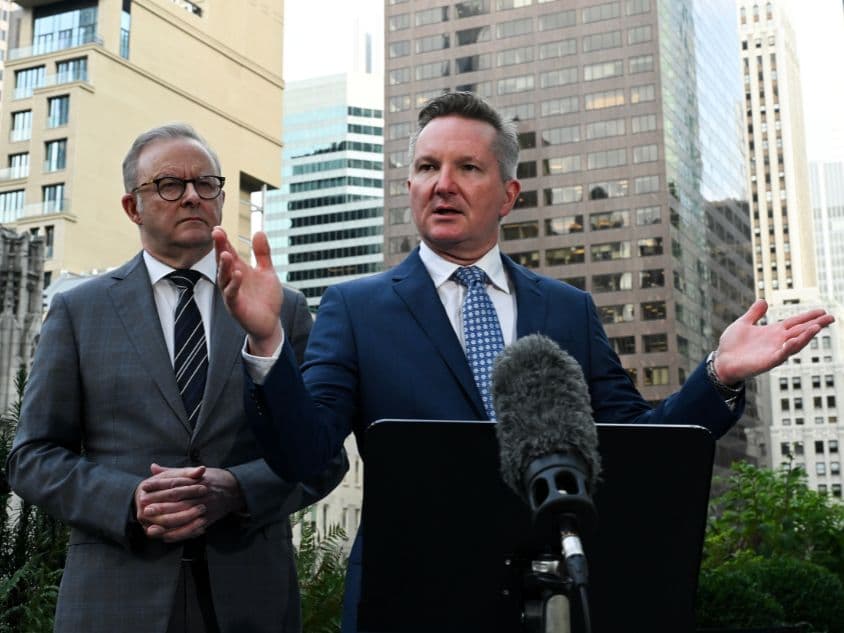
Climate Change and Energy Minister Chris Bowen is President of Negotiations, with the Pacific to host a special pre-COP for leaders and others to highlight the existential threat climate change poses to the region.
The Australia Institute’s Deputy Director Ebony Bennett says the Australian Government “is at a crossroads”, having recently approved several coal mine expansions.
“It can take strong action by ending its own coal and gas expansion and encouraging other nations to do the same, or it can carry on as it has been, exacerbating the climate crisis while trying to tell Pacific Island countries what a good neighbour it is,” she explained.
Not only does Australia risk damaging its relationship with the Pacific, it also stands to undermine its claims of climate leadership.
“When you see how the Australian Government treats its own climate vulnerable communities, it is not shocking to see that it’s going to treat climate vulnerable communities who are their neighbours, even worse than they treat their own citizens when climate impacts hit,” Mr Naidoo said.
The Labor Government recently approved a seven-year extension of Queensland’s Middlemount Coal mine, which the Greens say “will generate hundreds of millions of tonnes of CO₂-e when burned overseas”.
Mr Naidoo accused governments of “denying reality” if they aren’t “shutting off the tap of the poison that is driving climate change as fast as its’s humanly possible.”
For Australia’s neighbouring island nations on the frontline of rising seas and inundation, the hypocrisy is hard to hear.
“I would go so far as saying it’s not only disappointment, it’s not only shock, it’s not only incredulity, like ‘how could you do this?’. But it’s also hurt,” Mr Naidoo said.
“Australia has a really patronising relationship with its Pacific neighbours and it has revolved around neo-colonial distribution aid while Australia continues to exert commercial dominance in the region.”
He said the global conference needs to start putting words into action and stop letting the fossil fuel industry “control most of governments around the world”.
“COP has not delivered for 30 years what we needed to deliver, let’s be blunt about it.”
“That’s like Alcoholics Anonymous holding 30 years of very expensive, huge conferences and not having a backbone to actually mention alcohol in the outcome document.
“The largest delegation, year in year out, to the climate COP is in fact the fossil fuel industry.
“Again, that’s as absurd as Alcoholics Anonymous holding a global conference and the largest delegation to the conference each year is the alcohol industry.”
The Australia Institute believes “The most important contribution Australia can make to stabilising our climate is committing to no new gas and no new coal”.
Its research shows that Australia is currently expanding fossil fuels, with 94 new coal and gas projects in the pipeline.
“Nearly a fifth of Australia’s domestic emissions now come from exporting fossil fuels overseas” said Leanne Minshull, co-CEO of The Australia Institute.
“Australia is facing devastating environmental and economic consequences as a result of climate change – and fossil fuels are the cause.”
Mr Naidoo pointed out it’s not the planet that needs saving but rather humanity.
“The end result is that we will be gone. The planet will still be here.
“Once we become extinct as a species, the oceans will recover. The forest will grow back.
“We have to understand that the conversation of climate change is nothing more and nothing less than protecting our children and their children’s futures.”
Subscribe to Follow the Money on Apple Podcasts, Spotify, Pocket Castsor wherever you get your favourite podcasts.
Advertisement