Labor has announced a new gas reservation policy that will require energy giants to set aside 20 per cent of exports for the east-coast domestic market from July next year. With the announcement of this policy, the Albanese government has been accused of “caving” to the gas lobby and offering a “half-baked” solution to avoid mounting pressure for a 25 per cent export tax.
By Tegan George
Thu 7 May 2026 15.27 AEST
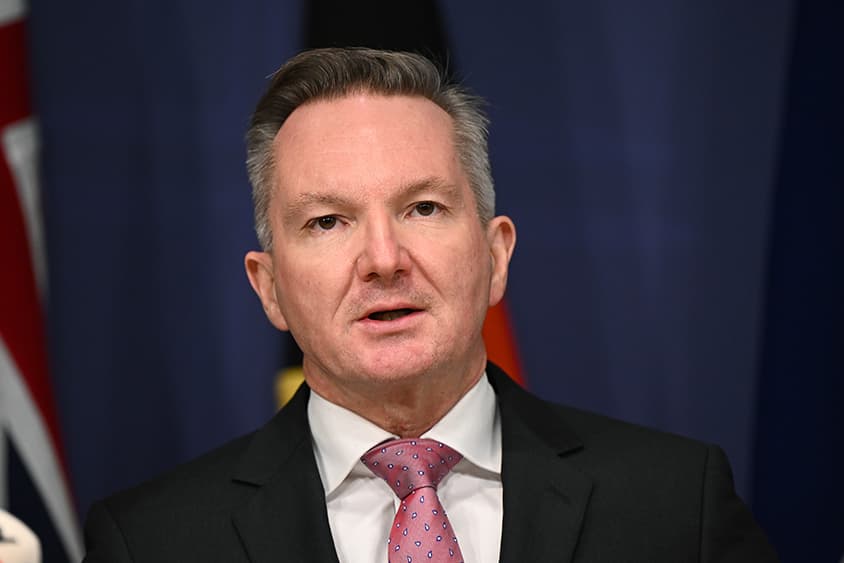
Photo: AAP Image/Bianca De Marchi


The Albanese government has been accused of “caving” to the gas lobby and offering a “half-baked” solution to avoid mounting pressure for a 25 per cent export tax.
Labor has announced a new gas reservation policy that will require energy giants to set aside 20 per cent of exports for the east-coast domestic market from July next year.
“Australia has been the only gas exporting country in the world without some form of reservation. That changes under the Albanese government,” said Minister for Climate Change and Energy Chris Bowen.
“It will ensure a modest oversupply of Australian gas use, which will put downward pressure on prices.”
LNG exporters will be required to demonstrate to the federal minister that they have “properly supplied the domestic market” before being allowed to sell excess gas to the overseas spot market.
“It’s a structural shift which changes the bargaining balance and creates really a buyer’s market for domestic gas buyers,” said Minister for Resources, Madeleine King.
However, the Australia Institute co-CEO Dr Richard Denniss said the policy was a distraction, designed to divert attention from reports the Prime Minister is poised to rule out a potential gas export tax in next week’s federal budget.
“The government is trying to shift attention away from its determination to keep giving more than half the gas Australia exports away for free,” Dr Denniss said.
“The Albanese Government wants Australians to think it’s doing something about gas, but instead of collecting $350 million per week from a gas export tax, it is pursuing a new policy that won’t raise a cent.”
National momentum for a 25 per cent export levy has been surging ahead of the budget with a broad coalition urging the Commonwealth to act.
“Labor has the numbers in parliament. It has the support of unions, crossbenchers and, most importantly, voters,” said Dr Denniss.
“One Nation voters want a gas export tax. Clive Palmer supporters want a gas export tax. Labor voters want a gas export tax,” said Dr Denniss.
The Greens have been among the loudest advocates, securing a Senate inquiry in March into how Australia taxes its oil and gas industry.
“This policy was written to protect gas corporate profits and Labor has just adopted it as government policy,” said Greens senator and committee chair Steph Hodgins-May.
“It will raise no revenue and prolong the great Australian rip-off.”
Research by the Australia Institute shows the levy could generate $17 billion a year.
“The gas corporations get to keep their obscene wartime profits while Australians will see services like the NDIS slashed in the budget when the government cries poor,” said Senator Hodgins-May.
The policy only applies to prospective contracts and the spot market and “will not disturb any existing contracts”.
Critics argue it provides clear proof that Australia never had a “gas shortage” and has been suffering from excessive gas exports.
The Senate inquiry held three public hearings in late April, with The Australia Institute finding the Japanese Government collects more revenue from taxing imports of Australian gas than Canberra earns from exporting it.
Climate Council councillor Greg Bourne, a former BP executive, urged the Albanese government to stand up to threats by gas companies to shift investment offshore, telling the inquiry that fossil fuel companies will “fight like a rat in the corner” to protect their profits.
Former Greens leader Adam Bandt gave evidence in his new role as CEO of the Australian Conservation Foundation (ACF), telling Canberra to “tax gas now, while we can.”
“It’s a finite resource,” he argued. “We won’t be extracting gas for much longer if we want to stop the climate crisis and have something to sell the rest of the world that won’t kill us.”
Fossil fuel giants such as Shell, Woodside Energy, and Santos consistently argued higher taxes risk undermining energy security and future supply, particularly amid global instability and rising demand.
“Announcing this policy just before the gas export tax committee report is released, as if people aren’t smart enough to know a distraction tactic when they see one, proves Labor is running a protection racket for gas corporations,” said Senator Hodgins-May.
“While Australians are getting smashed by interest rate rises and cuts to services in the budget, the Albanese government has made it clear that their priority is protecting corporate profits, not people. And they’ll have to explain that decision next week.”
Treasurer Jim Chalmers will hand down the federal budget next week on 12 May 2026.
Advertisement


