Who spent big in Canberra’s last election – and how proposed changes would hurt newcomers
Could big spending explain the success of the independents at the ACT election? New data from the ACT Electoral Commission shows this isn't the case.

A damning audit report has revealed major government departments -including the Department of the Prime Minister and Cabinet - are routinely rejecting Freedom of Information requests (FOI) and failing to meet their own transparency standards.
Fri 22 May 2026 16.05 AEST
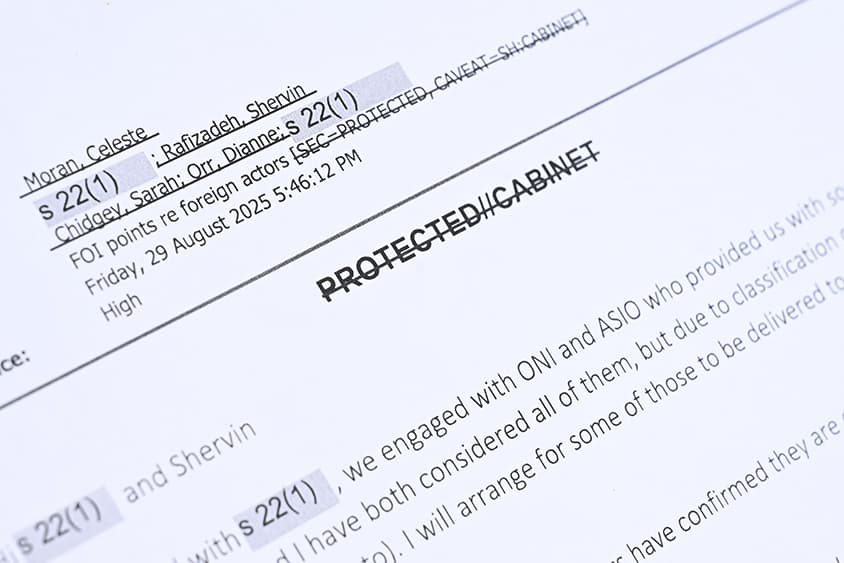
Photo: AAP Image/Lukas Coch
A damning audit report has revealed major government departments -including the Department of the Prime Minister and Cabinet – are routinely rejecting Freedom of Information requests (FOI) and failing to meet their own transparency standards.
The audit of three government departments observes that almost 80 per cent of requests were either partially or fully denied and that decision-making was “not consistently transparent, accountable and pro-disclosure”.
The Auditor-General’s investigation focused on the departments of Prime Minister and Cabinet (PM&C); Treasury; and Infrastructure, Transport, Regional Development, Communications, Sport and the Arts (DITRDCSA).
It followed a 2023 Senate inquiry report that concluded that the “system is not working effectively and for some time has not functioned as it was intended”.
The audit observes that of the 25,211 decisions made on FOI requests, 25 per cent resulted in full refusals and 54 per cent were only partially granted.
Just 21 per cent were granted full access – a sharp decline from 2006–07, when 81 per cent of FOI requests were granted in full.
“It’s not just incompetence that explains why FOI is badly mismanaged and government departments routinely breach their legal obligations,” said Bill Browne, director of the Australia Institute’s Democracy & Accountability program.
“It is a deliberate attempt to starve the public of information they are entitled to, to escape accountability.”
Anthony Albanese made transparency a central theme of the 2022 federal election campaign, repeatedly promising to lead a government that would be more open and accountable than Scott Morrison’s “cult of secrecy”.
However, Labor’s proposed FOI changeswere highly controversial and would have allowed agencies to reject requests expected to take more than 40 hours to process.
They would have also imposed a new fee, removed the ability to make anonymous FOI requests, and given the government broader powers to refuse access to documents.
In March 2026, the PM effectively abandoned the bill after it became clear it would struggle to pass the Senate.
“The Albanese government’s proposed Freedom of Information Amendment Bill 2025 would have only exacerbated these problems identified by the auditor-general, making it harder and more expensive for Australians to get information from the government,” said Mr Browne.
In its most recent report, Australian National Audit Office (ANAO) found that departments weren’t meeting their own obligations to “take reasonable steps to assist applicants” and find the requested documents.
Almost two-thirds of the requests were also subject to longer response times than the mandated 30-day deadline.
And when people appealed a decision, 62 per cent of cases were then “set aside”.
In its 2024-25 Annual Report, the Office of the Australian Information Commissioner (OAIC) acknowledged that the “high-set-aside rate indicates there is more work to do to embed a pro-disclosure approach”.
Analysis by the Australia Institute in 2025 showed that while the average request once took 13 hours to determine (2006-07), it now takes 51 hours (2023-24).
“In other words, the Albanese government employs four public servants to do what only took one public servant under the Howard government,” said Mr Browne.
“If the Albanese government achieved the Howard government’s cost-per-FOI-request ratio, taxpayers would save $61 million per year.”
The report also pointed to poor administrative management, noting there were inadequate records of searches and public disclosure documents.
It noted, “the FOI system is recognised as a critical pillar of open government and robust democracy in Australia.
“Australian Government information is a national resource that should be available for community access and use.”
Advertisement

Could big spending explain the success of the independents at the ACT election? New data from the ACT Electoral Commission shows this isn't the case.
The Australian Electoral Commission (AEC) has been urged to rethink plans that could shut or merge about one third of its divisional offices, with a union warning the loss of local expertise could disrupt future elections.